


In 1971, when I was nine years old, my mother gave me an abridged ‘Classics Today’ copy of David Copperfield. She was the manager of the book department at WH Smith, here in the UK, so books arrived in our house the way other families accumulated milk bottles, steadily and without ceremony. I still have it, and it’s the first ‘grown up’ novel I ever read.
I loved it. I still love it, and what I remember the most are the characters.
Mr Murdstone. The name is the man. Peggotty, warm and solid and safe. Mr Dick, flying his kite on the cliffs, and in my mind, a favourite uncle I would like to have had. Aunt Betsey Trotwood, terrifying, yet compassionate and magnificent. Uriah Heep, whose humbleness made your skin crawl before you understood why. Micawber, waiting for something to turn up with a confidence that even a nine-year-old could see was heartbreaking.
No one explained these characters to me. No one told me what I was supposed to feel about them. No one softened Murdstone’s cruelty or tidied up Heep’s malice or made sure I understood the correct moral lesson. Dickens simply trusted the reader whether ninety, or in my case, nine years old.
In today’s world, I am sure many ‘gatekeeping adults’ would deem a Dickens novel not a suitable first novel for a child, too ‘Victorian,’ and inappropriate for a whole bunch of reasons, not least that a child today wouldn’t be able to keep their attention on the story for a single chapter, let alone the entire book. In any event I loved it. I loved every page of it. In my view, and even though he wasn’t writing for children specifically, it is because Dickens understood something that too many authors who write for children today have forgotten: children do not need to be protected from complexity or moral ambiguity. They need to be trusted with it.
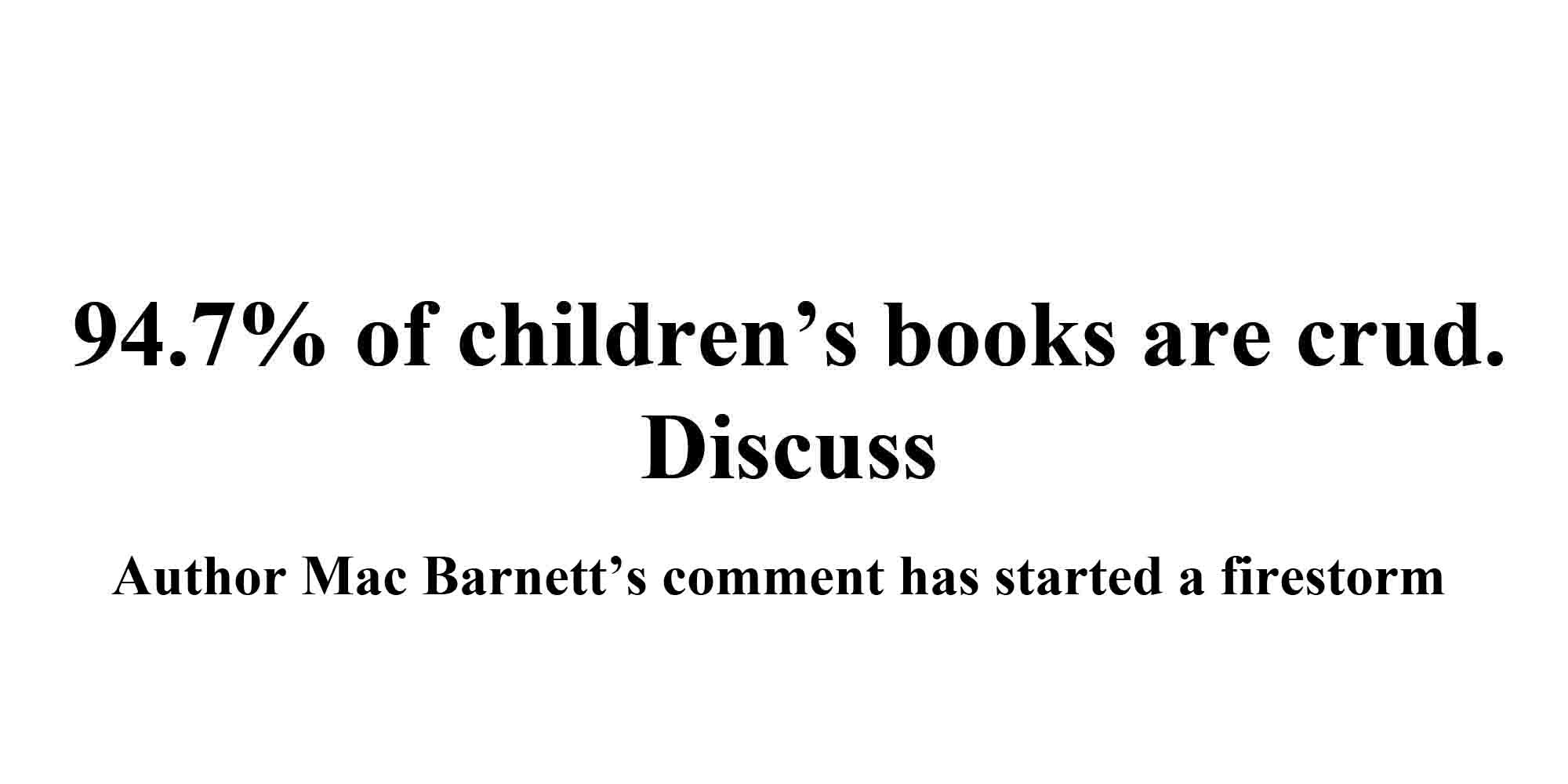
Recently, American children’s book author Mac Barnett published Make Believe: On Telling Stories to Children. In it he riffed on an old line by the science fiction writer Theodore Sturgeon – that ninety per cent of everything is crud – and added his own addendum: that children’s literature might suffer from an even higher percentage. 94.7, he suggested, with the kind of deliberately absurd precision that is obviously a joke – until it gets screenshot and shared without its context.
The screenshot travelled. Authors were hurt. A petition circulated. The row became about privilege, identity, gatekeeping, and who gets to define quality. All of which matters, none of which I intend to wade into here, but underneath the fury, there is a real question. And it is not a new one.
Are too many children’s books written by adults who see children as projects to be shaped, rather than as people who deserve a story?
Yes.
Absolutely – yes.
Charlotte Mason, the Victorian educator whose radical conviction was that children are born persons – not empty vessels to be filled,– knew it in 1886. Tolkien knew it in 1939. C.S. Lewis knew it in 1943. Rowling knew it in 1997.
Today, more than ever before, far too many parents watch their child’s eyes glaze over three pages into a book about a morally perfect eleven-year-old who delivers a sociology lecture to the incompetent adults around them.
Mason called it twaddle – the diluted, pre-digested material that adults produce when they do not trust children to handle the real thing. Tolkien, in “On Fairy-Stories,” argued that children are not a lesser audience requiring simpler fare, but natural recipients of wonder because they have not yet learned to distrust it. In my view, far too many children’s authors today are doing precisely that: writing stories that invoke distrust and cynicism in children before their capacity to be captured by wonder has had a chance to develop.
Lewis, in The Abolition of Man, warned that an education which strips away the capacity to feel, which replaces genuine emotional and imaginative response with approved correct thinking, produces what he called “men without chests.” People with intellects and appetites but nothing in between – no hearts.
To quote Charlotte Mason – ‘children are born persons,’ who deserve the finest literature, beauty, and the deepest truth we can offer them. Not lessons dressed as stories. Not messages with characters bolted on. Stories.
I have some evidence for this, and it is not a percentage.
In March this year I stood in front of two hundred and twenty children in a school hall in Sussex and asked them a question. What is magic? Not a single child reached for their phone. Not one looked at the floor. They leaned in, every single one of them. They wanted to talk about magic, about stories, about which books they loved and why. Those eleven year old children were fierce, hungry, imaginative human beings who had been offered something real, and they rose to it. Children always do – when we let them.
The question is whether we let them often enough.
An American author wrote this week about taking her children to the library and finding it hard. Characters who burst into the world already morally perfect, with nothing to learn, whose only function is to educate the flawed adults around them. Sudden epiphanies that read like public service announcements. She is not a literary critic. She is a mother watching her children’s faces, and she can see what works and what does not. A school librarian who circulates thousands of books a year into the hands of children said the same thing from the other side of the counter: too much of what comes through the pipeline does not meet the needs of the children in front of her.
These women are not saying that all children’s books are crud. Nor am I. There are people writing magnificently for children right now, with courage and imagination and faith in their readers. But the instinct to protect children from difficulty, and not only to soften every edge, but to ensure every character models correct behaviour, to replace the wild uncertain magic of a real story with the safe predictable mechanics of a lesson – that instinct is not new, and it has always been the enemy of great children’s literature.
Tolkien did not protect his readers from difficulty. The mines of Moria are terrifying. The Dead Marshes are haunting. The Scouring of the Shire is devastating. And children have loved The Hobbit and The Lord of the Rings for seventy years because Tolkien trusted them with the weight of it. He did not write down to them. He wrote across to them, as equals in the act of imagination.
Alan Garner did the same. So did Susan Cooper, and C.S. Lewis, and Rowling at her best. They trusted children with darkness, with ambiguity, with characters who made terrible decisions and suffered real consequences, with endings that did not resolve neatly, with beauty that was not explained.
And so did Dickens, in 1850, when he gave the world a child narrator who endured cruelty, loss, betrayal, and confusion, surrounded by adults who were variously monstrous, ridiculous, heartbreaking, and magnificent. Although it was not written for children, it is frequently adapted into children’s versions, because, once upon a time, adult ‘gatekeepers’ trusted children to feel their way through stories without a single instructional aside.
As a nine-year-old boy in 1971, I did not need anyone to explain that Uriah Heep was dangerous and morally bankrupt, I could see it for myself, in Heep’s character and the evolving narrative. That is what a living book does. It trusts the child’s imagination to do the work.
Mac Barnett asked the right question, but in my view, he asked it badly, too glibly, too provocatively, from too high a platform, at exactly the wrong moment – or perhaps that was precisely his intention. The hurt he caused is real, and the people who felt it are not wrong to say so. But the question remains, and it will remain long after the controversy has faded from social media.
What do children deserve from their books?
The answer has not changed since Dickens. Since Mason. Since Tolkien. Since Rowling. It has not changed since my mother put David Copperfield into my nine-year-old hands let me find my own way through it.
What children deserve from their books, is the freedom to draw their own conclusions.
In remembering the books we read, or had read to us, as a child is it that we know although they are stories someone wrote, fairy stories we still remember the people in them, the characters stay with us, the 'goodies' and the 'badies' the hero's who were brave, fearless and caring. Maybe in remembering these characters we are mindful of them when we meet real people who we admire or those we abhor for their dishonesty; do we recognise the qualities we admired in our childhood book hero's?
Great piece, Vincent. I’m not sure what the opposite of twaddle is, but this was definitely that.
It made me think how hard adults seem to find it not to talk down to children. The good stuff tends to trust them more. There’s also still a sense, I think, that writing for children is easier or doesn’t need the same depth, when the not-crud 5.3% proves exactly the opposite.
Really interesting read.