

AI is not the enemy
What the Great Exhibition of 1851 can teach us about artificial intelligence

AI is not the enemy - What the Great Exhibition of 1851 can teach us about artificial intelligence. I will be the first to admit that this is an odd essay to find on a Substack publication whose title and tagline reads Care & Craft, ‘Why we all need something real in a world dominated by digital.’ You might reasonably expect me to be sharpening my pitchfork and screaming for revolution from the crafting community, condemning artificial intelligence and everything it represents outright.
But I won’t.
Not because I don’t think the world is too dominated by digital. I firmly believe it is. My argument is that AI is not the enemy. Human greed is the enemy, it always has been.
And many people are already pushing back. I believe we are heading towards a quiet revolution and a resurgence of human-made art and craft, because historically, we have been here before. It all began with one of the biggest greenhouses ever built: the Crystal Palace.

In 1851, six million people walked through the doors of the Crystal Palace in Hyde Park, London. Six million people in a country of twenty-one million. Nearly a third of the population came to stare at what the Industrial Revolution had made possible. Steam engines. Power looms. Hydraulic presses. Mechanical reapers. Over a hundred thousand exhibits from forty-four countries filled a glass and iron cathedral that stretched the length of six football pitches. There were French silks and Sèvres porcelain. Indian textiles displayed on a stuffed elephant. Pianos, telescopes, firearms, furniture. A fountain made from four tons of pink glass. The Koh-i-Noor diamond. An early fax machine. Even the world’s first public flush toilets, which cost a penny to use, and gave us a phrase that can still be heard today. The Great Exhibition was industry’s coronation - and it was magnificent.
It was also, for a great many people, terrifying.
Because alongside the art and culture, there were the machines that had emptied cottage workshops, and put people out of work, and leading to widespread poverty. The handloom weavers suffered most. They had once produced cloth at their own pace, in their own homes, but they were being rapidly replaced by machinery that could do the same work faster, cheaper, and without complaint. The potter, the woodcarver, the glassblower and many other craftsman, all felt the ground shifting beneath their feet, and they too eyed the future of their livelihoods with fear.
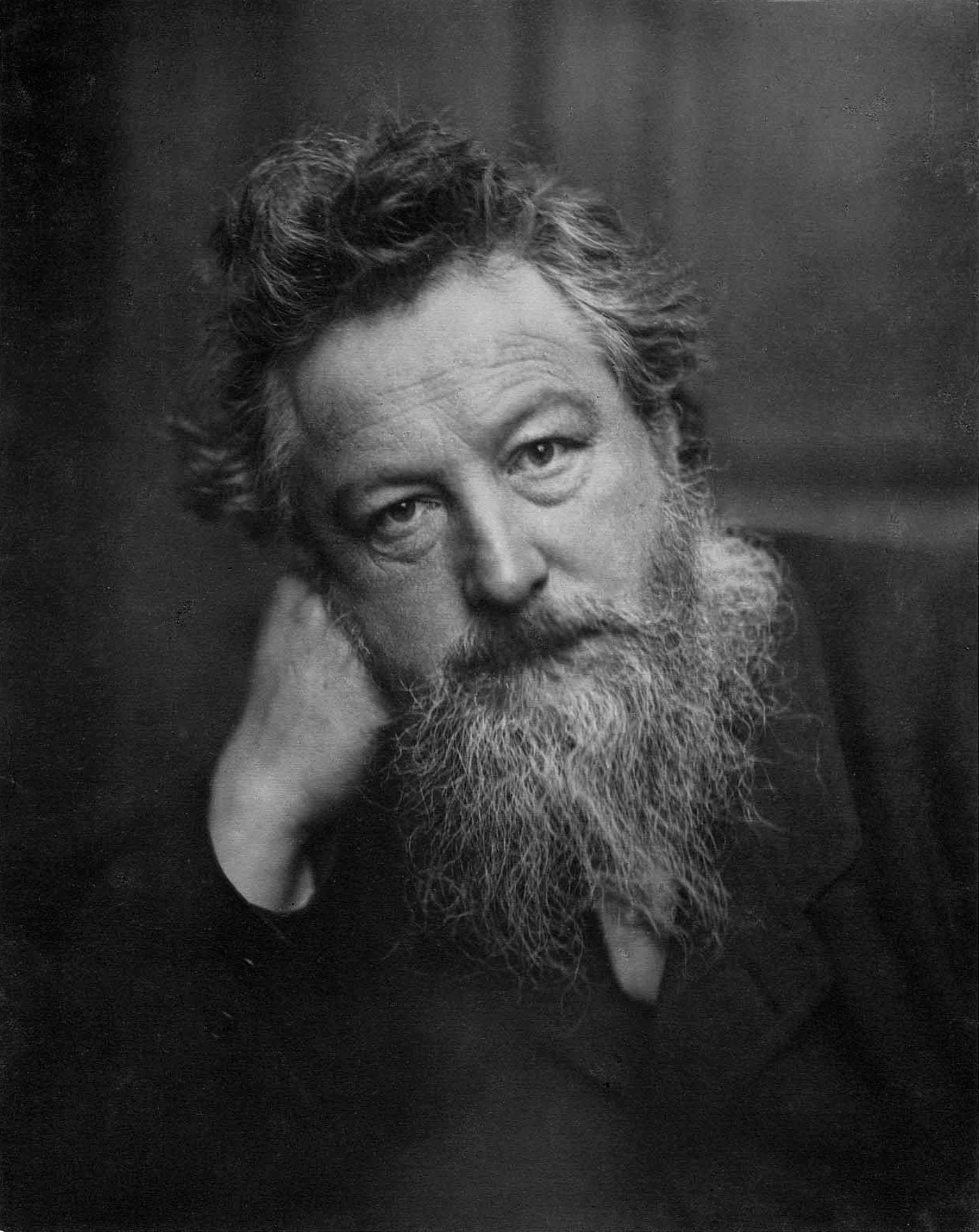
Within a generation, the response came. Primarily from William Morris. He was not only a craftsman but a social revolutionary who sought to replace industrial capitalism with a society based on equal opportunity and artistic craftsmanship. Along with artists such as Walter Crane and Edward Burne-Jones, he founded the Arts and Crafts movement and declared that industry itself was not the problem. He famously clarified his position by saying:
“It is not this or that tangible steel and brass machine which we want to get rid of, but the great intangible machine of commercial tyranny, which oppresses the lives of all of us.”
Commercial tyranny. I would argue that the basis of his objection can be summarised in a single word: greed.
Morris did not hate industry. He objected to machines being used to dictate to human beings, turning workers into machine minders. He viewed machines as valid tools to assist workers and eliminate what he called ‘donkey work,’ the tedious manual labour that consumed lives without enriching them.
The Arts & Crafts movement grew out of a simple conviction: that the Industrial Revolution, for all it had given us, was taking something essential away. The factories were producing more than ever before, faster and cheaper than anyone had thought possible. But the things they produced had no soul in them. No fingerprint. No evidence that a human being had sat down and cared about what they were making. Morris and his contemporaries looked at what was pouring out of the mills and the foundries and said: this is not enough. We can make things that are beautiful, and the making of them with our own hands and imaginations matters as much as the result of that effort.
I believe William Morris’s view towards AI today would be exactly the same as it was towards industry in his time. Machines exploited by the greedy to increase profit, not to make life easier for the people doing the work.
In an ideal society, machines would be used to reduce labour and increase leisure time. Time to think, to read, to make something beautiful with your own hands.
And in the end, that same Industrial Revolution that destroyed the livelihood of the handloom weaver has also given us an extraordinary number of benefits. Clean water. Abundant energy. Modern medicine. And in my view, one of the most liberating machines ever invented: the washing machine. It returned hours to the lives of millions of women who, until its invention, had spent entire days bent over washtubs.
Industry, at its best, has always done that. It can take away the drudgery and free human hands and imaginations.
And so here we are again. A new machine has arrived, artificial intelligence, and it is extraordinarily powerful. And once again, people are understandably afraid. And once again, greed has seized the tool before most of us have had time to think.
You can see it everywhere you look. Websites filled with soulless text that reads like a Wiki entry.
Children’s books with illustrations that have the eerie, waxy perfection of a mannequin’s smile. Articles that say nothing in a thousand words, all of them competent, none of them alive. Content - and there’s a word that should make us uneasy - generated not because someone had something to say, but because a space needed filling and a machine could fill it faster and cheaper than a person.
I have come to think of AI generated content as the great ‘almost’ flood.
Almost writing. Almost art. Almost human. Close enough to pass a glance, but dead the moment you hold it up to the light.
The fault is not with AI, it is with the person who commissioned it. They didn’t want something good. They wanted something quick. They didn’t want craft. They wanted content. They didn’t want to put in the effort, they wanted to go straight to the product and profit. And so we come back to it yet again.
Greed, human greed.
That is not a technology created problem. It is not the fault of AI. AI is just a tool, like any other. It is a person created problem - human greed and laziness.
But something positive is happening too.
Many of us are pushing back against the ‘almost.’ There is a growing movement that is steadily gaining momentum, as people look beyond the AI fakery, determined to find something real. You can see it in the rise of craft markets and maker spaces. In the parents who are getting children to put down their tablets and pick up their paintbrushes. In the queues outside independent bookshops. In the young people who are choosing vinyl records, film cameras, handwritten letters, and notebooks over their digital equivalents. Not because they are Luddites, but because they are hungry for something that has texture and weight and the unmistakable mark of being made by human imagination and hands.
And crucial to this desire to once again own real media such as vinyl and DVD, is that people are pushing back against corporate greed. People want to own what they purchase. You own the vinyl, you own the Blu-ray. You don’t own streaming services, the provider does. You simply rent it, and you are also held hostage to their terms and conditions. And so I make no apology for coming back to it yet again.
Greed, human driven corporate greed.
And with no apology for repeating myself and coming back to my argument. The enemy is not AI.
Why is AI not the enemy?
Because quietly, away from the greed, slop and the outrage, that same AI powers some incredible technology that is of real benefit.
AI is helping researchers untangle protein structures that hold the keys to diseases we have fought for generations.
AI is helping doctors identify cancers that human eyes would miss, and is reading medical scans with a precision that saves lives.
AI is translating languages in real time, connecting people who could never have spoken to one another.
AI is doing what industry does at its best — taking the drudgery, the impossible volume, the tasks too vast for human hands alone, and freeing us to do what only we can do - create beautiful things.
The tool is not the problem, the problem is ourselves and our human nature.
We choose to generate rather than create. We choose to consume rather than make. We choose to let our children scroll rather than draw, watch rather than read, absorb rather than imagine. That is not the machine’s fault. The machine didn’t make that choice. We did.
The world is becoming more greedy and more lazy. That is the inevitable consequence of human nature. All we can do, those of us that passionately believe in Care & Craft, is push back against it and continue to strive in our chosen analogue pursuits. It’s time to stop blaming AI and take responsibility for our own actions.
Care & Craft – Why we all need something real in a world dominated by digital.