

Beauty Bound in a Book
A scribe, six artists and no names

Beauty bound in a book.
A cathedral is impressive enough from the outside, simply by the sheer scale of it, but that is not what stirs most visitors, myself included. The full impact does not hit until you enter the building.
The air changes. It is cooler, stiller, and it carries a particular smell: old stone, candle wax, polish, and underpinning all this, is the feeling that you just walked into the presence of something far greater than yourself.
That sense of awe is not accidental. The people who commissioned these buildings knew exactly what they were doing. The soaring nave, the impossibly high vaulted ceiling, the way the light pours through the stained glass: all of it exists for a single purpose. This is God’s house, and it must be worthy of Him. Every arch, every carved capital, every pane of glass was created as an act of devotion: the best that human hands could offer, coming together collectively to create something magnificent.
I have always loved old churches. I love the cool, the musty quiet of a space that by its nature, pulls you into a gentle but insistent whispered respect.
But a cathedral takes that feeling of quiet respect and raises it into awe, and Winchester Cathedral does this in spades
However, it is not the magnificent building that draws me back to Winchester Cathedral time and again. It is the treasure it contains.
In the easternmost corner of the south transept is, in my opinion, one of the most beautiful handmade objects ever created: the Winchester Bible.
You do not come to the Winchester Bible directly. There is an anteroom first, with a small permanent exhibition on how the Bible was made, from raw materials to working methods. In a display cabinet there are the raw pigments in both their whole state and powdered forms, some of which are toxic. Vermillion, a beautiful luminous red, made from ground mercury sulphide. Lead white, made from lead carbonate. Ultramarine blue, derived from lapis lazuli, a semi-precious stone whose only known source in the twelfth century was Afghanistan, and that was once more valuable than gold.
There is also a stretcher showing how calfskin was prepared by being soaked in lye, scraped, pulled taut, dried, and scraped again until it became vellum, a surface smooth enough to hold ink and strong enough to last a thousand years. The Winchester Bible required more than two hundred and fifty calf hides to create it.
In the centre of the room, there is a large digital display table. You can scroll through full-sized pages, tap on illuminations, zoom in to see brushwork and gilding and reveal the Bible’s beauty. This exhibition is well worth exploring before you see the Bible itself.
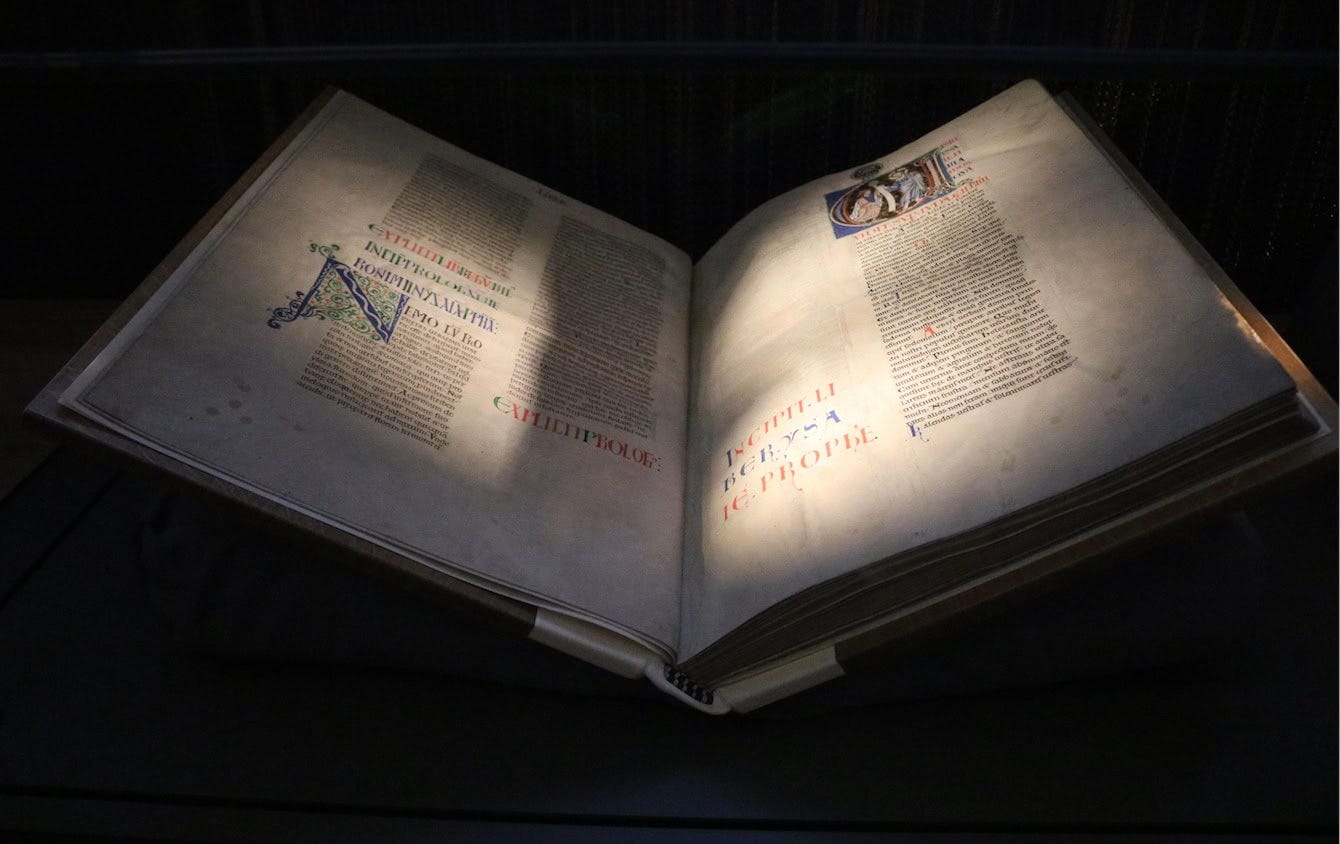
Directly next to the exhibition is the Bible room, and in here everything changes.
The room is not a room. It is the south-eastern corner of the south transept, and it is very dimly lit as in front of the original windows there is a curtain of very fine chain that filters out most of the daylight. In here there are three display cases, each holding one of the Bible’s rebound volumes, and each case is itself partly covered with heavy cloth.
The only illumination on the pages comes from two small LEDs in each case. They cast a warm glow not even as bright as a candle, to keep the light levels down to an absolute minimum.
By accident, or by design, the Bible room is the holy of holies - the inner sanctum.
The Winchester Bible was made in Winchester between roughly 1150 and 1175. It is the largest surviving English Bible from the twelfth century, and it contains the complete Latin Vulgate: Old and New Testaments, two versions of the Psalms, and the Apocrypha, and the entire text was written by one person.
Every word of the Latin Bible is written in a consistent, beautiful Gothic hand across hundreds of enormous pages, each one measuring nearly two feet tall. It is estimated that the text alone took over four years to complete, and as the scribe worked, another monk followed behind, checking and leaving corrections in the margins that are still visible today.
And then came the artists.
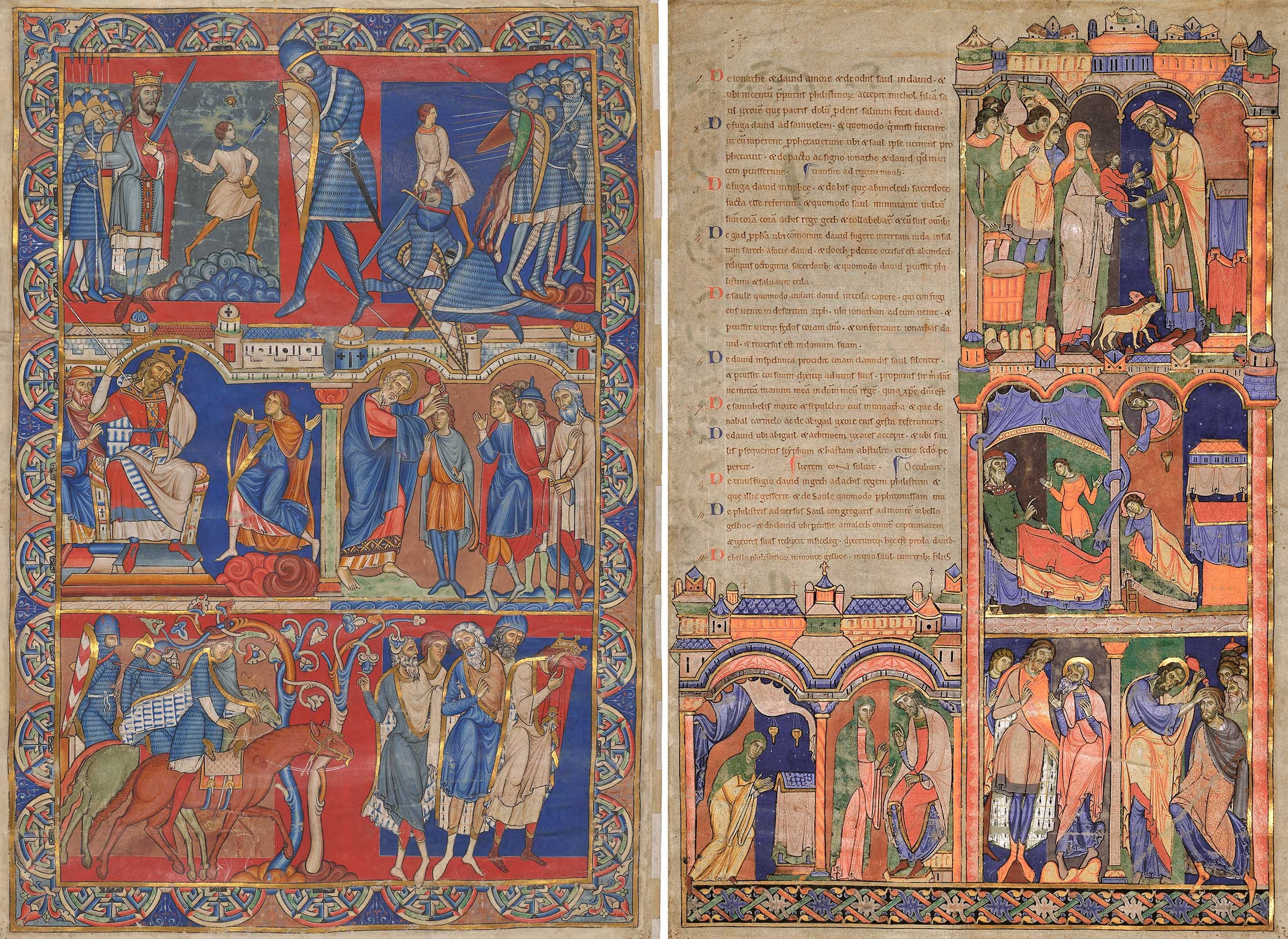
At least six of them working over a period of twenty-five years. None of them signed their work and we do not know their names. In the 1940s, an art historian named Walter Oakeshott studied the Bible systematically, and for the first time gave the artists names based on what he could see in their work: the Master of the Leaping Figures, the Master of the Apocrypha Drawings, the Master of the Genesis Initial, the Amalekite Master, the Master of the Morgan Leaf, the Master of the Gothic Majesty.
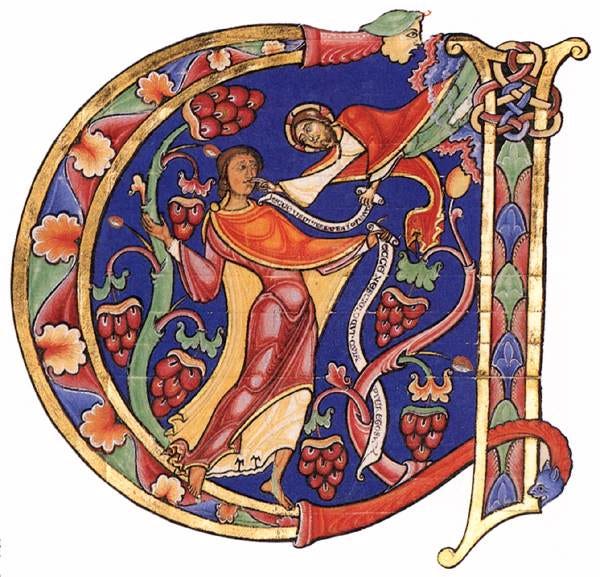
Those names alone tell you something. These were not journeymen following a template. Each had a distinct artistic personality. The Master of the Leaping Figures filled his illuminations with figures in dramatic, dynamic poses, bodies mid-leap, robes flying. The Master of the Genesis Initial, punched patterns into gilded surfaces and created figures turning their backs to the viewer: a striking innovation for the twelfth century. The Master of the Morgan Leaf worked in bold emotional expression and vivid blues and reds.
The process began with a drypoint drawing traced onto the vellum, then line inking, then gilding or silver accents applied by another hand. Finally the paint was added using a painting technique called tempera.
Tempera uses egg yolk instead of binder oils such as walnut or linseed. There is no working time as the paint dries instantly on application, and this constraint of the paint has very much influenced the overall style of not only the Winchester Bible, but illuminated manuscripts in general.
Those monks spent years of their lives on this work. They ground pigments that could poison them. They laid gold leaf over gesso and punched it with patterns for texture, and not one of them expected to be remembered for it. The work and the resulting beautiful bible was the point – not their names, but the Winchester Bible was never finished.
After twenty-five years the work stopped when its likely patron, Henry of Blois, Bishop of Winchester, died in 1171.
Because the artists stopped at different stages on different pages, you can see every step of the process. On some pages there are only rough outlines. On others, inked drawings waiting for colour. On others, gilding laid but not yet painted over. And on the completed illuminations, the full blaze of colour that was the intended destination of all that patient, painstaking, anonymous work.
The Bible is not only a beautiful object but its unfinished pages an invaluable document on the methods and techniques of illuminated manuscript creation. The Winchester Bible is one of the most beautiful examples of Care & Craft in existence, and I still find it extraordinary that the Bible still looks like it was completed only yesterday.
Six artists, one scribe, twenty-five years of work, and not one of them signed their names.
They did not need to. The Winchester Bible is still here. Still in the building it was made for. Still taking the breath away in a quiet corner of the south transept, nine hundred years after the last brush stroke was made.
In the crypt of St Paul’s Cathedral, there is an epitaph to its architect, Sir Christopher Wren. It is written in Latin and reads:
Lector, si monumentum requiris, circumspice.
Reader, if you seek his memorial, look around you.
The monks who worked on the Winchester Bible have no epitaph. But if you ever find yourself in that dim corner of the south transept, leaning over a dimly lit case and looking at brushwork nine centuries old, you will understand why they do not need one.
Such a stunning, enduring work of art 😍 I remember being completely awestruck seeing Winchester Cathedral one year with all the chairs removed - an amazing experience, as was a tower tour and being able to walk through the roof. I do miss Winchester, but I was lucky to spend the first four years of my life there, and then many visits back to Granny - who lived in the cathedral close - until she died in 2004.