

Charlotte Mason - The Woman on My Doorstep
What a forgotten Victorian teacher understood about children, stories, and the power of imagination.

The Woman on My Doorstep - Charlotte Mason. What a forgotten Victorian teacher understood about children, stories, and the power of imagination.
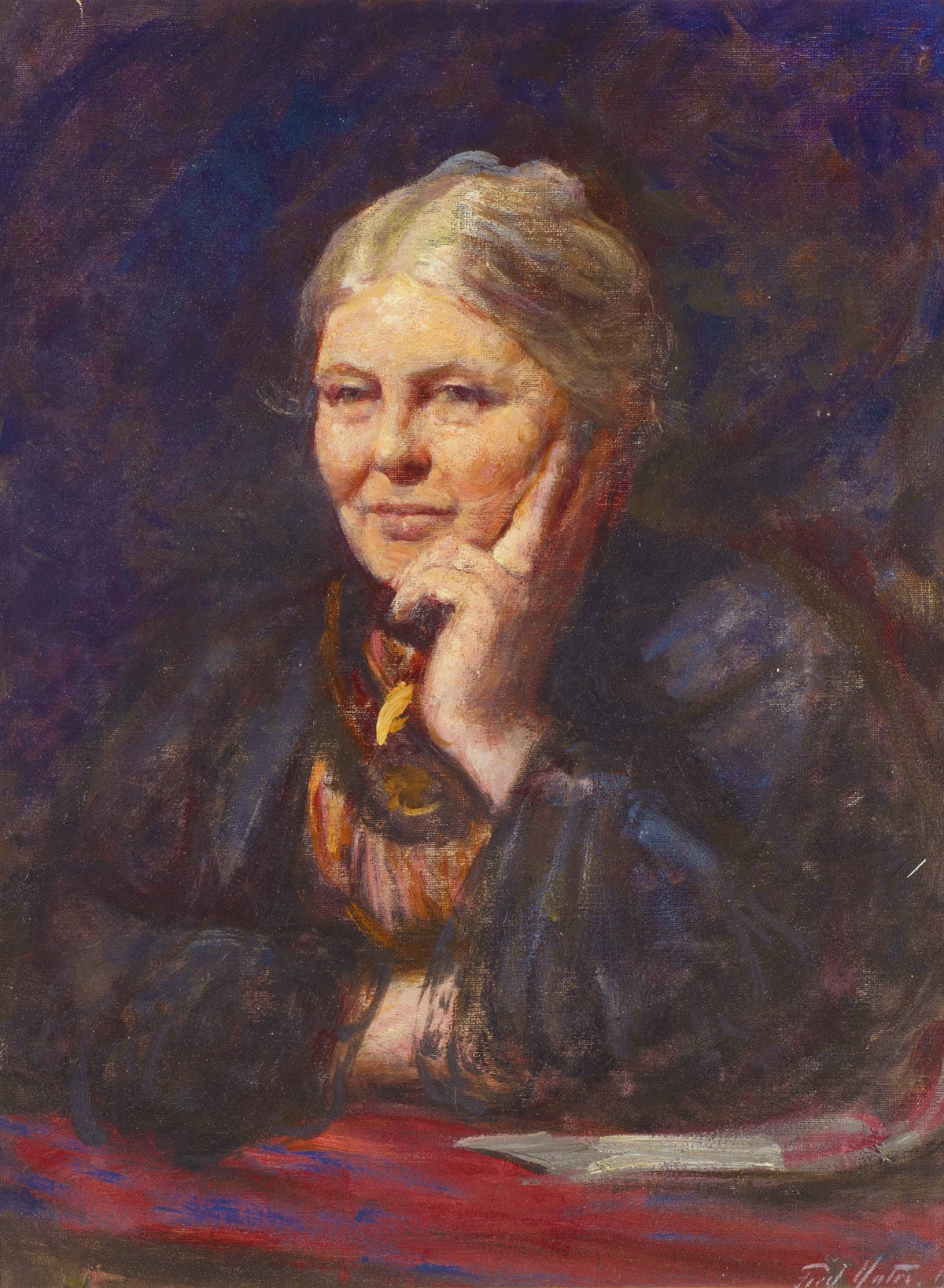
I have been digging into the local history of my area and I have found someone remarkable.
Her name is Charlotte Shaw Mason, (no relation). She was born on New Year’s Day 1842 in a hamlet near Bangor in North Wales, an only child, educated at home by her parents. By the time she was sixteen both her parents were dead and she was alone in the world, without means or relations. She enrolled at the Home and Colonial Training College in London, earned a First Class Certificate, and was sent to a school by the sea to continue her training.
That school was the Davison School in Worthing, my brother and mother still live there and I went to art college there in the 1970’s
Charlotte taught there for more than ten years – over a decade of her life. During those years, something began to form in her mind. She looked at the children in front of her and saw something that the educational establishment of Victorian England did not see, or did not wish to see. She saw that every child, regardless of class or background, was a person. Not a vessel to be filled. Not a blank slate to be written upon. A person, already whole, already capable of engaging with the finest ideas that human civilisation had produced.
From Worthing she went to Bishop Otter College in Chichester – ten minutes from my home – where she lectured for five years, training teachers in her methods. The lectures she gave there became the foundation of her first book, Home Education, published in 1886. She eventually moved north to Ambleside in the Lake District, where she founded the House of Education, a training college for teachers, and spent the rest of her life building a network of schools devoted to what she called ‘a liberal education for all.’
She died in January 1923, at the age of eighty-one. On her gravestone in Ambleside they carved a line from the book of Isaiah: ‘Thine eyes shall see the King in His beauty.’
I had never heard of her. I suspect most people in Worthing and Chichester have never heard of her either. But in the United States, among many homeschooling families, Charlotte Mason is not merely known; she is highly respected and understandably so. Her philosophy of education – living books, narration, nature study, short lessons, the conviction that children are born persons – has shaped the way hundreds of thousands of American families educate their children at home, particularly through Ambleside online. Here there are curricula built on her principles, conferences devoted to her methods, podcasts and book clubs and online communities that study and very much follow her foundational six-volume series on education.
And I knew nothing about her until a few weeks ago, when I started researching the history of Bishop Otter College and her name appeared.
The more I read, the more something uncanny began to happen. I kept hearing clear, distinct, unmistakable echoes – of voices I already knew well. Tolkien and Lewis.
Charlotte Mason believed that children are born persons. That they are not lesser beings to be managed but whole human beings to be respected. That children deserve the best ideas, the finest literature, the most beautiful art and music – not diluted versions, not simplified summaries, not what she called ‘twaddle’, but the real thing, served up with the confidence that a child’s mind is not only willing, but strong enough to receive it.
She believed that the job of the teacher was not to explain and pre-digest and spoon-feed, but to set a feast of living ideas before the child and trust them to take what they needed. She called this ‘spreading the feast.’ The child’s mind would do the rest, because the mind was designed to feed on ideas the way the body was designed to feed on bread.
She believed that a living book – a book written by a single author with genuine passion for a subject, a book that speaks to the reader as one person to another – was worth a hundred textbooks compiled by committee.
And she believed all this a full generation before Tolkien and Lewis were born.
I have not yet written anything on C.S. Lewis, but I have written about Tolkien several times in the following essays, here on Care & Craft.
In Middle-earth: A World of Craftsmanship and Faith, I argued that Tolkien’s world is built on craft, not conquest. In From Lord of the Rings to Lord of the Spreadsheet I traced the way magic in his work is not a system but received grace. In From King Arthur to Hogwarts I followed the pattern of every generation reaching back to older stories when the present fails to nourish.
But I had never connected Tolkien’s thinking about stories and children to the work of a Victorian schoolteacher who lived and worked on the south coast of England.
In 1939, Tolkien delivered a lecture at the University of St Andrews called On Fairy-Stories. It is one of the most important things he ever wrote, and it contains an argument that Charlotte Mason would have recognised instantly.
Tolkien argued that fairy stories are not for children. They never were. The assumption that they belong in the nursery is, he said, ‘an accident of our domestic history’ – the result of adults deciding they had outgrown such things and handing them down to the young, the way old furniture gets moved to the children’s room when it is no longer wanted in the drawing room.
Children, Tolkien insisted, are not a separate species. They are human beings. Some of them like fairy stories. Some of them do not. Their tastes are as varied as those of adults. And the stories themselves – the real ones, the old ones, the ones that deal with beauty and hope to terror and death – are not childish things. They are intrinsic and inseparable from what makes us human.
Tolkien went further. He said that life is ‘above the measure of us all’ and that we all need literature that is above our measure too. He said, one should never write down to children, or to anyone.
Charlotte Mason, half a century earlier, had said essentially the same thing. Children are born persons. They deserve real ideas, not simplified ones. A living book is one that does not condescend. The moment you begin to dilute an idea for a child, you have already decided that the child is not capable of receiving it, and in doing so you have diminished both the idea and the child.
The parallels do not stop there. Tolkien described one of the great gifts of fairy stories as ‘recovery’ – the regaining of a clear view. We need, he wrote, to clean our windows, so that the things seen clearly may be freed from the drab blur of triteness or familiarity. A fairy story helps us see the world afresh, as though for the first time. The child who reads about an enchanted forest in a story looks up from the book and sees the real trees outside anew.
Mason’s entire philosophy is built on the same insight. Education, she said, is ‘the science of relations.’ A child learns by forming living connections with the world – with books, with nature, with history, with art, with ideas. The purpose of education is not to fill the child’s head with facts but to help them see the world clearly, richly, and with wonder. The feast is spread. The child’s mind makes the connections. And the world, seen through those connections, becomes new.
Tolkien called it recovery. Mason called it relations. They were describing the same thing.
And so was C.S. Lewis. In The Abolition of Man, Lewis’s fierce little book about education, Lewis argues that modern education was cutting the hearts out of children by teaching them that values are merely subjective feelings rather than real qualities in the world.
He argued that a waterfall really is sublime. A traitor really is contemptible. These are not just things we feel; they are things that are true. And if, today, we teach children to believe that nothing is objectively beautiful or good or worth defending, we will produce what Lewis called ‘men without chests’ – people with clever heads and active appetites but nothing in between to connect the two.
Charlotte Mason had been saying something remarkably similar decades before Lewis was born. She believed that children needed to be fed on the best ideas because ideas were real things with real power. A child who was given noble ideas would grow into a person of noble character – not because the ideas had been explained and enforced, but because the ideas themselves did the work because they are founded on truth. The mind feeds on truth in the same way the body feeds on food. You did not need to study the bread to prove it is nourishing, you simply need to eat it.
Lewis, Tolkien and Mason all arrived at the same conclusions by different paths. Mason through the classroom. Lewis through philosophy and theology. Tolkien through philology and the ancient languages, and now more than ever, they are very much not alone in their opinion.
In my view Charlotte Mason is more relevant today than she was in her time. Homeschoolers across the USA, and a growing number here in the UK, share that conclusion, and I absolutely and unashamedly share her values
What Lewis, Tolkien and Mason shared was a conviction that children do not need to be managed into learning. They need to be trusted with real things – real stories, real beauty, real difficulty – and their own minds and imagination will do the rest.
It now all suddenly fits. When I recall standing in front of two hundred and twenty eleven-year-olds at Rother College in March, I saw with my own eyes, conclusive proof of Lewis, Tolkien and Mason’s convictions.
Up until a week ago, I had not read, or even heard of Charlotte Mason. I had never heard of narration or living books or the science of relations. I did not know her name. But I knew absolutely, that children today deserved real stories, not simplified ones. I instinctively knew that children were, and are, capable of leaning in to listen to, enjoy stories that contain difficult themes. I knew that the hunger was there – the hunger for something that respected their intelligence and spoke to them as whole human beings, not as lesser versions of adults.
For me, finding Charlotte Mason, has been a revelation and confirmation of everything I believe in.
Those children at Rother College proved it. Two hundred and twenty children, (and five teachers) sat in silence for twenty minutes while I read to them from a story that is unafraid of morality, truth, and danger. Those children did not fidget. They did not check out. They leaned in.
Charlotte Shaw Mason would not have been surprised. I am sure she would have seen the same thing countless times over a hundred and forty years ago.
Charlotte Shaw Mason believed children were born persons. She believed they deserved the best. She believed that if you spread the feast – if you trusted them with real ideas, real stories, real beauty, real challenges, – their minds would rise to meet it.
Charlotte Shaw Mason was right then and she is right today.
There is something that moves me very much about the fact that she was here, local to me - the same as my distant connection (via my great, great, grandfather, to William Morris). Charlotte was not in some distant city, not in some famous university, but here – in nearby Chichester. She probably walked on the same stretches of the Sussex coast where I walk today. She taught children in the schools I know. She trained teachers in a building I can drive to in ten minutes.
Charlotte Mason developed the ideas that would shape education on the other side of the world, and she did it in a place that has almost entirely forgotten her.
I have not read her six volumes - yet, but I came to the same convictions she held by my own independent path – through Tolkien, through the Arts and Crafts movement, through the experience of reading stories to children. But finding her here, on my doorstep, isn’t a coincidence – it’s confirmation.
Children are born persons. Stories matter. The best ideas are not too good or challenging for the younger minds. And the magic of reading – the real magic, the kind that transforms a child sitting in a school hall into someone who leans forward and forgets to breathe – does not come from simplifying things. It comes from trusting children with the real thing and watching them rise.
Charlotte Mason knew this. Tolkien knew this. Lewis knew this, and I knew this, when in a school hall in Sussex, in March of 2026, two hundred and twenty children and five teachers leaned in.
‘Education is an atmosphere, a discipline, a life.’
Charlotte Mason, 1842–1923. Worthing. Chichester. Ambleside. The world.
Care & Craft. ‘Why we all need something real in a world dominated by digital.’
@Ruby-Faith Smith Thank you so much for restacking. Best wishes Vincent
I’ve been studying her work for 20 years and practiced her educational ideas with my children for most of their education here in the UK too - she’s an absolutely hero 👌 I’m so glad you’ve met her!