

Charlotte Mason — Twaddle and Living Books
Part 1 Twaddle

For any new readers to my Substack — who is Charlotte Mason?
Born in 1842, Charlotte Mason was a Welsh born teacher who spent her life educating children. She founded a teacher-training college in the Lake District town of Ambleside and developed a philosophy of education that has outlived her by a century. Surprisingly, her philosophy and teaching methods are better known in the USA than here in the UK.
Crucially, Charlotte believed above all things that children are born persons – not blank pages to be written on, not vessels to be filled, but whole human beings who deserve the same honesty, beauty, and seriousness that adults expect for themselves. She applied this thinking to every aspect of children’s education, but in my view nowhere more fiercely than to the study of nature, art and books.
Charlotte chose one word to define anything that she thought was too simplistic or condescending for children. That word is:
Twaddle.
The Merriam-Webster dictionary defines Twaddle as ‘silly idle talk, drivel or something insignificant or worthless.’
Charlotte saw twaddle as diluted, watered down. There might be a single grain of actual knowledge, but it was lost in an ocean of worthless talk.
She very much saw it in the lesson-books of her time, and in her view these books were:
‘written in a style of insufferable twaddle, probably because they are written by persons who have never chanced to meet a child.’
She saw it in the ‘pretty books’ that arrived the moment a child could read – books in which the page was ‘nicely broken up in talk or short paragraphs.’ Designed to be pleasant, easy and utterly forgettable.
And she traced, with devastating precision, what happened next.
Pretty books for the nursery give way to pretty books for the schoolroom. Pretty books for the schoolroom give way to the lightest novels at Mudie’s lending library. And before long the habit is set.
‘We have no time for works of any intellectual fibre, and we have no more assimilating power than has the schoolgirl who feeds upon cheese-cakes.’
Cheese-cakes. That is Mason’s image for a mind raised on twaddle. Fed, so not starving, but fed on something with no nutritional value.
Charlotte saw twaddle in the goody-goody story books that girls were given and in the highly-spiced tales of adventure that were given to boys – sensational, exciting, and like the goody-goody books, equally vacuous. And she saw it in the stale, predictable writing in the many hundreds of books that filled the shelves of every nursery and schoolroom in England.
‘We give them second-rate story books, with stale phrases, stale situations, shreds of other people’s thoughts, stalest of stale sentiments. They complain that they know how the story will end! But that is not all; they know how every dreary page will unwind itself.’
She put it most plainly in a single sentence that could have been written yesterday.
‘That children like feeble and tedious story books does not at all prove that these are wholesome food; they like lollipops but cannot live upon them.’
In my view, far too much – but by no means all – of children’s literature today is pure twaddle.
That is quite a claim to make, so let me make my case.
Children’s book publishing in the English-speaking world is controlled by five corporations. Just five.
Between them – Penguin Random House, Harper Collins, Hachette, Macmillan, and Simon & Schuster – they hold more than eighty per cent of the trade book market.
Penguin Random House alone publishes fourteen thousand new titles a year and sells seven hundred million books.
These five companies, through roughly five hundred imprints, determine what gets published, what gets marketing spend, what gets placed on the front tables in bookshops and what gets reviewed or selected for libraries. If your child is reading a book that was published in the last ten years, there is a very good chance it passed through the hands of one of these five companies, and those hands are remarkably similar.
Since 1990, seventy-one per cent of all political contributions from the books and publishing sector have gone to one side of the political spectrum. The editors and agents who staff the Big Five are drawn overwhelmingly from elite universities whose faculties are themselves heavily liberal and left leaning.
Nobody has directly surveyed publishing editors on their politics. Nobody needs to. The children’s books that have been published quite literally speak volumes about the gatekeepers and who gets to decide what types of children’s books are published.
This essay is not about criticising any individual editor, agent, or publisher, or a comment on anyone’s politics. I am sure all these people love books and genuinely care about children’s publishing. But when the vast majority of the people making decisions about what children should read are drawn from the same demographic, educated at the same universities, living in the same cities, and sharing the same broadly progressive cultural assumptions – something inevitable happens.
Published books all become the same. The same themes recur. The same moral lessons are embedded. The same types of stories are commissioned, and an entire generation of children is offered a narrower and narrower window onto the world, all while being told that the window is getting wider.
This is not a conspiracy. It is something far more ordinary and far more difficult to fix. It is a monoculture.
A monoculture business does not need to be coordinated to produce uniform results. It simply needs to be staffed across the board by people who share enough similar assumptions that they no longer notice what they are not publishing, rather than what they are.
A literary agent who advertises that they are looking for books by and for ‘marginalised and underrepresented communities’ is not doing anything sinister. They are responding to the culture they work in, the conversations they have with their colleagues, the books that win awards, and the reviews that generate attention. But the cumulative effect of a thousand such agents, a thousand such editors, and a thousand such marketing meetings, creates an industry in which certain kinds of stories are published, and others are not.
Adventure stories with male protagonists have become harder to find. Historical fiction that treats the past on its own terms rather than through the lens of modern identity politics has thinned. Fantasy that draws on the Western literary tradition – on Tolkien, on Lewis, on the Norse myths and the Arthurian legends – has been displaced by fantasy that foregrounds contemporary social concerns. Books in which children encounter genuine danger, genuine moral complexity, and genuine consequences have given way to books in which the primary drama is the protagonist’s journey toward self-acceptance.
None of these newer books are necessarily bad. Some of them are very good. But when an entire shelf of recommendations cannot produce a single title that would appeal to a boy who wants to read about courage, honour, danger, and sacrifice without also being asked to examine his privilege – something has gone wrong.
Not because the new books should not exist, but because the old books, the kind of books that set children’s imaginations on fire for centuries, are no longer being written.
Or if they are being written, they are not being published.
Or if they are being published, they are not being promoted.
And then there is the matter of the books that already exist.
In 2023, Puffin Books – the largest children’s publisher in the world, owned by Penguin Random House – hired sensitivity readers to revise the works of Roald Dahl.
Hundreds of passages were altered across Charlie and the Chocolate Factory, Matilda, The Witches, James and the Giant Peach, and Fantastic Mr Fox. Words were changed, sentences rewritten, descriptions of characters amended to align with contemporary sensitivities around weight, gender, mental health, and race.
Dahl himself, during his lifetime, had explicitly instructed his publishers not to change so much as a single comma.
Salman Rushdie – a man who knows something about the consequences of other people deciding what should and should not be written – called the revisions ‘absurd censorship.’ Puffin eventually agreed to publish the original texts alongside the revised editions, but did not withdraw the changes.
Similar revisions have since been applied to Enid Blyton, Agatha Christie, and Ian Fleming.
The sensitivity reader is the modern equivalent of Mason’s
‘persons who have never chanced to meet a child.’
The impulse is the same: to place a layer of institutional judgement between the author’s voice and the child’s mind, on the assumption that the child cannot be trusted to encounter the original. Mason fought this in 1886. The mechanism has not changed. Only the justification has.
Beneath all of this lies something simpler and perhaps more damaging than any ideology.
Money.
The Big Five are corporations owned by larger corporations – Bertelsmann, News Corp, Hachette Livre, Holtzbrinck.
Netflix bought the Roald Dahl Story Company for six hundred and eighty-six million dollars. The revisions to Dahl’s texts were made under Netflix’s ownership. When a dead author’s words are altered not by a fellow writer or a thoughtful editor but by a corporation that paid nearly seven hundred million dollars for the right to exploit those words across every media platform on earth, we are no longer talking about sensitivity.
In my opinion, we are talking about greed and the bottom line. A sanitised Dahl is a Dahl that can be licensed globally without risk. A Dahl who calls Augustus Gloop fat is a Dahl who might generate a headline, so get rid of the word, but that decision is based on commerce, not morality.
And so the children’s bookshelf in 2026 is shaped by two forces that Charlotte Mason would have recognised instantly, because she fought them both.
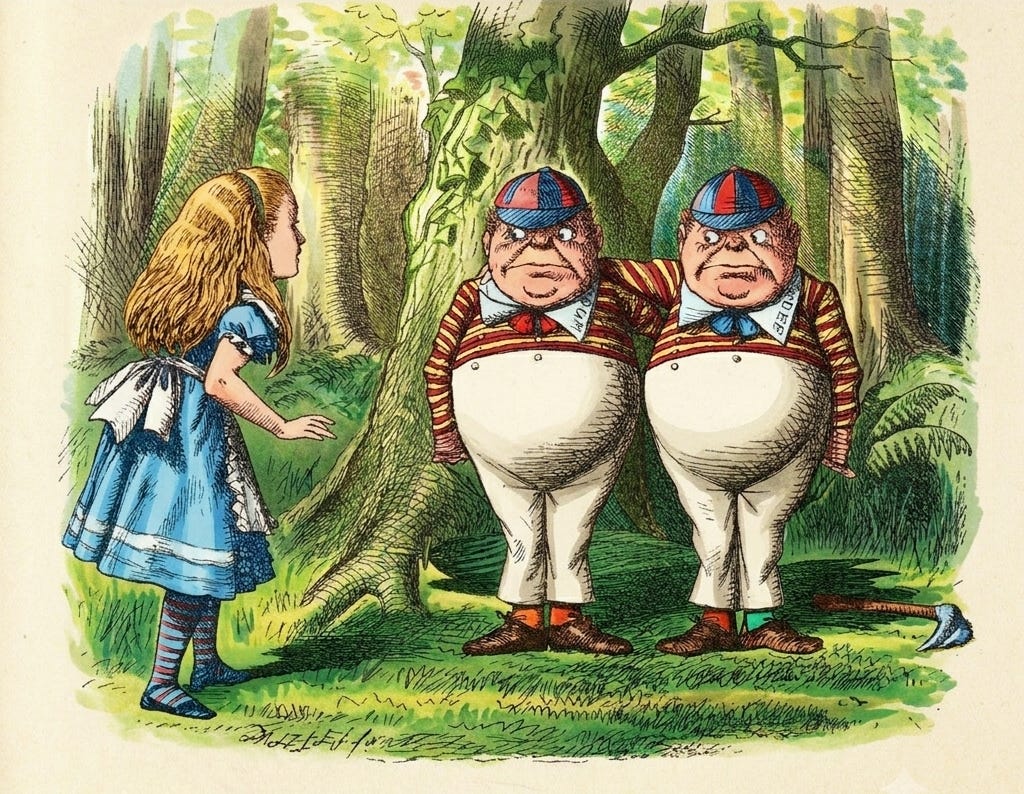
The first is condescension, Tweedledum – the belief that children cannot be trusted with real language, real ideas, real darkness, or real moral complexity without an adult hovering over them to ensure they draw the right conclusions.
The second is commerce, Tweedledee – the reduction of children’s literature from a living art to a product category, optimised for the widest possible market with the smallest possible risk.
The greatest enemies of quality children’s literature today are identity politics and corporate greed, and the result today is as it was in Charlotte Mason’s time. Twaddle.
I know of Rabbit Room Press and Waxwing Books by reputation and admire what they are both doing – they exist for exactly the reason we've been discussing, because their founders care about quality, well written living books. The fact that presses like these exist, and more and more of them are emerging is encouraging. The appetite for not only children's books, but all kinds of books that aren't drowning in twaddle and identiy politics is growing.
Hi @Shannon Richardson Thank you so much for restacking. Best wishes Vincent.