


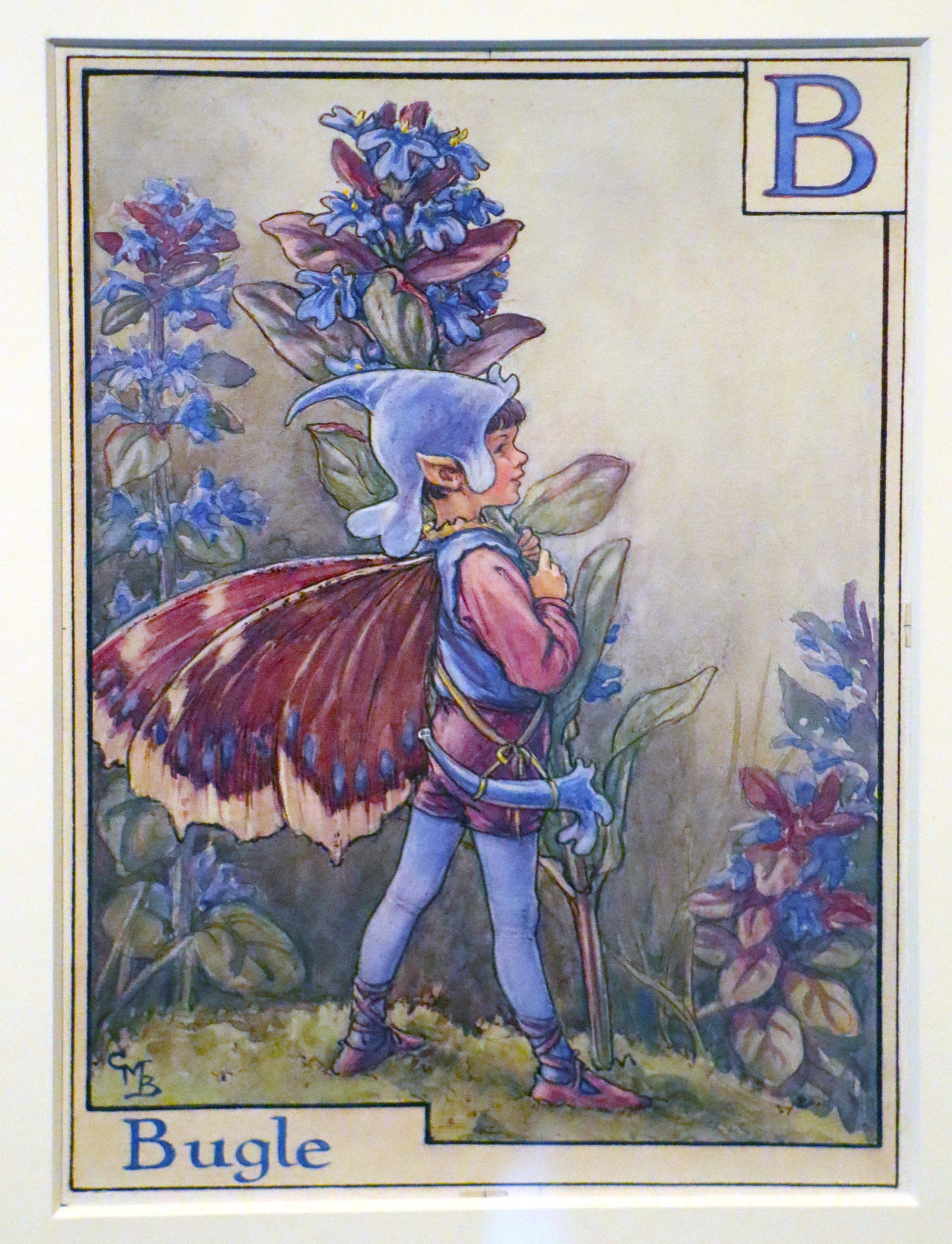
Bugle
At the edge of the woodland,
Where good fairies dwell,
Stands, on the look-out,
A brave sentinel.
At the call of his bugle
Out the elves run,
Ready for anything,
Danger, or fun,
Hunting, or warfare,
By moonshine or sun.
I was born in London, and my strongest early memories as a toddler are of long walks with my grandmother in the great London parks. Actually, she did all the walking. I was in a pushchair enjoying the ride.
For this essay, one park in particular springs to mind – Kensington Gardens. In the gardens there is a statue of J.M. Barrie’s Peter Pan, created in 1912, but it is not the statue I remember. What caught my attention was an old dead oak tree, except to me it was far from dead. It was teeming with life. And I am sure that my fascination with fairies was born from that old tree.
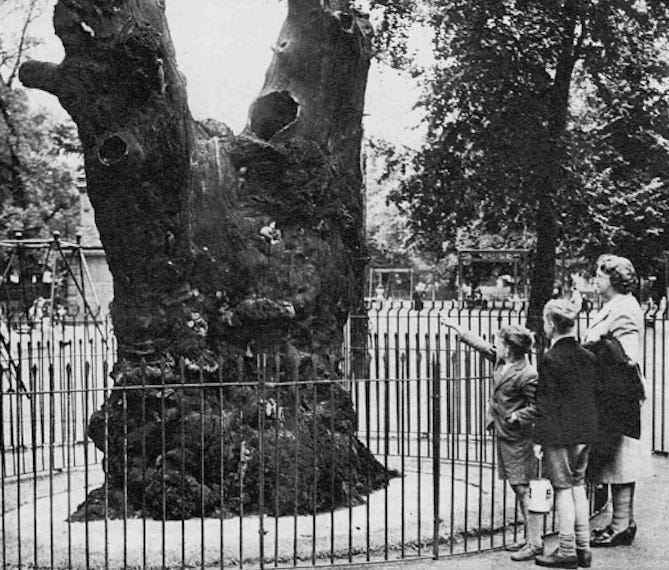
The tree is the Elfin Oak. The Elfin Oak is the stump of a nine-hundred-year-old oak tree, covered in miniature, painted figures of elves, gnomes, fairies and small animals. The enormous hollow log came from Richmond Park and was moved to Kensington Gardens in 1928. Over the following two years, the illustrator Ivor Innes carved dozens of figures into it – Wookey the witch with her three jars, Huckleberry the gnome carrying berries up the Gnomes’ Stairway, Grumples and Groodles the Elves being woken by brownies stealing eggs from a crow’s nest. The comedian Spike Milligan was a lifelong fan and in 1996 personally financed its restoration, repainting much of the tree himself. It was granted Grade II listed status in 1997.
I remember being fascinated by it, but also somewhat nervous. Those little figures, carved from wood, were to my toddler eyes rather scary.
As I got older, the fascination with fairies never quite left me, although it went underground for a while, as these things do when you are a teenager.
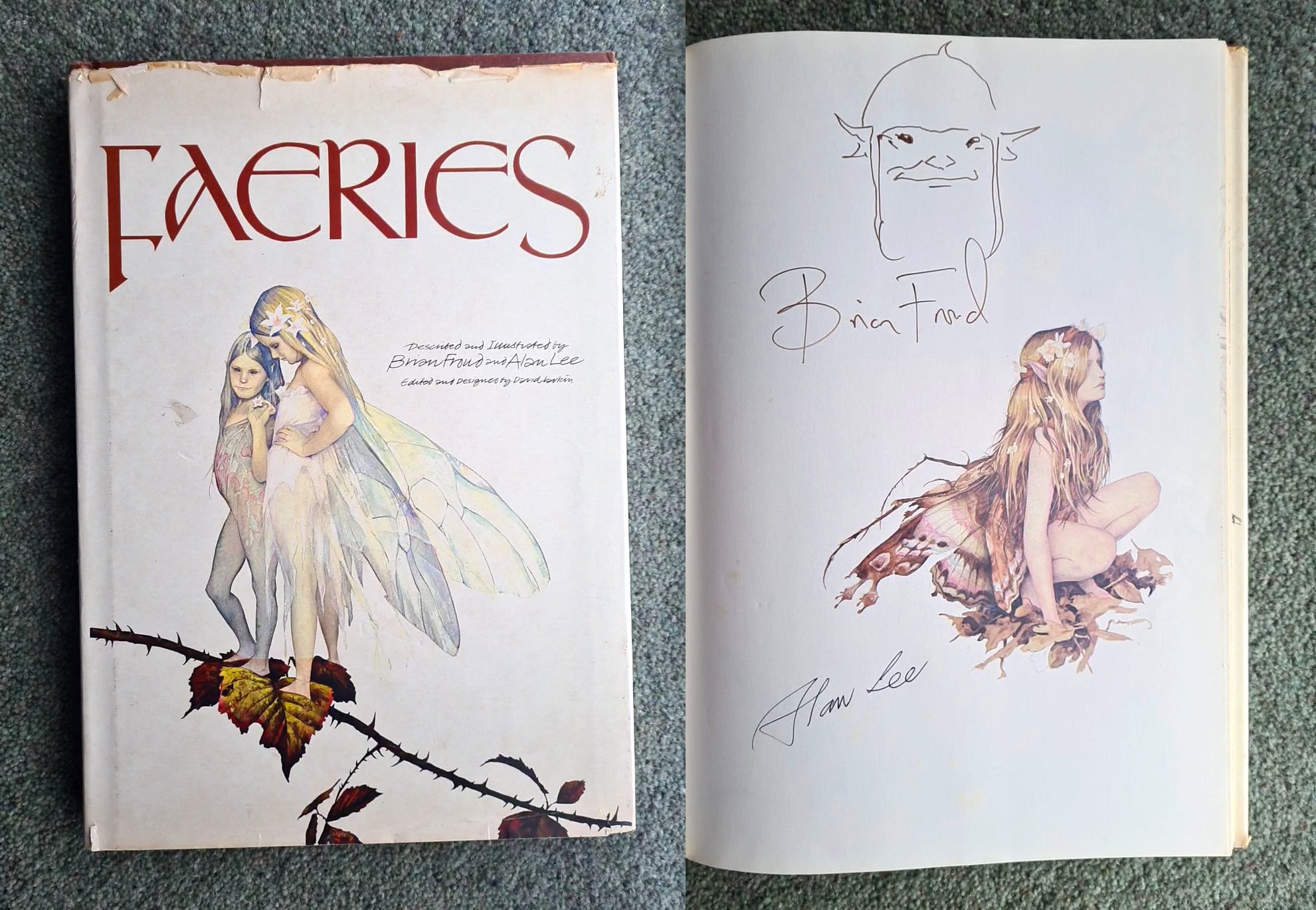
It resurfaced in my first year at art college. West Sussex College of Art and Design, Worthing, 1979. I was sixteen, and I bought a first edition of Faeries by Brian Froud and Alan Lee. I still have it.
That book changed everything. Froud and Lee took fairies out of the nursery and into the landscape – into the mud and the moss and the tangled roots of old trees. Their fairies were not cute, they were wild, ancient, unpredictable, and rooted in the same English and Celtic folklore that had produced the stories I had grown up half-knowing, and without understanding where they came from – the English countryside.
That book opened a door. Through it I found my way to Tolkien, Lord of the Rings and the Elves, and I loved them. Not the battles, not the quest, not even the Ring – it was the Elves of Lothlórien and Rivendell that I liked the most. The Elves of Middle-earth are tall, ancient, luminous, and profoundly sad creatures. There is a beauty in Tolkien’s Elves that aches, because you know it is passing. And of course it was Alan Lee who went on to define the visual world of Middle-earth for Peter Jackson’s films, so the thread from that first edition of Faeries in a Worthing bookshop runs all the way to the screen.
But the older tradition kept pulling me back. The Victorian fairy painters – Richard Dadd’s impossibly detailed and disturbing The Fairy Feller’s Master-Stroke. Joseph Noel Paton’s tangled fairy courts. These artists were not making art for children. They were looking at the natural world and seeing something behind it, something half-hidden in the bark and the undergrowth, something that would vanish if you looked at it directly.
And then there was Arthur Rackham, especially his trees. Rackham’s trees are alive – literally. His trees have faces, they have fingers, they are watching you. His forests are places where the boundary between the natural and the supernatural has dissolved completely. A gnarled oak in a Rackham drawing is not a tree with a fairy sitting on it. The tree is the fairy. The roots and the magic are the same thing. I have spent hours with Rackham’s illustrations, and they have never once lost their power. I think that is because Rackham understood something essential: that enchantment is not prettiness. It is strangeness. It is the feeling that the world is deeper than it looks.
So when it came to Cicely Mary Barker and her Flower Fairies, I was dismissive.
Barkers fairies were twee and too cute. They were not fairies, they were children playing dress-up. I had Rackham’s gnarled forests and Froud’s wild creatures and Tolkien’s luminous, grieving Elves. What did I need with pretty children sitting on flowers?
I held that view for over forty years, until a holiday in Wales in 2023.
On the journey to Wales, we stopped at Port Sunlight to visit the Lady Lever Art Gallery. I had always wanted to see its Pre-Raphaelite collection, and one painting in particular – A Dream of the Past: Sir Isumbras at the Ford by Millais. Port Sunlight itself is a remarkable Disney-like place, a model village built by William Lever for his soap factory workers, and founded on the conviction that working people deserved beauty in their daily surroundings. That is an Arts and Crafts principle if ever there was one.
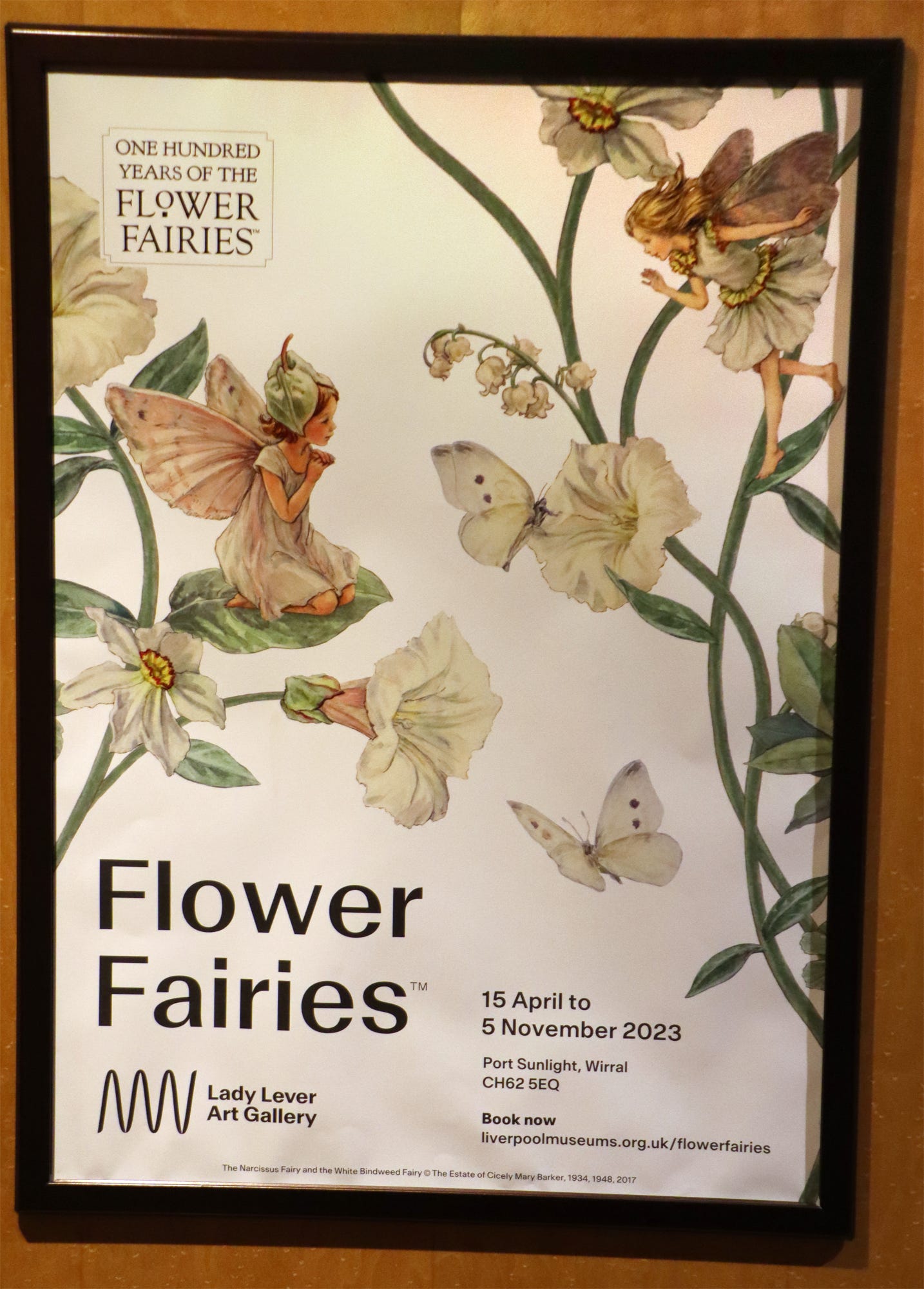
Quite by coincidence, there was an exhibition of Cicely Mary Barker’s original Flower Fairy paintings. I almost walked past it, but I’m glad I didn’t. Sometimes the things that change your mind arrive not through argument but through circumstance.
The originals are not what you expect. They are not the soft, slightly faded images you know from the printed books and the greetings cards. They are precise and they are still luminous and bright. The botanical detail is extraordinary – every petal, every stamen, every leaf painted with a care and attention that reproductions cannot easily convey. And the children that I had dismissed as playing dress-up are not idealised cherubs. They are real children, caught in real poses, with weight and character. You can see the personality in their faces. I wandered around in that gallery for a long time. Much longer than I had intended.
What I had dismissed for prettiness was precision.
What I had dismissed as sweetness was devotion.
I had been looking at Cicely Mary Barker’s Flower Fairies through the wrong end of the telescope. I had confused gentleness with lack of depth, the same mistake that art critics have spent a hundred years making about Helen Allingham’s cottage paintings – technically accomplished, undeniably appealing, and dismissed as chocolate box. Too pretty. Too safe. Too easy to love. That accusation – chocolate box – deserves a moment’s thought, because it reveals more about the accuser than the accused. When we call something chocolate box, what we really mean is that it is beautiful without being difficult, and we have somehow decided that beauty without difficulty is not to be trusted.
We will forgive Rackham his beauty because his trees are frightening. We will forgive Dadd because his fairies are hallucinatory. But Barker’s beauty is gentle, and quiet, and grounded in the real – real flowers, real children, and most importantly real faith, and we do not quite know what to do with it. So we put it on a biscuit tin and move on. I dismissed her work for decades, and it took the originals to open my eyes.
Cicely Mary Barker was born in West Croydon, London on 28 June 1895. She suffered from epilepsy as a child and was physically frail for most of her life. She could not go to school, so she was educated at home, spending much of her time on her own, reading and drawing. Her father was an artist – he carved the pulpit at their local church and played the organ – and he recognised his daughter’s talent early, enrolling her at the Croydon Art Society at thirteen.
At sixteen she was elected a life fellow, the youngest person ever to receive the honour. Her father died when she was seventeen. The family were left in difficult circumstances. Her elder sister Dorothy opened an infants school – kindergarten – in the back room of their house. Meanwhile Cicely began to sell her paintings. She sent her Flower Fairy illustrations to several publishers before Blackie accepted them. She was paid twenty-five pounds for twenty-four paintings and their accompanying verses. She was only twenty-eight years old. Flower Fairies of the Spring was published in 1923, and was well received by a public weary of war and tired of the horror and pointless slaughter.
Seven more Flower Fairy books followed. But the illustrations were only part of what Barker made. She wrote every one of the poems herself. The paintings always came first – she painted the flower and the child before she wrote the verse – and the poems were crafted to match, each one a small, precise observation of the plant’s character and its habitat. They are not great poetry, and she would not have claimed they were. But they are true. They carry real botanical knowledge lightly, in a form a child can hold in memory, and they were written by the same hand that painted the pictures. The Flower Fairies are not illustrated poems. They are not poems about nature. Each illustration and poem needs to be considered together. Her method was extraordinary in its care. She painted every flower from life. When she could not find the specimen she needed, she wrote to the staff at Kew Gardens, who would visit her, bringing plants for her to study.
The children who modelled for the fairies were real, and most of them from Dorothy’s infant school. Cicely made the costumes herself, stitching them from scraps of fabric, fashioning wings from twigs and gauze. She asked each child to hold the actual flower, because she wanted to be certain of its shape, its texture, its weight in a small hand. Her only alteration was to scale – she enlarged the flower to match the size of the child. Everything was real except the fairy. In the foreword to Flower Fairies of the Wayside she wrote:
‘So let me say quite plainly, that I have drawn all the plants and flowers very carefully, from real ones; and everything that I have said about them is as true as I could make it. But I have never seen a fairy; the fairies and all about them are just “pretend.’’
The flowers were true. The children were real. The craft was meticulous. And the fairy – the enchantment, the wonder, the thing with wings – was honestly declared as imagination.
She did not ask anyone to believe in fairies. She asked them to look at flowers and the wonder of childhood. This matters, because in the very same years that Barker was painting real children holding real flowers, two girls in a Yorkshire garden were propping up paper cutouts with hatpins and saying the photographs were of real fairies. The Cottingley hoax fooled Arthur Conan Doyle, whose son Kingsley was wounded at the Somme and died of pneumonia, and who was desperate to believe that the material world was not all there was. He published the photographs in The Strand Magazine in 1920 and wrote The Coming of the Fairies in 1922. Barker’s Flower Fairies of the Spring appeared less than a year later. I would argue that the hunger that made both the Cottingley Fairies and the Flower Fairies were one and the same thing. But where the Cottingley fairies offered false evidence of the supernatural, Barker offered something more honest and more profound – real beauty, made by hand, grounded in nature, and openly declared for what it is. The fairy was pretend. The flower was real and sacred.
And the faith behind Cicely Barker’s work is genuine. The Barkers were a deeply religious family, and Cicely was a devout Christian all her life. She was described as one of the pillars of St Andrew’s Church in Croydon. Her faith was not a private matter kept separate from her art – it was the foundation of everything she made. She painted church murals, altar panels, and triptychs. She illustrated Bible stories with her sister Dorothy. In 1926, Queen Mary purchased one of her religious paintings, The Darling of the World Has Come. And towards the end of her life, she designed a stained glass window for St Edmund’s Church, Pitlake, in memory of her sister and mother. A stained glass window. Made in grief and love for a dead sister.
If you have read any of my other essays, then you will know why that stops me in my tracks. My great-great-grandfather Robert made stained glass windows for Morris and Company and knew William Morris. The only surviving examples of Robert’s work are in a church around the corner from my home, windows I did not know existed until I went looking for them. Barker’s window was installed in 1962. Unfortunately, the church no longer exists and the window has disappeared. Robert’s windows survived by accident. Barker’s was lost. But the impulse behind both was the same – the belief that making something beautiful with your hands, for a sacred space, was itself an act of faith.
Barker saw no contradiction between her fairy paintings and her religious art. The Flower Fairies are not pagan. They are a celebration of the natural world made by a woman who believed that world was God’s creation, and that painting it truthfully was a form of praise. I would argue that the fairy is simply the device that invites a child to look more closely and to learn to appreciate nature. Which brings me once again to Charlotte Mason.
Charlotte Mason believed that children are born persons – complete human beings capable of receiving real ideas, real beauty, and real difficulty from the very beginning. She called the alternative ‘twaddle’: the watered-down, oversimplified material that adults produce when they do not trust children to appreciate the real thing. Two of the cornerstones of her method were picture study and nature study. In picture study, a child is shown a single painting and asked to look at it carefully, to notice what is there, to hold it in memory. No analysis. No art history. Just looking, attending, receiving. Mason wanted every child to leave school with ‘whole galleries of mental pictures’ hanging in the halls of their imagination.
In nature study, Mason sent children outside to directly encounter the living, natural world, which she argued is itself a form of knowledge. She encouraged children to keep nature journals and draw and note what they saw. Children learned the names of flowers and trees not from textbooks but from the things themselves, held in their own hands and studied with their own eyes. Art and nature. The trained eye and the living world. Mason understood that these were not separate disciplines but two expressions of the same conviction – that beauty is a birthright, and the capacity to see it belongs to everyone.
This was Ruskin’s conviction before it was Mason’s, absorbed through her friend Julia Firth’s weekly picture study sessions in Ambleside, where Firth showed students how to look at paintings the way Ruskin had taught her to look. (You can read about Ruskin and Julia Firth here.) Cicely Mary Barker never met Charlotte Mason. Mason died in January 1923, months before Flower Fairies of the Spring was published. There is no evidence they knew of each other, yet they arrived at the same truth independently, just from different directions.
Mason said show a child real art. Barker made art for children that was botanically precise, honestly observed, and painted from life. Mason said send a child into nature. Barker took nature and made it the foundation of her work. Mason said children are not lesser beings who need lesser things. Barker was paid twenty-five pounds for twenty-four paintings and she painted every one as though she were painting for a gallery, because she did not believe that work made for children deserved less care than work made for adults. And both of these women believed that the natural world was not merely beautiful but sacred, and that showing a child its beauty was a moral act, not a sentimental indulgence.
The connection runs through geography too. Charlotte Mason taught for more than ten years at Davison School in Worthing before she moved to Ambleside. Cicely Mary Barker moved to Sussex in her final years and died in Worthing Hospital on 16 February 1973. I started art college in Worthing six years later in 1979 when I was sixteen years old and brought a first edition of Faeries by Alan Lee and Brian Froud. Three people separated by only time, who believed that making things with care matters.
Right now, as I write this, thirty of Barker’s original Flower Fairy watercolours are on display at the Russell-Cotes Museum in Bournemouth, a couple of hours along the coast from me. The exhibition runs until October 2026 and includes preparatory sketches and rarely seen studies – the working process laid bare, the craft visible beneath the finished surface.
As a side note, Charlotte Mason’s teaching method and homeschooling is very much alive today in Bournemouth and nearby Poole.
In any event, I dismissed Cicely Mary Barker for decades because I thought her work was twee and simply too pretty. I was wrong. Past the ‘chocolate box cuteness’ there is a deeper truth to be found. The flowers are real, painted from life with a precision that any botanist would respect. The children are real, from the infant school in the back room, dressed in costumes made by hand.
The faith is real, expressed in every brushstroke of every fairy painting. Both the flower and the child are created by God, and I would argue that each one of her paintings and poems is a devotional piece and an act of faith.
Charlotte and Cicely would have understood one another completely.
The fairy is pretend. The flower is real. And the act of painting one to help a child see the other is, I think, as close to Charlotte Mason’s vision as any illustrator has ever come.
Upon reading this I recalled that I owned Cicely Mary Barker's book as a child, and loved it dearly, and have treasured flowers and natural places as magical all of my life.
This is fascinating! I knew about the Flower Fairies, of course, and always liked Cicely Mary Barker's illustrations, but I didn't know much about her background and am very glad to have learned so much more from your article. Thank you!
Incidentally, I hadn't heard of the Elfin Oak (even though I lived near London for some years, I don't think I ever visited Kensington Gardens, which I now realise I should have done) — but in Australia, where I grew up, we have a very similar tree in the Fitzroy Gardens in Melbourne! I visited it a few years ago for the first time since my childhood and was delighted to find the carvings have been restored — they were looking rather sad and faded when I was little. Here are some pictures and info:
https://beautifulbooks.info/2019/01/ola-cohn-the-stories-of-the-fairy-tree/