


When I was in my teens, here in the UK, there was a television programme called Connections. It was presented by a man called James Burke, who had a way of walking you through history, science and invention through unexpected connections. He would begin with something ordinary, a plough or a loom or a piece of glass, and by the end of the episode you would find yourself standing in a completely different century, looking at a completely different object. You could never have predicted the journey, the connections, and yet it felt entirely natural. Every step, every connection, followed on logically from the last.
I have been thinking about Connections recently because I had stumbled into a series of connections of my own. It begins with stained glass windows in my local church (and made by my great-great-grandfather who knew William Morris), and it ends in Ambleside, the Lake District, where Charlotte Mason spent years teaching children how to look at art. Every link connects to the next. And at the heart of it all stands a man whose name runs through Victorian England like a thread through cloth: John Ruskin.
But let me start at the beginning with the windows.
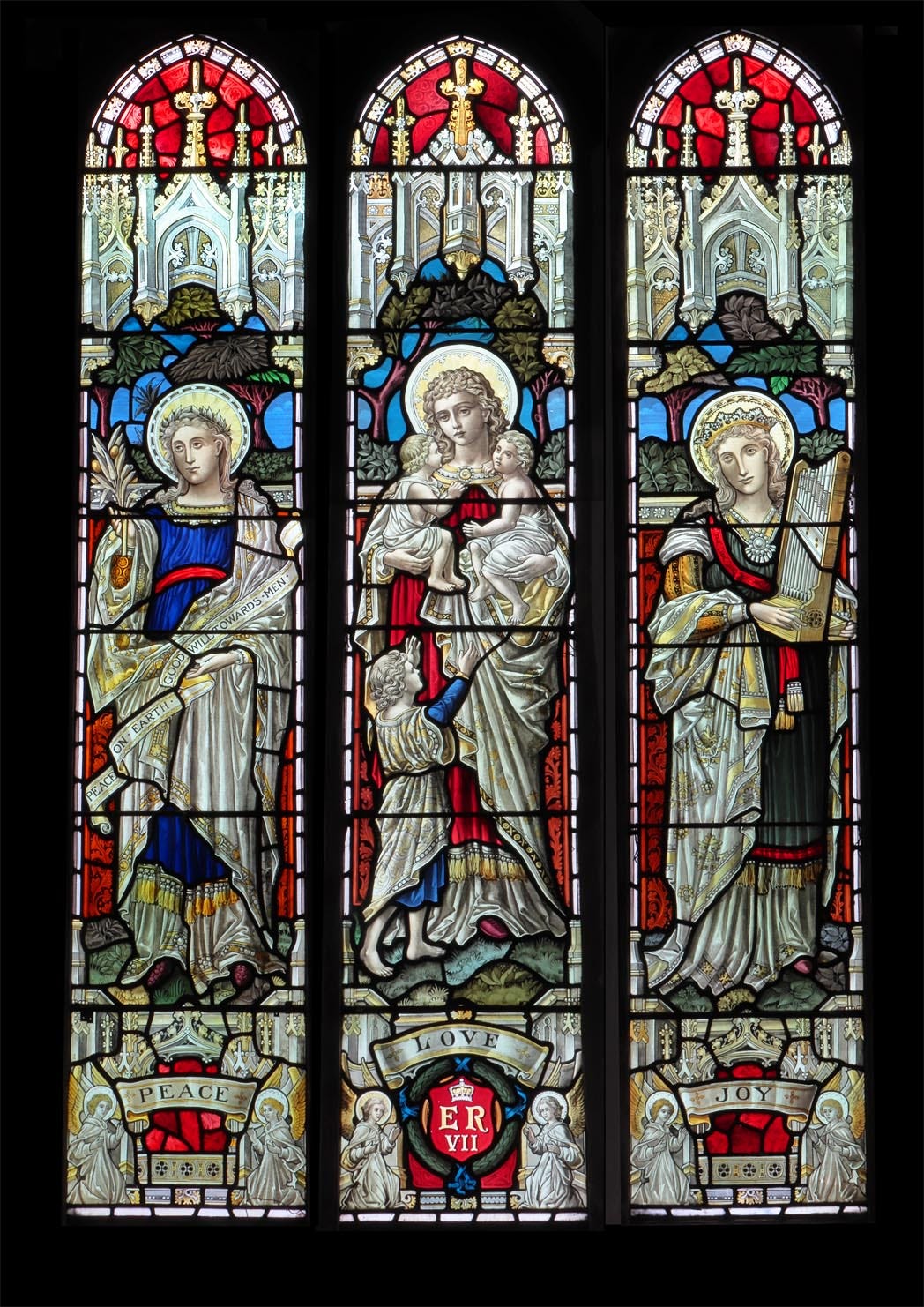
A few years ago, an elderly aunt told me that my grandmother had been given a gold sovereign by William Morris. I burst into tears on the spot. I had spent my whole life drawn to the Pre-Raphaelites, to Edward Burne Jones, to King Arthur, to the Arts and Crafts movement and everything Morris stood for, without knowing that my own family had actually been part of that movement. (You can read the essay Stained Glass and Tears here.)
It turned out that the gold sovereign did not come from Morris himself but from my great-great-grandfather Robert, who owned and ran a stained glass company in Marylebone London, and who undertook work for Morris and Company. His sisters lived above the very first Morris and Company shop at 449 Oxford Street. Both of them worked for the firm as cloth stainers.
And the only surviving examples of Robert’s stained glass windows are in my local church, not ten minutes away, windows that I did not know existed until I went looking for Roberts’ work.
That discovery changed me forever. It connected me to a world I had always admired and desperately wanted to be a part of, but what I did not understand then, and what I have only recently begun to see, is that Robert’s windows are not the end of the story. They are merely the entrance hall to a palace with room after room crammed full of Victorian art and culture.
Entering the palace.
In the autumn of 1856, two young men arrived at a set of rooms in Red Lion Square in London. They were Edward Burne-Jones and William Morris, both in their early twenties, both recently arrived from Oxford University, both on fire with a conviction they could barely articulate but could not ignore: that art and beauty were not merely decoration, they were an essential expression of truth. That making things with your hands, with care, with devotion, was a moral act, and that the industrial world grinding away outside their windows was destroying something essential.
They were not alone in thinking this. But they might never have found the courage to act on it without the man whose books had opened their eyes and imaginations - the books of John Ruskin.
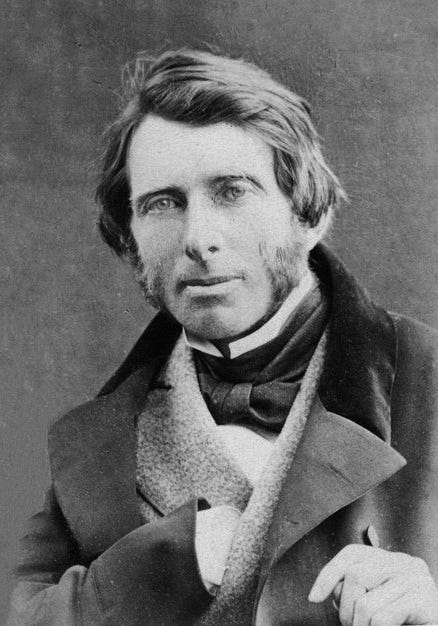
John Ruskin was thirty-six years old in 1855 and already the most influential art critic in England. He was writing Modern Painters, and had written The Seven Lamps of Architecture and The Stones of Venice. Ruskin had defended Turner when the art establishment dismissed him. He had championed the young Pre-Raphaelites, Rossetti, Holman Hunt and Millais, when their work was attacked as ugly and naive. Ruskin’s defence not only secured their reputations, more importantly, it had given them the confidence and permission to believe that what they were doing mattered.
But Ruskin did something more important than simply champion individual painters. He argued, with a force and eloquence that Victorian England had not heard before, that the ability to see beauty was itself a moral faculty. That looking at a painting properly was not a pastime for the leisured classes but a discipline that made you more fully and completely human. Ruskin argued that a society which could no longer see or embrace beauty was a society that was in danger of losing its soul.
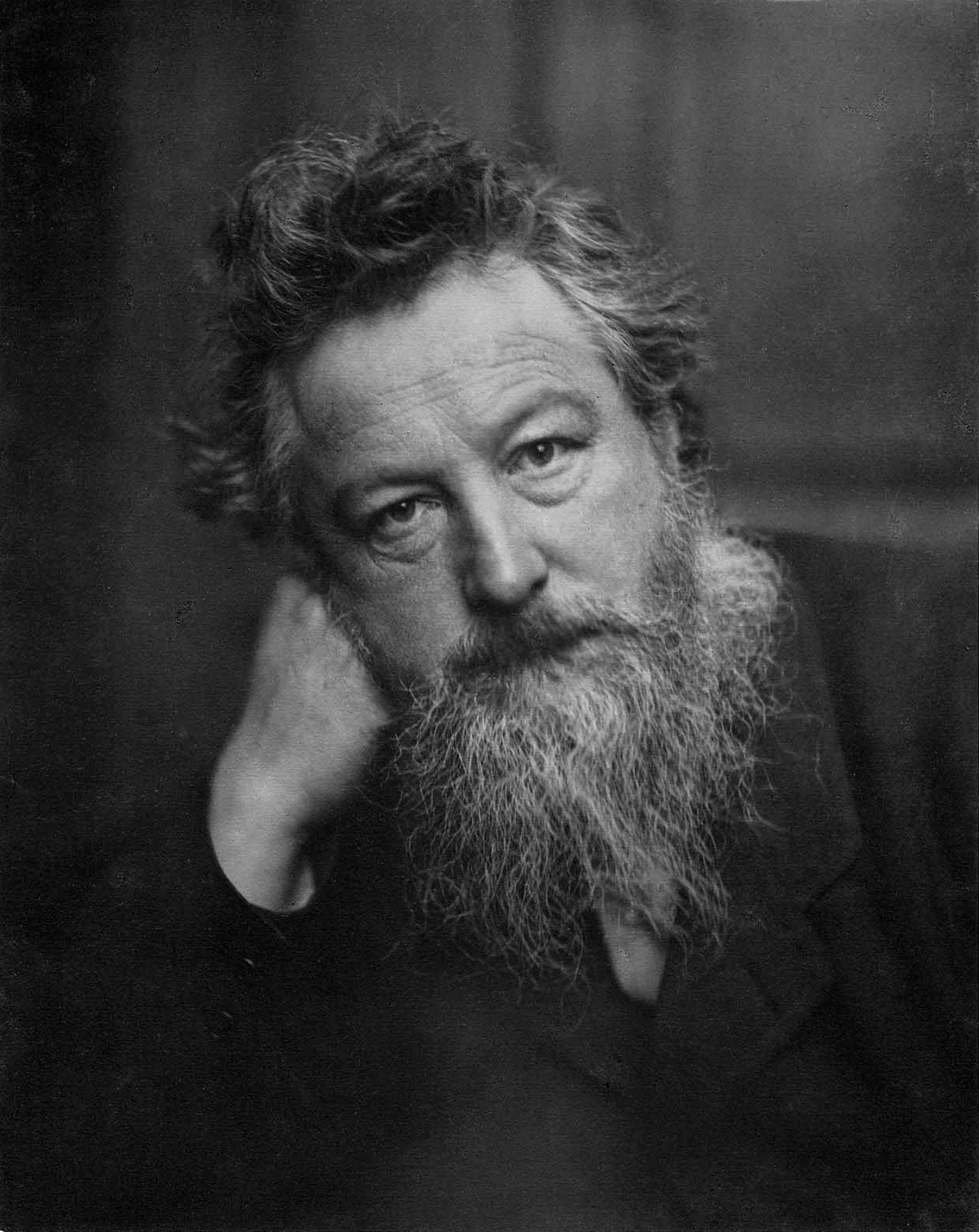
William Morris.
William Morris read Ruskin’s work whilst at Oxford and it changed the course of his life. Before Ruskin, Morris, (and Burne-Jones) had intended to take Holy Orders. After Ruskin, Morris understood that his vocation was not the Church but the workshop. The making of beautiful things, things made by hand with care and skill, things that honoured both the material and the maker, was not a lesser calling. It was the same calling, expressed through craft instead of liturgy.
The rooms in Red Lion Square, London was where it all began. Morris and Burne-Jones furnished their rooms with medieval-style furniture they designed themselves, because nothing available in the shops met their standards. Rossetti was a frequent visitor, painting, arguing, filling the rooms with his enormous personality. It was chaotic and earnest and sometimes absurd. Young men playing at being medieval craftsmen in a London lodging house, but it was also deadly serious. They meant every word. And they had Ruskin’s words and encouragement, the most respected art critic in England, in their ears, telling them to believe in and express their vision.
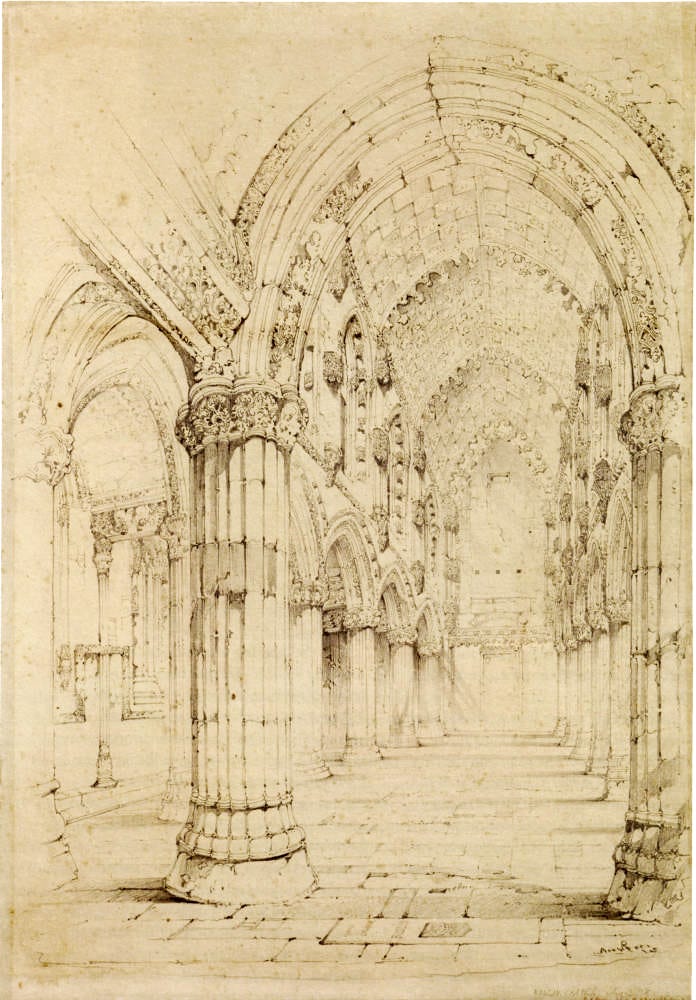
It would be easy, from this historical distance, to think of Ruskin as a man of words only, a critic who wrote about art but did not make it. That would be a mistake. Ruskin was a fine draughtsman and watercolourist. He drew obsessively, recording buildings and landscapes and geological formations with a precision that came from looking, really looking, at the world in front of him. He believed that drawing was a form of attention, that you could not truly understand something until you had tried to draw it, and that this discipline of close observation was available to everyone, not merely to the talented.
Ruskin taught drawing to working men. He gave lectures to audiences who had never been inside a gallery. He wrote not for scholars but for anyone willing to open their eyes and look. The Elements of Drawing, published in 1857, was written not just for art students but for ordinary people who wanted to learn to see. It remains one of the clearest and most generous books on the subject ever written.
Ruskin believed, and this is the thread that runs through everything, that the capacity to see beauty was not a gift given to a few but a birthright belonging to all, and not just adults, children too. The child in a slum school deserved the same access to great art as the child in a country house. The difference was not ability but opportunity. Give a child a great painting to look at, really look at, and the child’s mind would do the rest.
He said this in the 1850s. He said it in the 1860s. He said it in the 1870s and 1880s, as his health deteriorated and his mind began to fracture under the weight of grief and frustration that nobody was listening to him anymore.
But in Ambleside, in the Lake District, someone was listening.
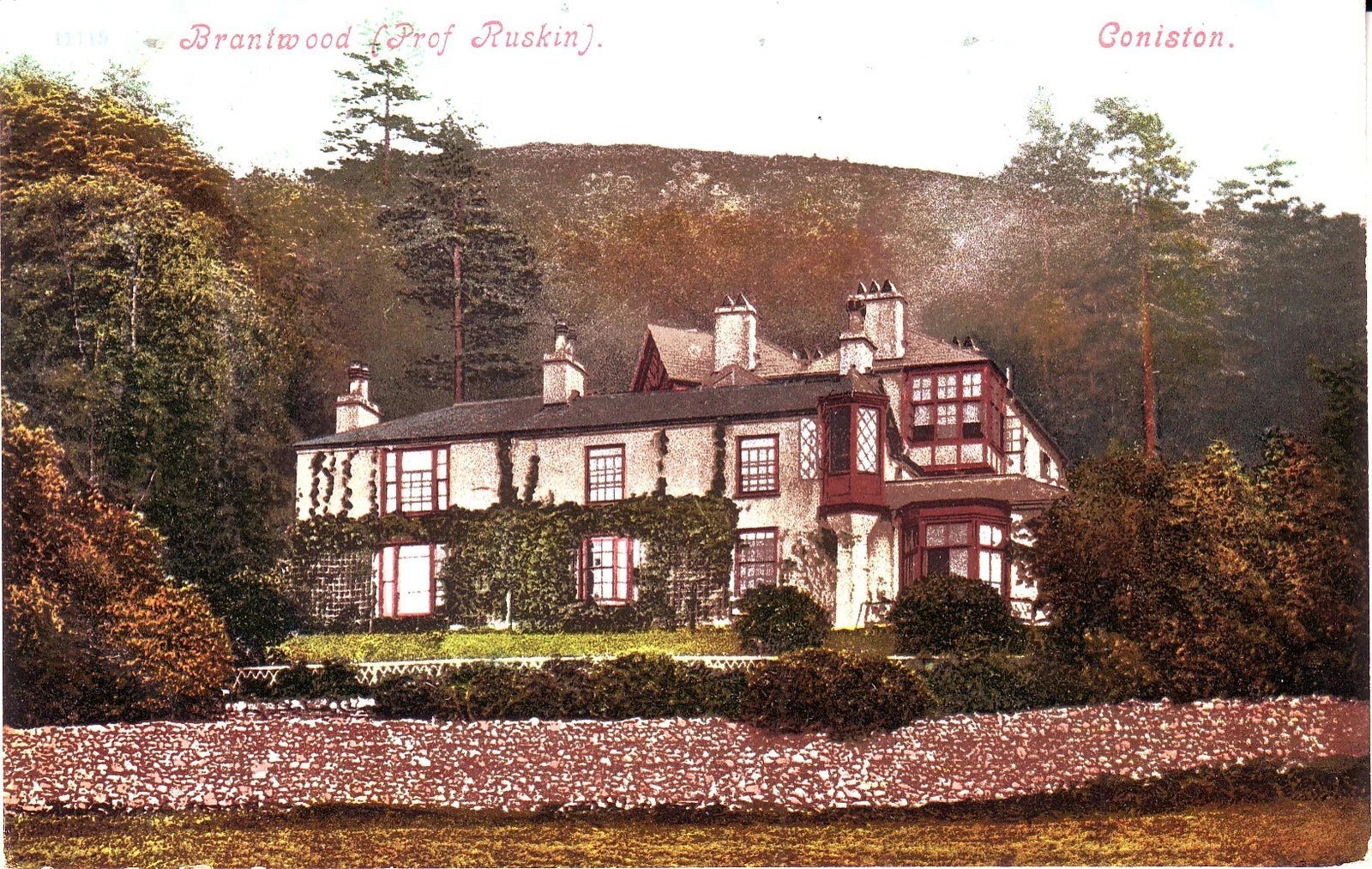
Ruskin spent the last twenty-eight years of his life at Brantwood, a house on the eastern shore of Coniston Water. He had bought it in 1871 because of its view across the lake. He filled it with art, with Turner watercolours and Pre-Raphaelite paintings and the minerals and shells he had collected all his life. He experimented in the gardens, creating different ‘rooms’ of planting as a kind of living laboratory for his ideas about the relationship between nature and human cultivation.
As he aged, his health declined, and from the 1870s onwards, he suffered repeated breakdowns, episodes of delirium and confusion that left him weakened and withdrawn. By the 1890s, he had largely stopped writing and sat in his turret room overlooking the lake, visited by friends and admirers, attended by his cousin Joan Severn and her family, a great mind slowly dimming in one of the most beautiful settings in England.
Among his visitors, and among his closest friends, was a woman called Julia Firth. Mrs Firth lived at Southwaite Rayne in Ambleside, not far from Brantwood. She was Ruskin’s friend and pupil, a woman who had absorbed his teaching about art with a seriousness and devotion that went far beyond admiration. She shared his conviction that art should be open to everyone. She shared his belief that looking at a great painting was not a matter of technical expertise but of attention and humility: you did not need to understand brushwork or perspective to be moved by a painting. You needed to look, and to keep looking, and to let the painting do its work.
And from 1895, Julia Firth opened her home.
Every week, she invited students to Southwaite Rayne. She spread out her collection of photographs and reproductions of great paintings, and she talked about them. Not as an art historian, not with technical vocabulary or academic apparatus, but in the light of what she had learned from Ruskin: that a great picture is great because it has something true to say, and that a child, or anyone, can receive that truth without needing to be an expert first.
The students who came to Julia Firth’s parlour were not art students. They were teachers in training, young women preparing to work in schools. And the school they were training at was the House of Education, founded and run by a woman who lived just up the road, and who would go on to become a close friend.
That woman was Charlotte Mason.
Until a few weeks ago, I had never heard of Charlotte Mason, and since finding her I have not been able to stop thinking about what an incredible woman she was, and the chain that connects her to everything I have not only been writing about on this Substack from my very first article, but everything about Victorian art and culture that I have loved my entire life.
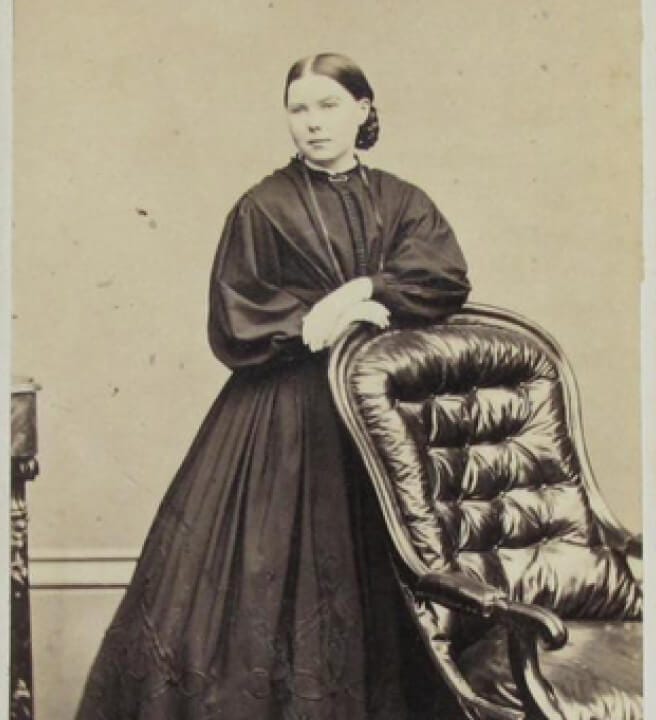
Charlotte Mason believed that children deserved real beauty. Not simplified versions, not summaries, not what she called ‘twaddle,’ but the real thing: great literature, great music, and great art, presented with the confidence that a child’s mind is strong enough to receive it.
One of the cornerstones of her method was something she called picture study. A child would be shown a single painting, one painting, and asked to look at it carefully, to notice what was there, to describe it, to hold it in memory. No technical analysis. No art-historical context. Just looking, attending, receiving. Mason wanted every child to leave school with, in her words, ‘whole galleries of mental pictures’ hanging in the halls of their imagination.
And here are the connections, (if you haven’t spotted them already of course.)
Charlotte Mason’s picture study method evolved from the teachings of Julia Firth, who created her method from the philosophy of John Ruskin. Charlotte’s method evolved from Julia Firth’s weekly sessions in her parlour in Ambleside, where she showed students how to look at paintings in the way Ruskin had taught her, and so on back. Ruskin to Morris, Morris to stained glass, stained glass to my great-great-grandfather and from there to my local church.
In 1952, a woman called Rose Amy Pennethorne, who had been a student at the House of Education and later became the organising secretary of Mason’s Parents’ National Educational Union, wrote an article tracing the connections. From Ruskin to Firth. From Firth to Mason. From Mason to the schools. From the schools to the children. Each one passing it forward, hand to hand, the same conviction: that beauty is not a luxury reserved for the privileged, but a birthright belonging to every child.
Pennethorne wrote that the great picture is great not because of its technique, but ‘because it has a great thought to convey, or a flash of insight to make available.’ A child, she said, can love El Greco without being troubled by his perspective. A child can receive Fra Angelico without knowing his theology. The door into the palace of art is wide open for anyone willing to walk through it.
That is Ruskin. That is Mason. And it is the same conviction that would drive Tolkien to argue that fairy stories are not nursery furniture, and Lewis to warn that a society which teaches children that nothing is truly beautiful will produce men without chests.
I keep finding these threads, these connections. Morris and my great-great-grandfather. Mason was once local to me and walked the same streets. And now Ruskin, at the centre of all of it, the man who taught Morris to see beauty as a moral calling, whose pupil Julia Firth, taught Charlotte Mason and her students that art matters, that the capacity to see truth and beauty is a birthright and not a privilege. That belief runs through everything I passionately believe in and everything that I have been writing about here on Substack.
James Burke would have enjoyed this. One connection leading to another, room by room, each door opening onto something you could not have predicted but which, once you see it, feels entirely inevitable.
From my great-great-grandfather’s stained glass to Morris. From Morris to Ruskin. From Ruskin to Julia Firth’s parlour. From that parlour to Charlotte Mason’s schools. And from those schools, across more than a century, to every homeschooling family that still believes a child deserves real beauty, real art, and the trust to receive it.
A great read and good to see an article about my neck of the woods!