

Charlotte Mason's England – The Light That Didn't Go Out
Why the Golden Age of Illustration never ended

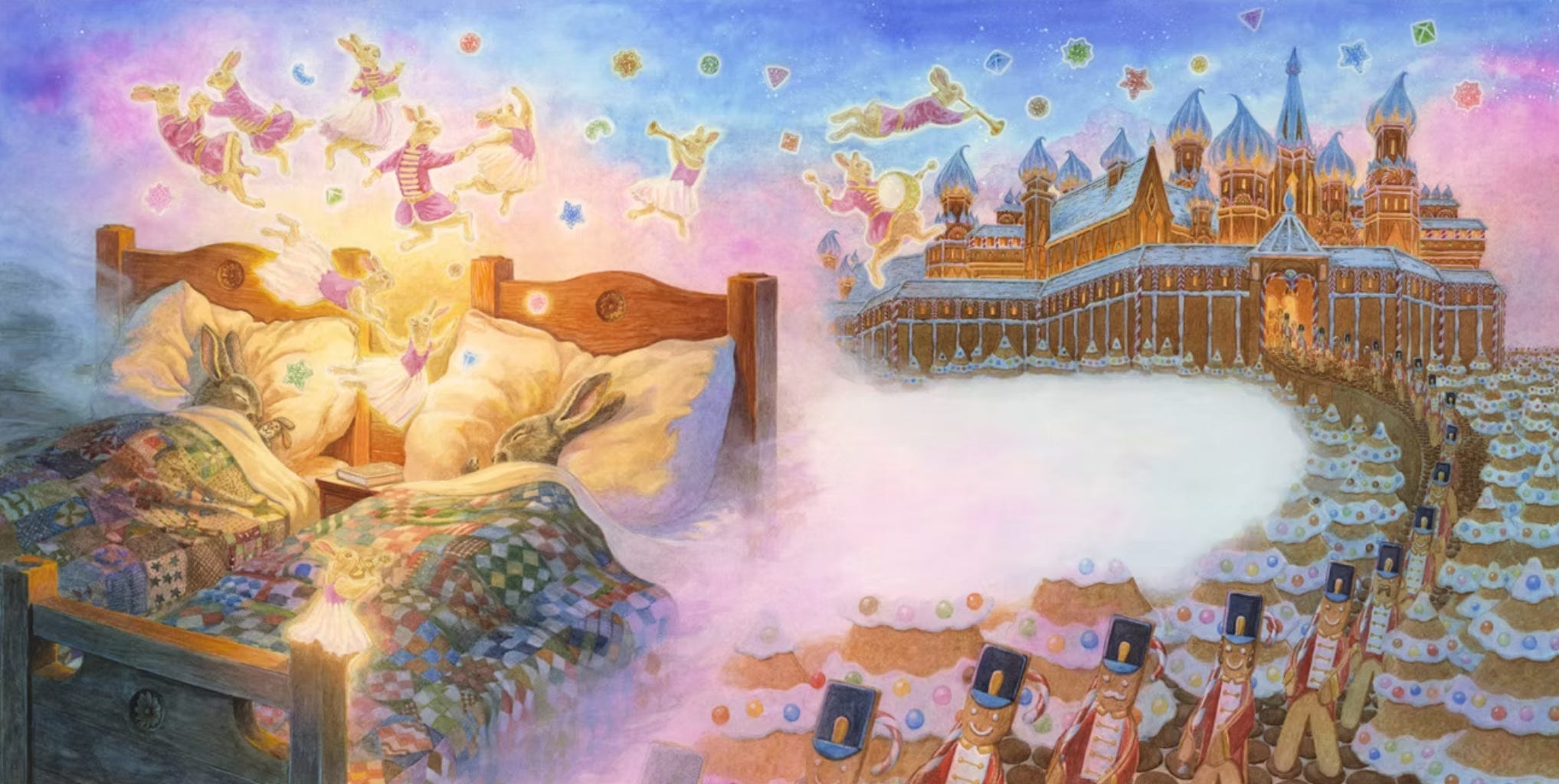
I very much admire the artists of the Golden Age of Illustration, and have been meaning to write an article about them – Rackham, Dulac, Pyle, and many more – that extraordinary generation of artists who, between about 1880 and 1930, elevated the children’s book into something to be treasured. I had been browsing their work one evening, when I came across this.
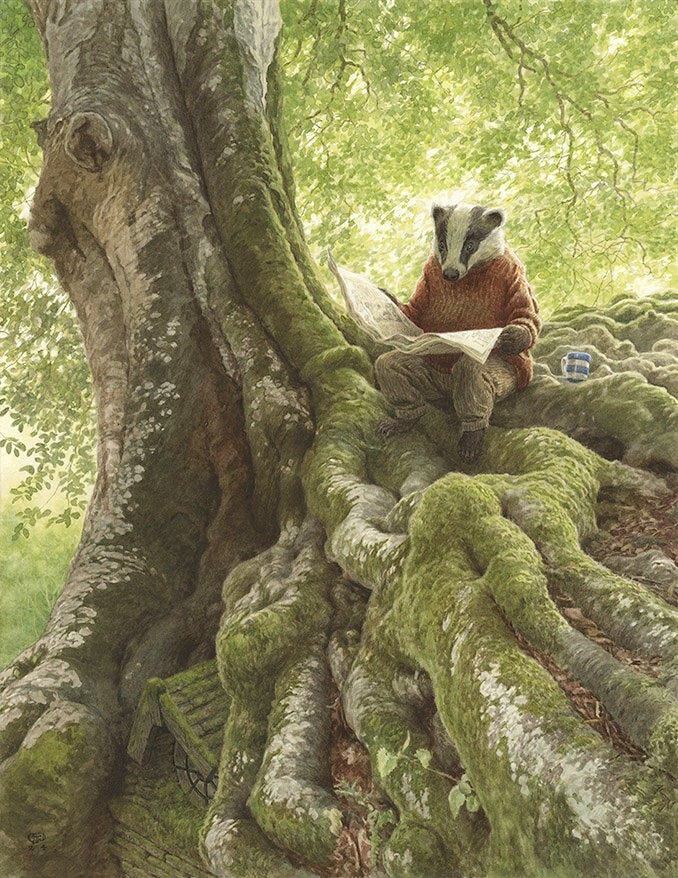
It’s Badger from The Wind in the Willows. Badger in a worn russet jumper and trousers, seated on the roots of an enormous beech tree and reading the paper. Dappled spring light gives the picture a wonderful spring-morning feel, whilst tucked into the roots below, almost hidden if you aren’t looking – a little gabled window. Badger’s home.
The illustration is deeply romantic and pure magic. Something went yes, this, and I fell instantly in love.
On reflecting on my admiration for the piece, it opened up a broader question.
Why do I – along with so many others – love the work of the Golden Age of Illustration so much? Well, I would argue that it’s more than nostalgia. Society today dismisses nostalgia all too readily as trite, dusty, sentimental weakness. But nostalgia is so much more than this. Nostalgia is reaching back into the past when the present fails to give us adequate intellectual and emotional nourishment. In my view, it is not a coincidence that so many people crave nostalgia, and seemingly more so now than ever before. Tolkien called this recovery – the act of reaching back as a way of seeing and understanding the present more clearly.
Nostalgia and reaching back is not weakness or sentimentality – it’s diagnostic. Reaching into the past tells us exactly what is missing in the present – truth, beauty, and craftsmanship.
And what I felt looking at Badger reading his daily paper was not only the longing for a simpler, less complex, less selfish, and less disposable world – it was also the craftsmanship of the piece itself, let alone its sheer beauty. Every line, every brushstroke, every colour choice of the painting had been considered. The lichen on the bark, the moss on the roots, the soft, spring-green light. This was not an image made quickly or carelessly. Badger was painted by someone who is not only very talented, but by someone who takes pains with the act of craftsmanship and cares about their work.
I think that what we respond to in the golden age illustrations – in Rackham’s gnarled trees, in Dulac’s luminous skies, or in Beatrix Potter’s meticulously observed hedgerows, is exactly what we respond to here. The beauty of the piece, along with the skill and the craftsmanship of the artist, but there is more to it than that. I think there are two more important pieces to understand and complete the picture as to why we respond the way we do.
The first is that paintings like this nearly always illustrate a story we treasure.
The second is that when we add in our conscious knowledge that the illustration is from a children’s story, we unconsciously and emotionally respond, becoming a child once again – instantly, re-living and re-loving the romance of that story.
Excellent illustrations like this resonate because they connect us back to our own childhood wonder.
I went to find who had painted it, expecting a name from 1910.
The artist’s name is Chris Dunn. He is a contemporary artist working in a Wiltshire studio here in England.
Chris Dunn is a superlative draughtsman and watercolourist. Not a digital artist recreating a watercolour effect on a screen, but a man using real pencils and real paint on real paper, slowly, the way Rackham did, the way Beatrix Potter did. The patience shows. His paintings reward the kind of looking that most contemporary illustration has stopped asking for – the sustained, unhurried attention of a child lying on the floor with a book, chin on hands, finding delight and wonder on every page.
And it is all in service of the story. Badger is not floating in front of a backdrop – he belongs in the painting. The beech tree is his home. You can feel the weight of him, the coolness of the shade. The small details are not charm for charm’s sake. The mug, the newspaper, the half-hidden doorway: they are visual storytelling at its best. They tell us who Badger is before we read a word.
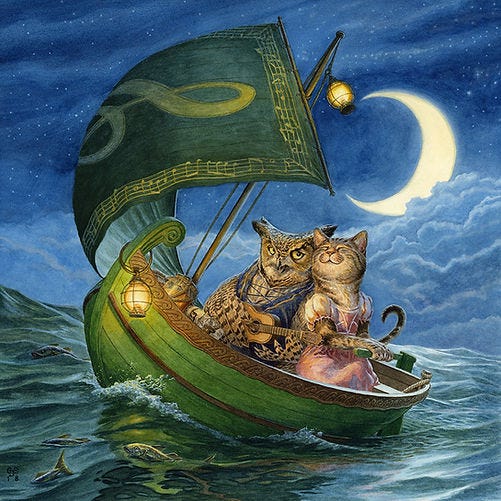
Chris Dunn was born in Keighley, Yorkshire, studied illustration at what is now Bath Spa University, and spent years working as a freelance editorial illustrator before finding the subject that would define his life’s work. Inspired by Beatrix Potter and Brian Jacques’ Redwall, he began painting the anthropomorphic animal world he is now known for – a world of hedgerow kitchens and moonlit rivers, of creatures in waistcoats and rolled-up sleeves, going about the ancient, ordinary business of living. His paintings for The Wind in the Willows, commissioned by Galerie Daniel Maghen in Paris and published by Éditions Caurette, are – in my view – the finest illustrated interpretation of Grahame’s world since Shepard’s original line drawings. They earned Chris a major Parisian exhibition, representation by one of Europe’s foremost illustration galleries, and a following that now numbers in the tens of thousands.
He is, by any reasonable measure, one of the most accomplished children’s book illustrators working in Britain today.
Charlotte Mason had a word for the thin, the cheap, the work that underestimates a child. She called it twaddle. She used the word about prose – the books that talk down, that simplify what needn’t be simplified, that offer a child less than they are capable of receiving. But the word very much applies to art and illustration as well.
I would argue that a child raised on living books that contain living illustrations like Chris Dunn’s, attains a different kind of eye from a child raised on the flat, quickly created, and equally quickly consumed and dismissed stories and illustrations. Not a better child, or a more virtuous one, but a happier child whose visual imagination has been nourished so effectively that it has naturally grown in strength and capability. Charlotte Mason understood this. She hung real paintings in her classrooms and trusted children to look at them properly, without condescension and dumbing down, and this principle extends naturally to the illustrated book.
The visual media a child grows up with becomes the fabric of their imagination, and the quality of that fabric matters enormously.
So where has this kind of illustrated beauty and craftsmanship gone?
Not from the world – Chris Dunn is the living proof of that, and he is not alone. But from mainstream children’s book publishing. Browse the catalogues of the major publishers and what you overwhealmingly find, are children’s illustrations optimised for a different set of priorities: clean lines that read clearly as a thumbnail on a screen, bold flat colour that suits a modern interior, and minimalist compositions designed to be glanced at rather than dwelt upon and enjoyed. There are commercial reasons for this – simpler art is cheaper and quicker to commission and reproduce.
The appetite for the richer tradition, meanwhile, has not disappeared, but it has become much rarer and more difficult to find. In the main, work such as Chris Dunn’s has migrated to galleries, to collectors, and to the enormous, passionate communities online who share Beatrix Potter and Brambly Hedge and Wind in the Willows imagery as though it were a living thing rather than a historical curiosity – because for them, it is, and I include myself amongst them.
Beautiful, well-crafted illustration is not dying – it is thriving, just outside the institutions that once made it their stock-in-trade. And there is something both heartening and sad about that. Heartening because the tradition is tougher than the market’s indifference. Sad because the children who would most benefit from it – the ones Charlotte Mason was thinking of, the ones lying on the floor with a book, chin on hands – are the ones least likely to encounter it on the shelves of their local bookshop or library, or increasingly – Amazon.
Imagine a bookshelf where children’s books illustrated with this kind of care were not the rare exception but the norm, and it is entirely within the industry’s gift to make that happen.
I would argue that more expensive illustrated works like Chris Dunn’s didn’t so much become less fashionable as less profitable. Not profitable enough, at least, for the corporate ledger.
In my view, corporate greed has disproportionately influenced the world of children’s book publishing in a negative way, and the biggest losers are of course – children.
What I find most heartening is that even though there are far fewer artists of Chris Dunn’s calibre living and working today, they are out there, keeping the light of the Golden Age of Illustration burning, because the fuel of that light – care, craft and beauty – is impossible to put out.
All illustrations in this essay are © Chris Dunn and are reproduced with his kind permission. You can find more of his work at chris-dunn.co.uk.
Thank you for introducing me to the artist featured in your essay. Like you, I think the Badger illustration is wonderful.
Something we were blessed to have growing up were 'Ladybird Books'. These pocket money-priced little books both entertained and educated. What really set them apart was the full colour illustrations by some incredibly talented artists. Many of if the images have stayed with me into adult life. The largest collection of these is in the Museum of English Rural life. It's definitely on my list of museums to visit:
https://merl.reading.ac.uk/visit-us/galleries/the-ladybird-gallery/
I’ve been following Chris Dunn for a long while on IG because of that very quality you speak of. Thank you for this piece!