


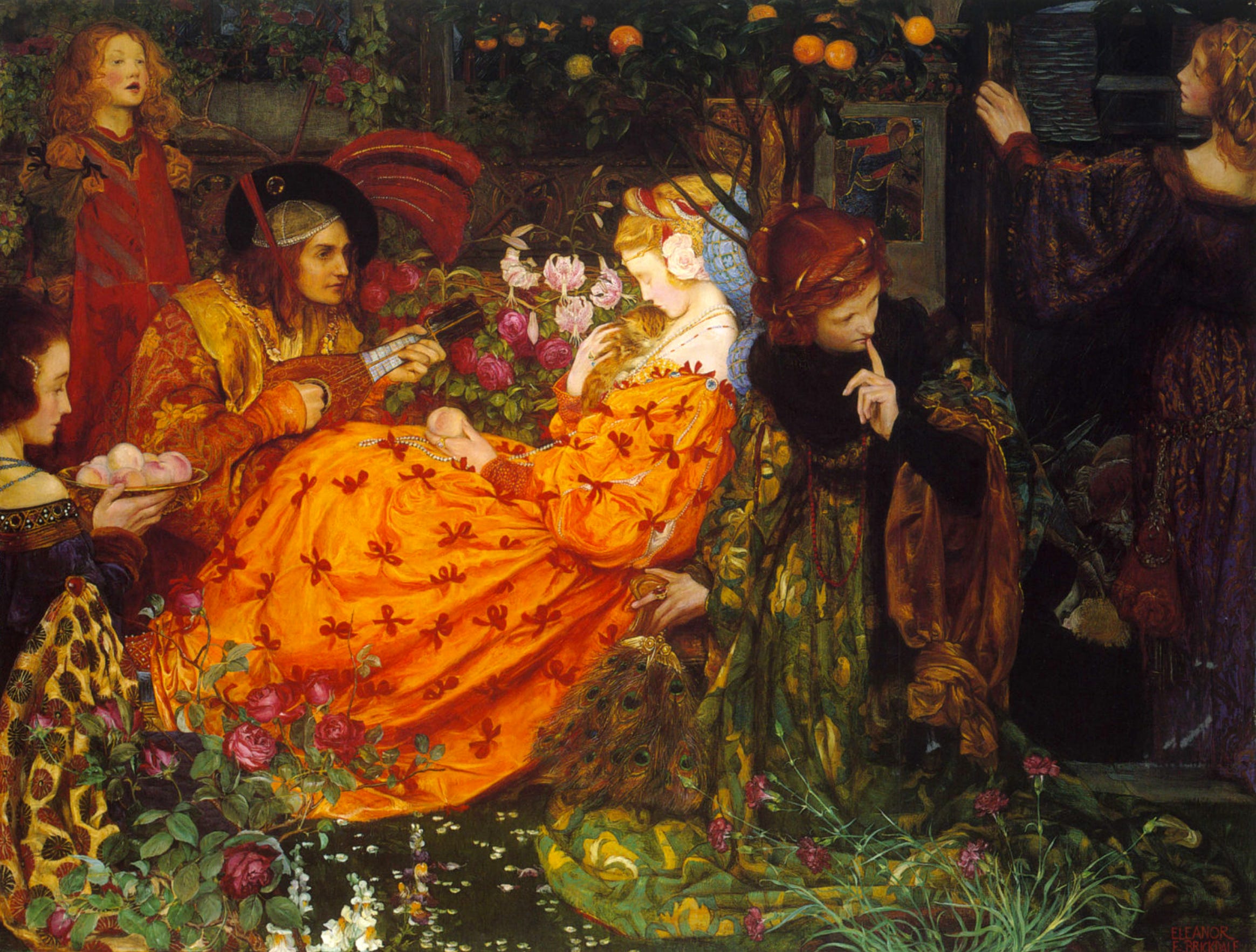
This is one of my all time favourite paintings.
A woman in an orange dress lies half-asleep in a garden, surrounded by roses and fruit and music. Someone is playing a lute for her. A child offers a bowl of peaches. The light is warm, the colours extraordinary – that dress, blazing out of the darkness like a bonfire in a forest. Everything about the painting says luxury, pleasure, rest. You want to be in that garden.
And then you notice what is happening at the edges.
To the right, a figure holds a finger to her lips. Behind her, someone is stealing away with a fan of peacock feathers. The sleeping woman does not see any of this. She cannot see it, she is asleep.
The painting is called The Deceitfulness of Riches. The title comes from Matthew’s Gospel – the Parable of the Sower, the seed that falls among thorns, where the deceitfulness of riches chokes the word and it becomes unfruitful. It was painted in 1901 by a Eleanor Fortescue - Brickdale when she was just twenty-nine years old.
In a previous essay, I traced a chain of connections from my great-great-grandfather’s stained glass windows through William Morris – who he knew well – through to John Ruskin and Charlotte Mason’s picture study method. Each link in the chain leading somewhere you could not have predicted but which, once you see it, feels entirely inevitable.
But there was another branch of that chain I did not follow. Another line running out from Ruskin, through a different family, to a woman painter who was part of the last generation to keep the Pre-Raphaelite tradition alive.
Thanks for reading Care & Craft! Subscribe for free to receive new posts and support my work.
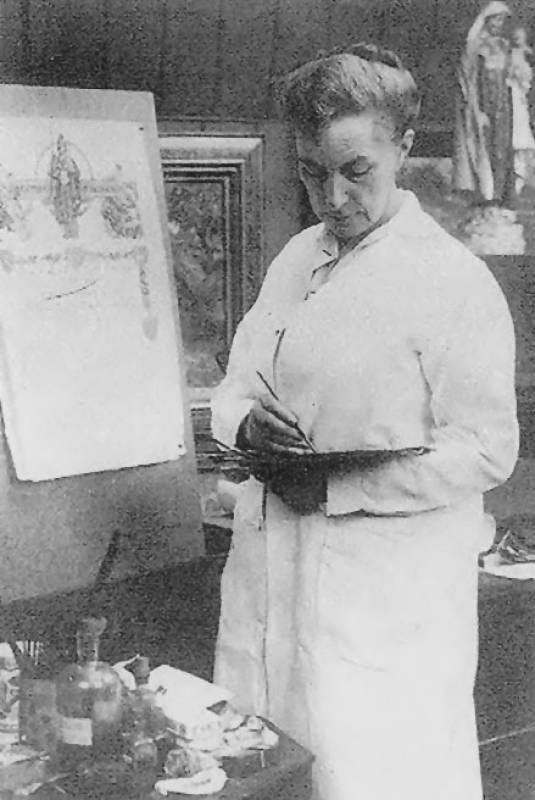
Eleanor Fortescue-Brickdale was born in 1872 in Upper Norwood, Surrey, the youngest of five children. Her father Matthew was a barrister at Lincoln’s Inn. He was also a fellow student of John Ruskin’s at Christ Church, Oxford, and a founding supporter of the Arundel Society – one of Ruskin’s projects to document and preserve the great works of European art through high-quality reproductions.
This matters, because Eleanor did not stumble upon the Pre-Raphaelite tradition by accident. She grew up inside it. Her brother Charles attended Ruskin’s lectures at Oxford and remained a keen amateur artist all his life. The household received illustrated periodicals, gallery-going was a regular family pursuit, and the conviction that art carries moral weight – that looking at beautiful things carefully is in of itself a form of education, that craft and vision are inseparable – was not something Eleanor would encounter for the first time at art school. It was simply the air in her father’s house.
Eleanor was educated at home by a governess, and at seventeen she enrolled at the Crystal Palace School of Art, near the family home. Her father died in a mountaineering accident in the Alps in 1894, when Eleanor was twenty-two. She then moved to the St John’s Wood School of Art, and later applied to the Royal Academy Schools.
It reportedly took her three attempts to gain admission to the Royal Academy Schools. Whether this was because of the quality of her early work or because of institutional reluctance to admit women is, I think, a question that answers itself.
At the Royal Academy Schools she came under the influence of John Byam Liston Shaw – himself a protégé of John Everett Millais, and deeply influenced by John William Waterhouse. There is an apostolic succession at work here, and it is worth tracing. Millais was a founding member of the Pre-Raphaelite Brotherhood in 1848. Millais taught Byam Shaw. Byam Shaw taught Fortescue-Brickdale. She carried the tradition on into the twentieth century, painting in the Pre-Raphaelite manner long after fashion had turned against it.
Byam Shaw was born the same year as Eleanor. They met at St John’s Wood and became close friends, and would remain so for the rest of their lives. They painted the same subject, the complexities and deceptions of love – simultaneously and in dialogue with each other. Byam’s Love’s Baubles appearing in 1897, Eleanor’s The Pale Complexion of True Love in 1899. Byam married in 1899; but Eleanor never did. Byam died in the influenza epidemic of 1919, aged forty-six and Eleanor went on teaching at the school he had founded, and painting, for another two decades.
And here is a thread that connects her to the artists Charlotte Mason’s homeschooling families study today: Waterhouse appears on the Ambleside Online picture study schedule. Waterhouse shaped Byam Shaw. Byam Shaw shaped Fortescue-Brickdale. She is, in a real sense, the next step in a tradition that Mason’s modern audience already knows – it’s just a step they have probably not yet taken.
Eleanor’s first painting exhibited at the Royal Academy, in 1899, was The Pale Complexion of True Love – its title borrowed from Shakespeare’s As You Like It. Two years later – the same year she painted The Deceitfulness of Riches – she held a solo exhibition of forty-five watercolours at the Dowdeswell Gallery in London. The reviews were extraordinary. The Artist commented that rarely had a woman painter made such a reputation so quickly and so thoroughly. In 1902, Eleanor became the first woman elected to the Royal Institute of Oil Painters, and she was also elected an Associate of the Royal Watercolour Society that same year.
Her work came to the attention of George Frederick Watts – the great Victorian painter, the man whose chapel and gallery stand in Compton, Surrey, and whose allegorical painting Hope remains one of the most reproduced images in British art. On seeing Eleanor’s work he said:
‘I feel inclined to throw away my palette and brushes. What are my things by the side of such stuff as hers?’
That is not polite praise from an artist who was widely considered to be Britain’s Michelangelo. That is a master recognising, in another painter’s work, something he was not sure he could match. Watts was in his eighties. She was in her early thirties. He had spent a lifetime painting moral allegories, and when he looked at her painting, he saw the tradition continuing in hands that were steadier than his own.
But as a woman, Elearnor could never become a Royal Academician. The door was open enough to let her in, but it was not open wide enought to allow her into the room.
And then, Eleanor’s illustration work is where the Charlotte Mason connection becomes impossible to ignore.
In 1909, Ernest Brown of the Leicester Galleries commissioned twenty-eight watercolour illustrations for Tennyson’s Idylls of the King, which Eleanor painted over two years. They were exhibited in 1911, and twenty-four were published in a deluxe edition by Hodder & Stoughton in 1912.
Charlotte Mason put Tennyson’s Idylls of the King on her reading lists, and her students read the same poems that Elearnor Fortescue-Brickdale was painting. The same stories, used for the same purpose – giving young people access to the Arthurian legends through great language and great art – by two women working simultaneously in the same tradition, drawing from the same well, apparently unaware of each other.
She also illustrated Robert Browning’s poems – thirty-two watercolours exhibited at the Dowdeswell Gallery in 1909. Charlotte Mason recommended Browning too.
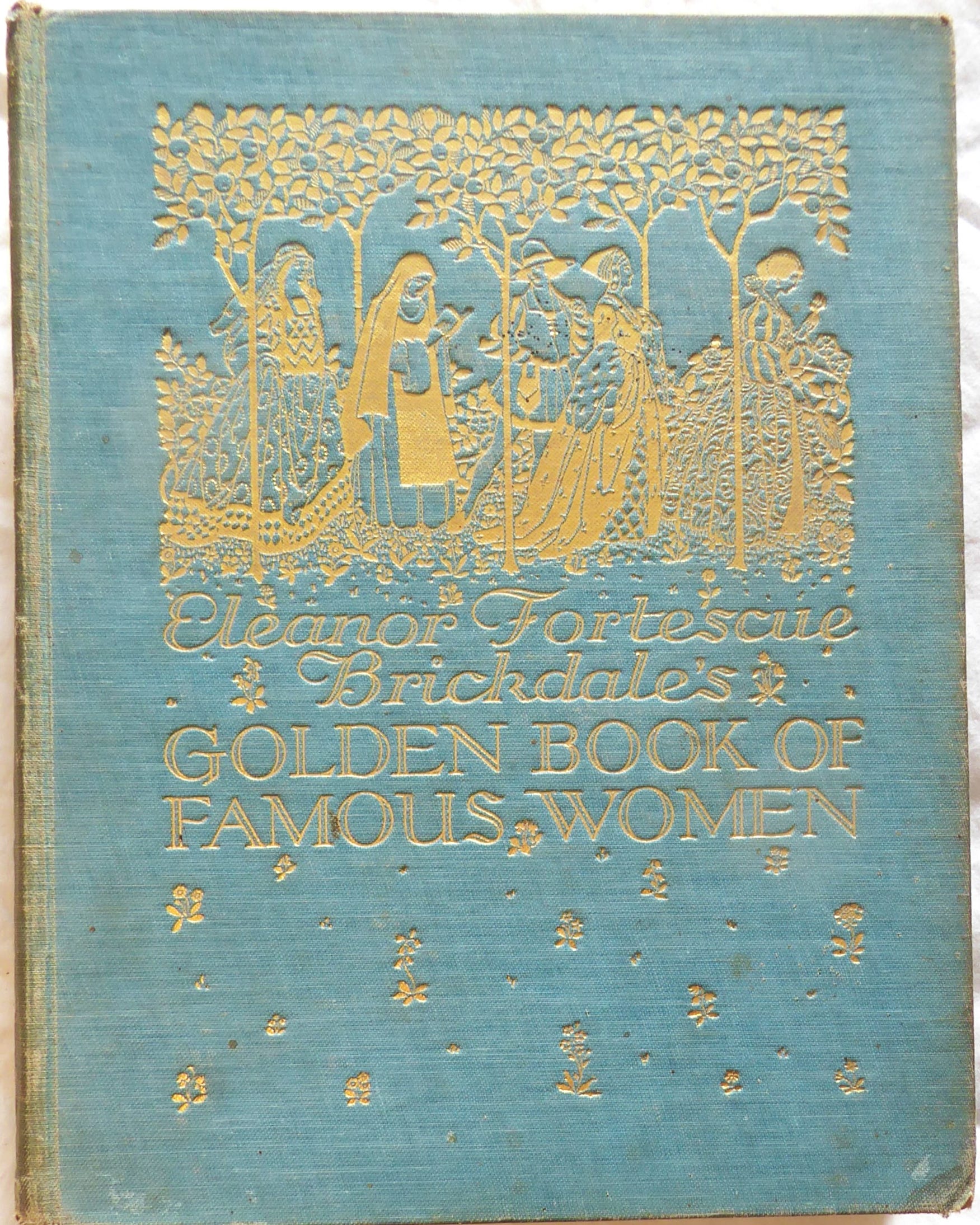
In 1919, Hodder & Stoughton published Eleanor Fortescue Brickdale’s Golden Book of Famous Women. Not ‘illustrated by’ – the book carries her name in the title because it was hers. She selected every passage, and chose which women should be included. She decided which moments from literature best captured each one, and then she painted fifteen of those moments.
The book contains excerpts from fifty-two works of fiction and poetry featuring women from history and legend. The authors she drew from include Shakespeare, Dante, Byron, Coleridge, Tennyson, Wordsworth, Thackeray, George Eliot, Hawthorne, Poe, and Jane Austen. The women include Cleopatra and Guinevere, Joan of Arc and Becky Sharp, Beatrice and Hester Prynne, Catherine of Siena and Maggie Tulliver.
Real women and fictional women, side by side, treated as equally alive, equally worthy of attention. Not a history book. Not a fiction anthology. A single artist’s personal gallery of the women she considered worth looking at, drawn from the full span of Western literature.
The binding was in the same style, from the same publisher, as the deluxe gift books of Arthur Rackham, Kay Nielsen, and Edmund Dulac. Elearnor stood alongside the greatest illustrators of the Golden Age. But where Rackham illustrated fairy tales and Dulac illustrated The Arabian Nights, Fortescue-Brickdale curated a canon of women from literature and history – and illustrated it with paintings that took the reader as seriously as the text did.
Charlotte Mason would have called this a living book. Not because it was beautiful or well-made – though it was both – but because it was the work of a single mind with genuine passion. One woman, choosing real literature for real readers, trusting them to receive it. That is Mason’s definition. And Fortescue-Brickdale met it without ever having heard of Charlotte Mason.
And then there is her stained glass window work.
Eleanor designed windows for more than twenty churches, the glass itself fabricated by her associate Harry Grylls and later by James Powell & Sons. Many were First World War memorials. Her 1921 window commemorating the King’s Own Yorkshire Light Infantry stands in York Minster. Others survive in Bristol Cathedral, in churches across Buckinghamshire and Somerset, in Brixham.
Thanks for reading Care & Craft! Subscribe for free to receive new posts and support my work.
She designed stained glass in the same tradition that my great-great-grandfather Robert worked in when he made windows for William Morris. Different workshops and decades, but the same inheritance. The conviction, passed down from Ruskin through Morris through the Arts and Crafts movement, that a church window is not decoration but devotion, and that the craft of making it is in itself a form of worship, and to quote Tolkien, ‘a form of sub-creation’.
Elearnor was a devout Christian, and donated works to churches. Her subject matter was soaked in Christian allegory and moral narrative – not as performance or signalling, but simply as a conviction of faith.
During the First World War years, she designed government recruitment posters. Afterwards, she turned to memorial windows – glass for the dead, made by a woman who had spent the same years painting famous women from literature. The memorials to the fallen men and the celebration of the enduring women. Both made by the same hands.
Three years after painting The Deceitfulness of Riches, Fortescue-Brickdale returned to the same territory with an even more ambitious work.
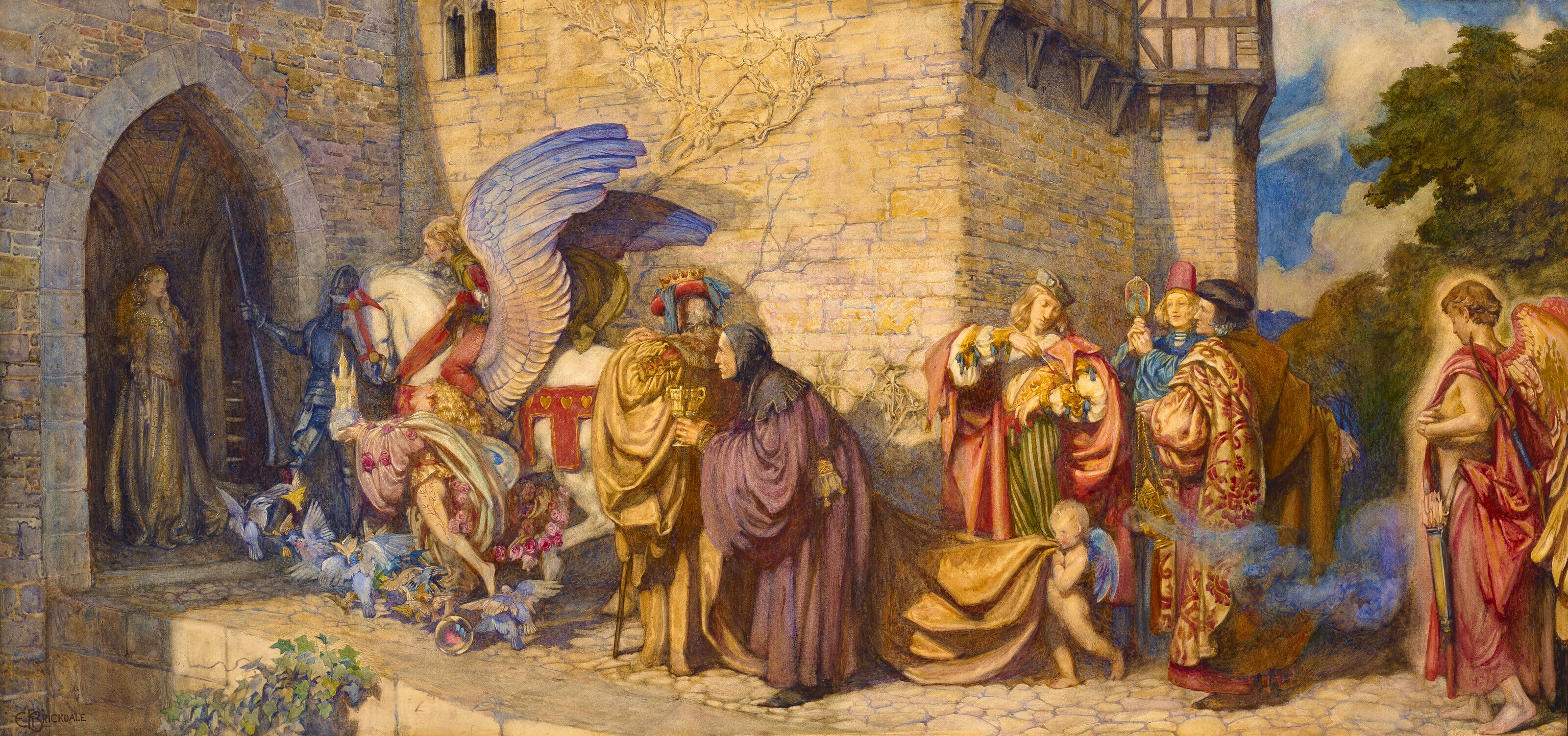
Love and his Counterfeits is a large watercolour, painted in 1904 and exhibited at the Royal Academy in 1905. On the reverse, she wrote a detailed programme note – a complete narrative key to every figure in the painting. A girl’s soul awakens at the left of the composition and opens the door of her Heart’s Castle to receive love. But she does not recognise him. First she sees Fear, in black armour with no coat of arms. Then Romance, a boy on a bubble with a castle of dreams in his hand. Then Ambition, riding Pegasus. Then Position, with his train of Appearance, Prestige, and Riches carried by a Cupid. Then Pity, with a cup of tears. Then Flattery, with a mirror. And finally, at the far right, almost at the edge of the painting, True Love arrives – empty-handed, to take and win her Heart’s Castle.
The counterfeits are louder. More elaborately dressed. Easier to mistake for the real thing. True Love stands at the margin, quiet, easy to miss if you are not paying attention.
She was thirty-two when she painted it and unmarried, and Eleanor would remain so for the rest of her life. Her closest friendship was with Byam Shaw, who had married five years earlier. No letters, no diary entries, no recorded commentary from Fortescue-Brickdale about her romantic life – or its absence – appear to have survived. What survived instead is the work itself, and it speaks for itself.
And the painting is a picture study waiting to happen.
Show it to a child, then take it away and ask them what they saw. The knight in armour. The winged horse. The figure with the mirror. The child would discover the allegory through looking – through attending, noticing, receiving – exactly as Charlotte Mason intended.
Charlotte Mason’s picture study method descended from Ruskin through Julia Firth, his friend and pupil in Ambleside, who showed Charlotte’s trainee teachers how to look at paintings not for their technique but because they had something true to say. Eleanor’s vocation descended from Ruskin through her father, who had studied alongside him at Oxford and supported his life’s work. Two channels from the same source, flowing into the same conviction: that looking carefully at beautiful things is a moral act, and that the capacity to see truth in beauty is not a privilege but a birthright.
In all likelihood, Eleanor and Charlotte never met. There is no record of Charlotte mentioning Eleanor, no evidence that the PNEU programmes ever included her in their picture study schedules. But they were breathing the same air, drawing from the same well, and arriving at the same conclusions independently. Charlotte taught children to look at paintings as carriers of ideas. Eleanor painted paintings designed to carry ideas. Charlotte put Tennyson and Browning on her reading lists. Eleanor illustrated Tennyson and Browning.
Two women who never knew each other, doing the same work, because the same man had taught both their traditions that art is not a luxury but a necessity.
Unfortunately, in her later years, Eleanor’s eyesight failed, and she suffered a stroke in 1938 that ended her painting career entirely. She spent her final years unable to do the one thing she loved, and had done since she was seventeen.
Eleanor Fortescue-Brickdale died in Fulham Hospital in 1945, aged seventy-three. She was buried at Brompton Cemetery, and her obituary in The Times called her ‘the last survivor’ of the Pre-Raphaelites.
And then she was forgotten.
Not slowly, not gradually – almost immediately. The art world moved on. Fashions changed, the critics turned their attention elsewhere, and the narrative painters, the illustrators, the women who painted Tennyson and Browning and allegories about the things that deceive us, were left behind. Her work fell from public consciousness. The paintings were still there, in galleries, in churches, in private hands, but nobody was really looking at them anymore.
The first monograph on her work was not published until 2012. Pamela Gerrish Nunn’s A Pre-Raphaelite Journey, accompanying an exhibition at the Lady Lever Art Gallery in Port Sunlight, which later travelled to the Watts Gallery in Compton.
I want to return to the painting I began with, The Deceitfulness of Riches.
That orange dress, blazing out of the canvas. The roses and the music and the sleeping woman. The thief at the edge, stealing away while everyone watches and nobody says a word.
Eleanor Fortescue-Brickdale painted a warning disguised as a gift. The painting seduces you before it tells you the truth. That is not a flaw, it is the point. The deceit is in how good it looks. You have to see past the surface to find what the painting is actually saying – and the only way to do that is to look carefully, to attend, to stay with it long enough for the beauty to stop being the whole story.
That is what Ruskin taught. That is what Charlotte Mason built her schools around. That is what Eleanor Fortescue-Brickdale painted, over and over, for forty years, until her hand could not hold a brush. And it is what we still need to hear, perhaps now more than ever.
The counterfeits are always louder, always more elaborately dressed and nearly always far more seductive, whilst the real thing, that which has value, is far too often pushed to the edges or out of sight entirely.
But here is the thing about hope, truth and beauty. It waits. It does not decay with time, it does not demand attention or dress itself up or shout from the centre of the room. It simply goes on being hopeful, true and beautiful – quietly, at the edges – until someone finally notices and once again pulls it into the light.
And slowly, unmistakably, after decades in which the brutal and the ugly were championed as the only honest response to the world, people are looking for hope, beauty, and truth again. You can see it in the queues at the Pre-Raphaelite exhibitions, in the parents choosing real books over screens, in the homeschooling families who pin watercolours to their walls and ask their children to look, really look, at what is there. The appetite for something that lifts rather than dismantles, that gives hope rather than despair was never extinguished, and it never will be.
Thanks for reading Care & Craft! Subscribe for free to receive new posts and support my work.
Hi Jess. Thanks for restacking. All the best from Sussex, UK.
Hi Kay. Thanks for restacking. Best wishes Vincent