

Charlotte Mason’s England – The Romance of King Arthur
How the Victorians brought the legend to life

In my very first Substack essay, Stained Glass and tears, which you can read here, I wrote about how my love for all things King Arthur began, as it did with so many English boyhoods, in front of the television. The film was Disney’s The Sword in the Stone, I was about seven, and it ignited something in me that has never gone out.
Around the same time – it would have been 1970 – my best friend was taken on holiday to California, to Disneyland, and I was sick with envy. I had watched Disney Time countless times on the tv and I wanted to live in that wonderful Sleeping Beauty castle. To me it was the most magical building in the world, and between the Sword in the Stone film and the castle in California, the seeds of a lifelong love were quietly sown.
The Sleeping Beauty Castle, that Walt Disney built drew much of its inspiration from Neuschwanstein castle in Bavaria. Neuschwanstein was itself a dream made solid, begun in 1869 by King Ludwig II, the Fairy-Tale King. He was a Romantic in the truest sense of the word: a man who cared far more for myth and music than for governing, a man who shut the real world out almost entirely, and kept his deepest devotion for the composer Richard Wagner. His castle was not designed by an architect, but by Christian Jank, a painter and set designer, primarily for Wagner’s operas – which makes Neuschwanstein, quite literally, an opera set built in stone, and nearly every room in the place is given over to legend.
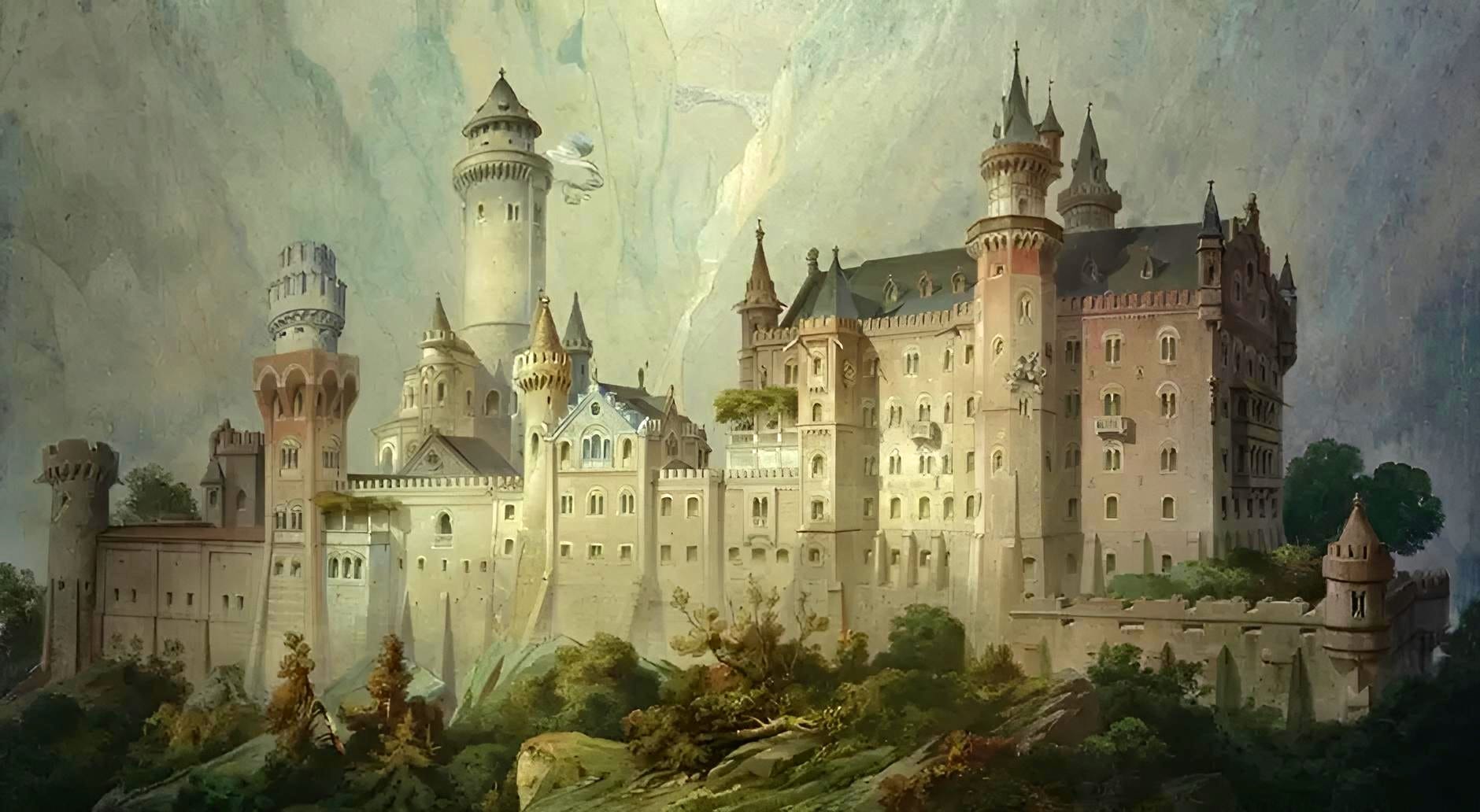
The throne room was conceived as the hall of the Holy Grail; the great singers’ hall was painted with the story of Parsifal, the Grail king. His son Lohengrin, is the Swan Knight, from whom the lonely King Ludwig took his own emblem. He died in 1886 in mysterious circumstances and with Neuschwanstein unfinished. King Ludwig was a recluse who had built a medieval myth into the Bavarian hillside and for an audience of just one – himself. And my whole childhood enchantment was an echo of his fantasy castle.
King Ludwig II and Neuschwanstein castle was the loneliest and strangest expression of a longing that was moving not only through one man, but through the whole of the nineteenth century: the wish to turn away from the smoke and iron of the modern industrial age and back towards a medieval dream of knights and quests.
But where the Bavarian king shut himself away and built for no one but himself, in Britain the same longing turned outward. Here it was not one recluse and his private stage set, but a whole company of poets and painters who, in the space of fifty years, took a legend that had been nearly forgotten and created a body of work, that went from art and architecture to poetry and story. That legend was of course, King Arthur, and this essay is the story of how the Victorians brought him to life.
Where does an obsession that grabs the imagination of so many people come from? Not with any single book, time or event, but with a hunger.
For half a century before Queen Victoria came to the throne, the English imagination had already been turning quietly back towards the Middle Ages: in the old ballads the antiquarians were rescuing, in the Gothic tales that thrilled the drawing rooms, in Sir Walter Scott’s romances of chivalry. It was, at heart, a reaching for enchantment in an age that was beginning to feel disenchanted – a turning-away from industry, reason and machinery and towards something older and less corrupted – but not the harsh reality of the middle ages – the romantic ideal of it, primarily from Sir Thomas Malory’s epic romance Le Morte d’Arthur.
Le Morte d’Arthur was printed by Caxton in 1485, and by the beginning of the nineteenth century, it had nearly been forgotten. Yet it was ‘the’ great treasure-house of the whole Arthurian legend – the book that first drew the scattered medieval tales of Arthur and his knights into a single English prose epic, from the drawing of the sword and the founding of the Round Table to the last battle that brings Camelot down. However, between 1634 and 1816, not a single new edition appeared. Then, in 1816, two rival editions were published and a third the year after by the poet Robert Southey. In my view, those three books ignited a creative fire that would burn fiercely across the 19th century, and right up to World War II. Arguably, the fire burned first and most fiercely in a young Alfred Tennyson, who first met King Arthur in one of those reprinted editions.
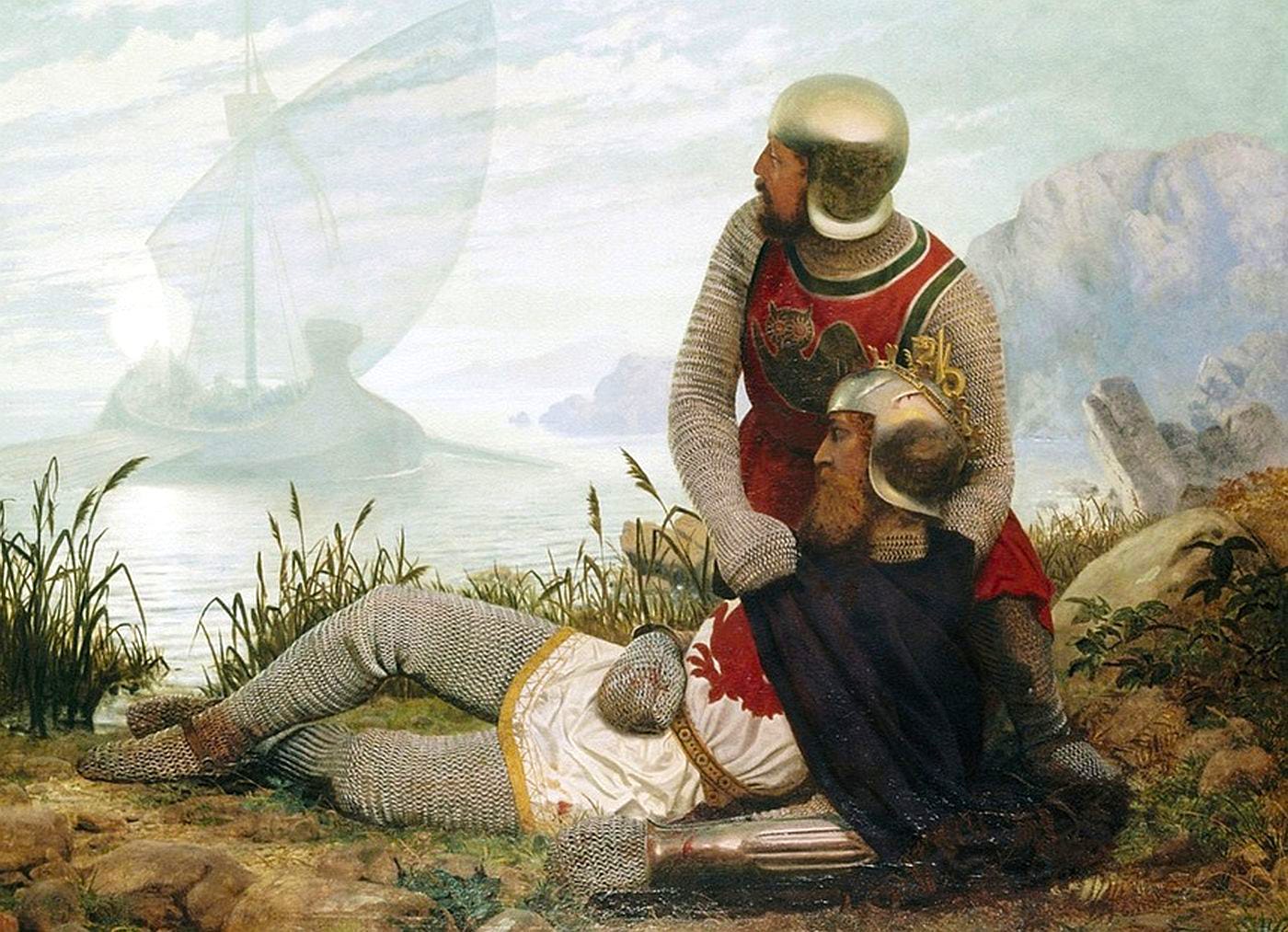
And Tennyson, that fire became a blaze. Scott had given the Victorians their love of the Middle Ages, but it was Tennyson who gave them their love for Arthurian myth. In 1842, Tennyson took the closing pages of Malory’s Le Morte d’Arthur – the mortally wounded Arthur borne from the field, Sir Bedivere hurling Excalibur back into the lake and finally the three Queens and the barge taking the dead Arthur to Avalon – and reworked that medieval prose into a short poem of his own, borrowing Malory’s title, and trimming it to ‘Morte d’Arthur’. It was a first proof that Tennyson could take an old tale, and tell it again in a new voice.
Then, from 1859, came Tennyson’s greatest work – the Idylls of the King, the long cycle of poems that turned King Arthur into a myth that defined the age. The Idylls were a sensation, and after their publication, Arthurian myth was everywhere. All the creators downstream from Tennyson, drew from him before they drew from Malory. When a painter wanted a scene, a weaver a subject, a photographer a face, they went to Tennyson’s Idylls first.
In my view, the Victorian obsession with King Arthur and the romance of chivalry took hold for the reason the deepest enthusiasms often take hold: the Victorians saw themselves in the tales, or rather, they saw the men they longed to be – dutiful, honourable, chivalrous, devout, and at the very moment the industrial world seemed to be losing all those values. The King Arthur legend was not only a story they loved, it was a crystallization of the chivalric ideal that they aimed for.
But before the Victorian love for King Arthur really took off, it had already been carried into the very heart of British Government – and by a man not many remember.
In 1847, whilst Arthur was still obscure and unfashionable, the Scottish painter William Dyce was asked to decorate the Queen’s Robing Room in the newly built Palace of Westminster. Of all the subjects available to him, he chose Arthur. It was a strange, brave choice, a full decade before the fashion for King Arthur caught up, and it gave Dyce nothing but trouble. He set out to embody the seven chivalric virtues, each drawn from a scene in the legend – and found, to his evident discomfort, that the story he had pivotal turns on a queen’s adultery and the fall of a kingdom. He wrestled with it for years, and completed only five: Mercy, Hospitality, Generosity, Religion and Courtesy. Dyce died in 1864 with the work still unfinished; the last two he had planned, Courage and Fidelity, were never painted at all.
There is something moving in that. In the room where the monarch robes before opening Parliament, a new King Arthur legend was created by a man who did not quite live to finish it, but none the less, the Arthurian legend was being quietly written into the fabric of British government whilst the rest of the nation had hardly noticed.
Meanwhile, a new generation was being bitten by the same bug. In 1855, an Oxford undergraduate named Edward Burne-Jones found a copy of Southey’s Malory in a bookshop – he could not afford it, so his friend William Morris bought it instead, and the two of them read it aloud to each other until they had virtually learned it by heart. Their love of King Arthur soon demanded they find their own creative outlet, which they did in 1857.
That summer, a loose band of seven young men descended on the Oxford Union and set about painting its new debating hall with scenes from Malory. Rossetti led them; Morris and Burne-Jones were among them, and so was Val Prinsep. They were high-spirited and largely untrained, and they made a glorious hash of the technique – painting straight onto barely prepared plaster, so that the colours began to fade almost before the scaffolding came down. You can still see the murals today, but only faintly. It was here, during the work, that a young woman named Jane Burden was noticed in an Oxford theatre and asked to model. She became the face of Queen Guinevere, and then she became William Morris’s wife.
The same year, Edward Moxon, a poet and pblisher, brought out a lavishly illustrated edition of Tennyson’s Poems, illustrated by Rossetti and Millais, as well as many others. Among the edition’s finest plates are Hunt’s Lady of Shalott and Rossetti’s Sir Galahad, Of note is that Edwared Burne-Jones did not contribute work, yet he would go on to spend the rest of his life inside Camelot and painting Arthurian myth.
Among that Oxford company, a little older than the rest, was George Frederic Watts – and his contribution has a quiet significance.
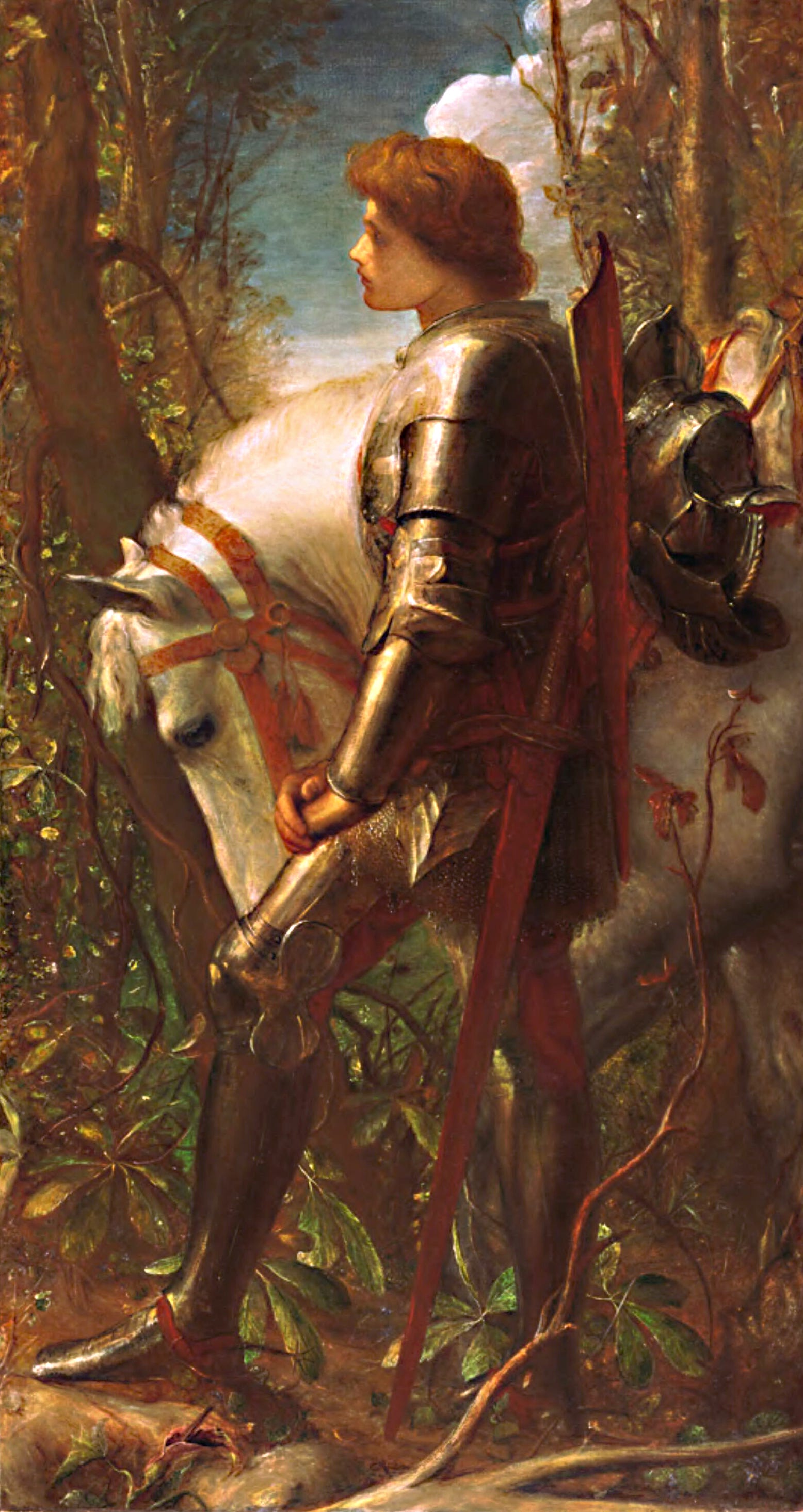
In 1862 Watts painted Sir Galahad: a young knight standing bareheaded beside a white horse, caught in the hush of his vision of the Grail. He modelled the knight’s features on a boy named Arthur Prinsep, a member of the household at Little Holland House where Watts lived, as artist in residence for nearly thirty years. And here is the part that matters. Watts later gave a version of the painting to Eton College, to hang in the ante-chapel, and he gave it so that boy after boy, year after year, might stand before the knight and be inspired.
A picture handed to children, so that children might be formed by seeing it. Hold that thought as we will come back to it.
A few miles across the water, on the Isle of Wight, another creator was giving King Arthur life via photography.
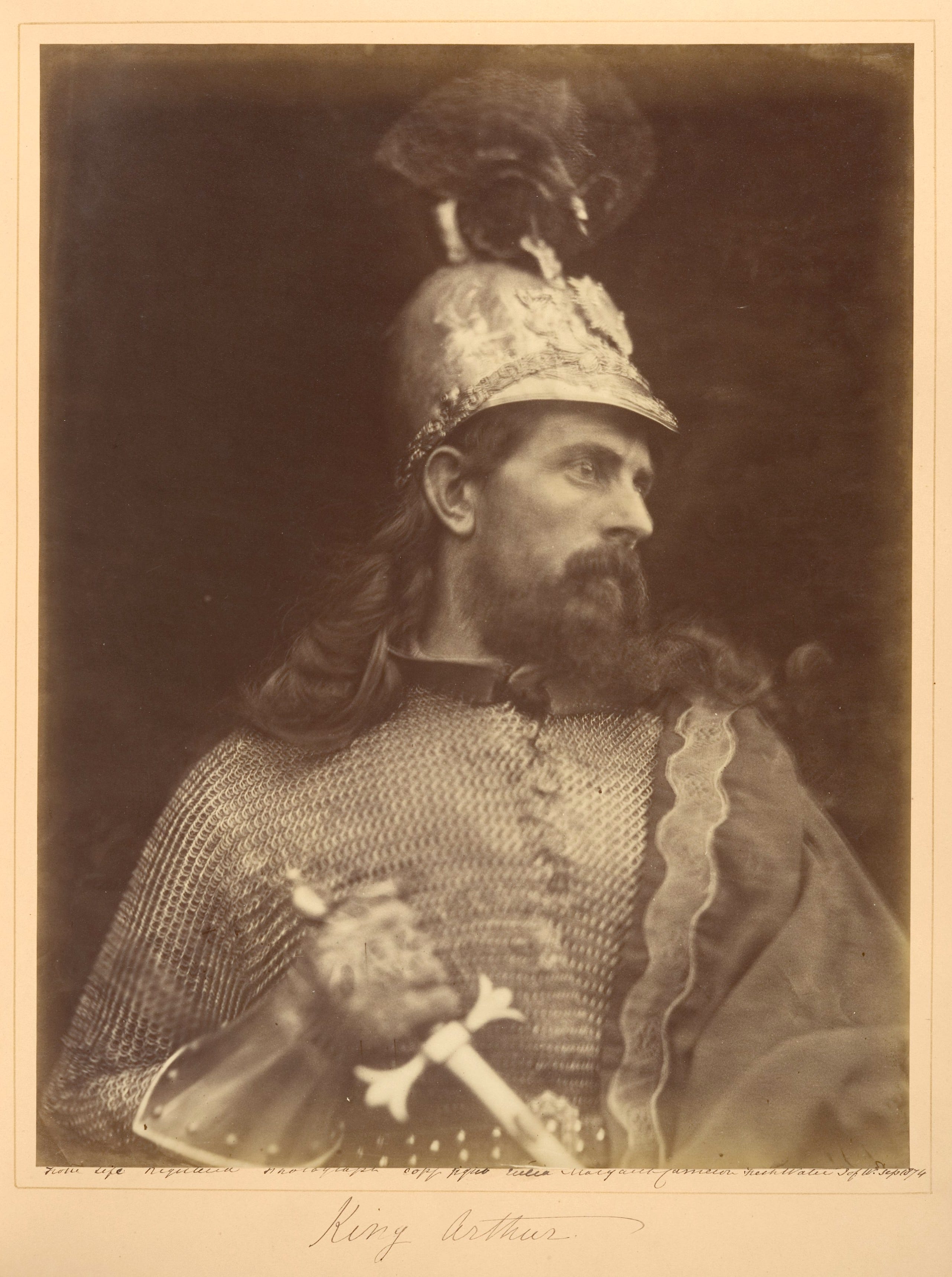
Julia Margaret Cameron came to photography late and sideways. She was forty-eight when her daughter gave her a camera in 1863, and she taught herself in a coal-shed turned darkroom, ruining plate after plate in pursuit of a vision most of her contemporaries thought was simply bad technique. She lived at Freshwater, with Tennyson for a neighbour, and in 1874 he asked her to make photographs for a popular edition of the Idylls. Her reply tells you everything about her: it would be, she said, immortality to be bound up with him. She threw herself at it, making some two hundred and forty-five exposures to arrive at the handful she wanted, dressing her housemaids and neighbours as Elaine, Guinevere and Lancelot until the Arthur legend was standing alive in her garden.
However, in the actual Tennyson edition, only three of her images were used – and those shrunk down and translated into woodcuts, diminished into exactly the mechanical thing everyone assumed a photograph was. So Margaret Cameron did something extraordinary. At her own expense and risk, she published two great volumes of her photographic prints set beside Tennyson’s verse and copied out in her own hand, determined to prove that photography could stand as high art beside any painter’s. The soft focus, the smudges, the long trembling exposures – these were never failures of craft. They were a woman reaching after the ideal and refusing to sacrifice the poetry of it for mere sharpness. Margaret Camera brought King Arthur to life with photography.
But it did not stop with poetry, painting and photography, the legend carried over into architecture.
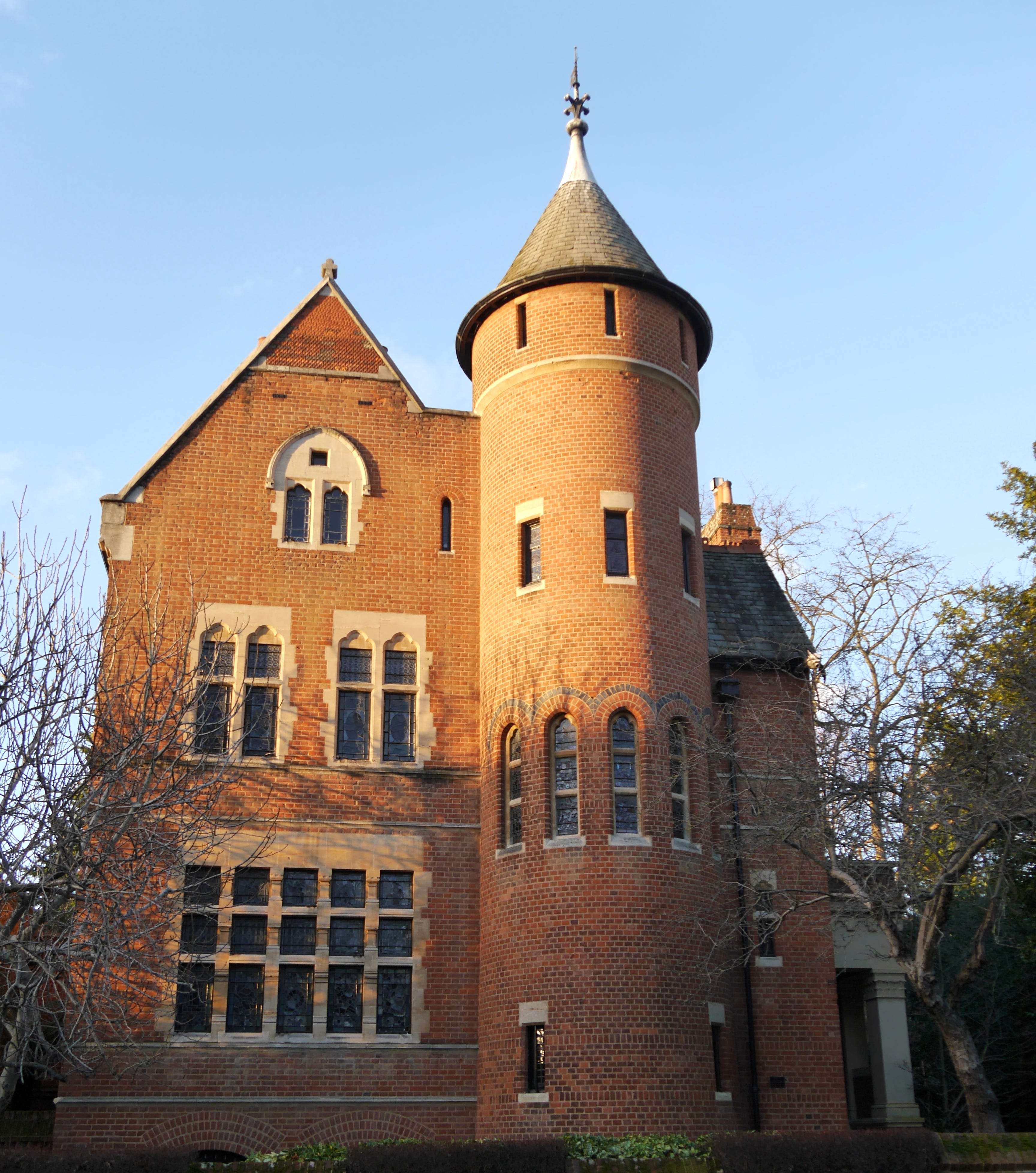
Enter architect and designer William Burges. In 1865 he met the third Marquess of Bute – reputedly the richest man in Britain, and as helpless a medievalist and romantic as Burges himself. Together they conjured whole worlds out of stone. Cardiff Castle and Castell Coch, along with Burges’s own Tower House on Melbury Road, in among the artists’ houses of Holland Park where the homes of Lord Leighton, Watts and countless others lived. Burges’s biographer called the great rooms passports to fairy kingdoms, and that is exactly right. These were not just paintings of Camelot; they were the romantic medieval dream-world made real. Burges gave the 19th century somewhere for the romance of Arthur to inhabit, and nearly a hundred years before Disney did.
And Morris’s own workshops wove the legend into cloth. In the 1890s, for a dining room at Stanmore Hall, Morris and Company made six great tapestries telling the Quest of the Holy Grail – Burne-Jones designing the figures, Morris the heraldry, the whole thing culminating in Galahad’s attainment of the Grail amid a company of angels. It is amongst the last and greatest of things either man made.
The knights and romance went into glass, too. Burne-Jones set them into stained-glass windows made in the Morris workshops.
And then, in 1892 a publisher named Dent gave a young, consumptive, insurance-clerk a commission to illustrate Malory. His name was Aubrey Beardsley, and he began, by dutifully imitating Burne-Jones – so closely that Morris accused him of theft. But Beardsley quickly broke into something entirely his own: sinuous, black-and-white, faintly wicked, medievalism seen through a strange new decadent glass. And Dent’s edition, unlike Morris’s beloved hand-made books, was printed cheaply and sold to the many. In forty short years the golden Avalon of the Pre-Raphaelites had become stranger than it ever had been before.
So there he stood, at the century’s close: a mythical king who had begun the century half-forgotten, and who was now, thanks to fifty years of craftsmanship, more vividly visible than at any time since Malory wrote Le Morte d’Arthur. Arthur was alive in verse and fresco and photograph, in real castles and tapestry and glass.
And here is the curious thing the age then said about him. By the 1890s, the fashionable verdict was that the whole Arthurian business had become too quaint – a cliché and a subject, people said, more fit for a child than for a grown man. The world, as ever, was too sure of itself and it was already turning toward the hard clean lines of the century to come, and it no longer wanted knights and legends.
But British painters, writers and artisans had already given England some of their most beautiful work, and the Arthurian genie could not be put back in the bottle. King Arthur had a face now – a hundred faces – and those faces simply went into the nursery. Into the schoolroom and onto the chapel wall.
Remember Watts’s Sir Galahad, given to a school so that children might be formed by looking at him. That was not a stray act of sentiment. It was the whole instinct of the age, distilled: the conviction that a child set before a truly beautiful thing, and taught to look at it properly, is being given something that will hold them for life.
It is exactly the conviction that Charlotte Mason built into her method of picture study – a child placed, unhurried, before a single great picture, and taught to see. She did not invent that idea out of nothing. She was the direct inheritor of a century of writers and craftsmen who had already decided that beauty was a birthright, and who had spent fifty years bringing to life a British myth worthy of a child’s attention.