Charlotte Mason's England - William Blake
From a Sussex village to Jerusalem, and the teacher who kept his cottage standing

I have begun several of these essays by talking about connections – the unlikely, unplanned convergences that reveal themselves only when you look back across enough time. James Burke made a television career out of tracing them in his Connections series in the late seventies. Well, this essay is another one about connections.
My parents moved to Bognor Regis in 1969. In 1974, I started attending Felpham Comprehensive School, a brand new school, and I was in the first year through the place.
At eleven I did not really have any academic interests, other than reading and art. My first love was the television show Doctor Who. Tom Baker was my Doctor. I never had the hat, but I wanted one, and I did have the ridiculously long scarf that my grandmother had knitted me, which I wore to school with the devotion of a true believer. I had even converted my bedroom wardrobe into a blue police box. I was fascinated by the TARDIS, Time And Relative Dimensions In Space, and what fascinated me most was not the travelling through space but the travelling through time. The idea that you could step into something ordinary and come out somewhere extraordinary. That you could go back and see what people and places were really like.
That is most likely where my love for history comes from. It is also, as it turns out, not a bad description of what happens when you walk into a thatched cottage on a village lane in Sussex and discover what was written there.
But I didn’t know that yet. I was eleven.
I found most of school a massive yawn, even English. I remember trying to get through Graham Greene’s The Quiet American and E.M. Forster’s Where Angels Fear to Tread with my English teacher, and struggling badly with both. However, despite not being in her class, I soon discovered another English teacher when I became involved in the school drama club. Her name was – and still is, at the time of writing, as she is still alive – Beryl Kingston. She started out as an English teacher, but went on to become a bestselling author and has published nearly thirty novels.
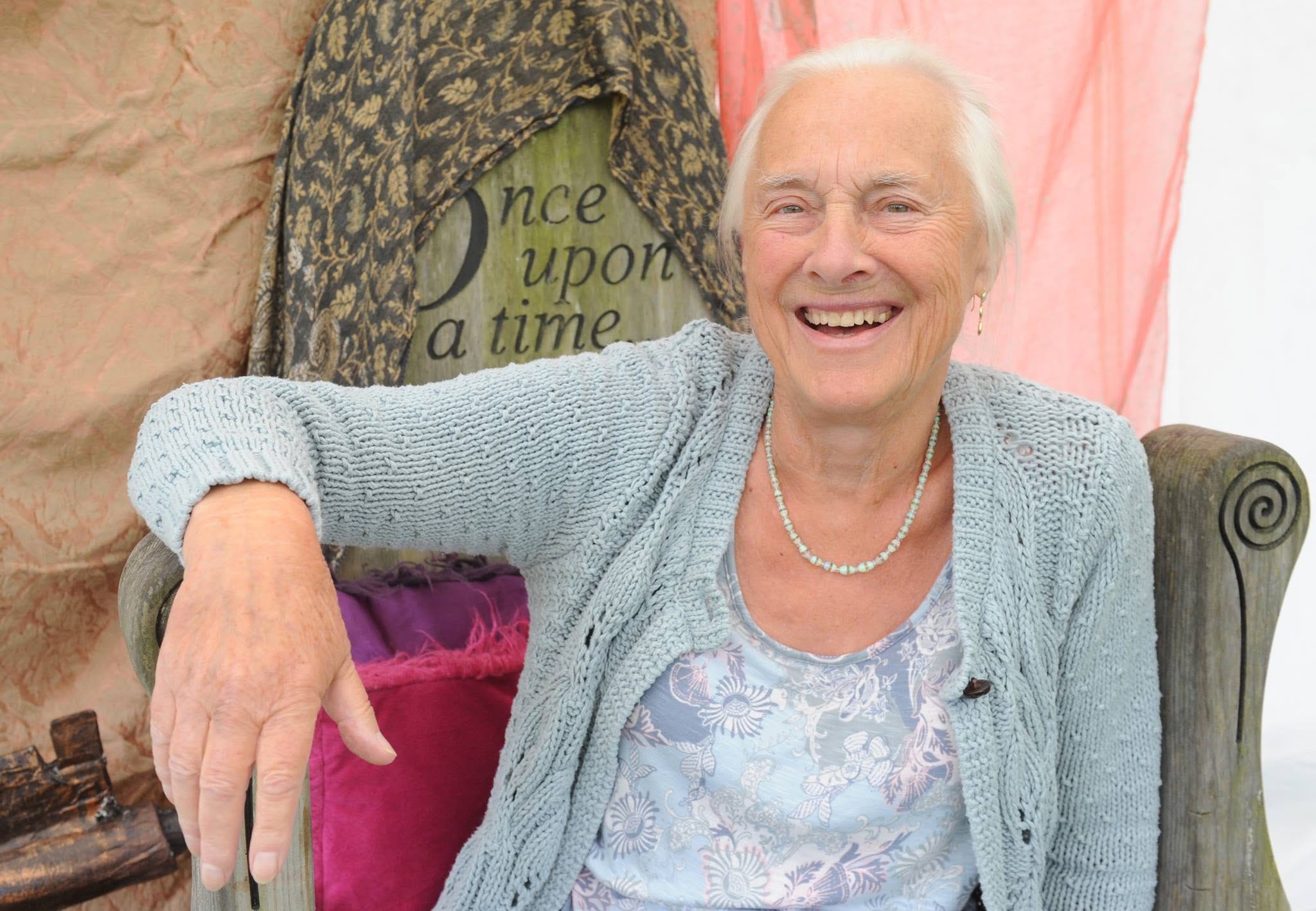
Beryl Kingston had arrived in Felpham herself, thirty-five years before I did, under rather different circumstances. She was eight years old in 1939, evacuated from London to Felpham at the outbreak of the Second World War. She would later go on to read English at King’s College London, and it was there that she discovered William Blake and realised that she had been living in his village during the war. By the time I met her, she was teaching English at Felpham Comprehensive School. As soon as I met ‘Mrs Kingston’, I learned that William Blake was her hero.
Beryl Kingston not only taught English, she was also a massive fan of the theatre, which is how I met her, when I became part of her after-school drama club. She wrote, directed and cast the productions herself. I was in several of her plays, including an adaptation of Chaucer’s Wife of Bath – although I cannot for the life of me remember which part I played. What I remember is the thrill of acting in front of an audience. The sense that words and stories could come to life.
That was Beryl Kingston’s gift. She didn’t teach literature as something to be studied. She taught it as something alive and as something you could inhabit.
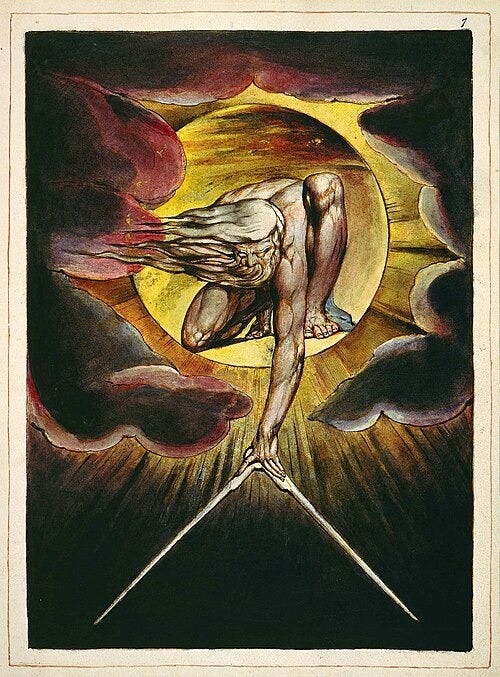
And William Blake was her first true love, the man was ever present from classroom to conversation. Although it’s over fifty years ago now and the memory is vague, she knew I really liked art and could draw, and I’m sure my first encounter with Blake was when she showed me a print of Blake’s Ancient of Days.
My very first ‘adult’ encounter with poetry was also one of Blake’s, via ‘Mrs Kingston’, and the poem was The Tyger. I can remember the first verse of the poem to this day, which was more than Graham Greene’s Quiet American ever managed.
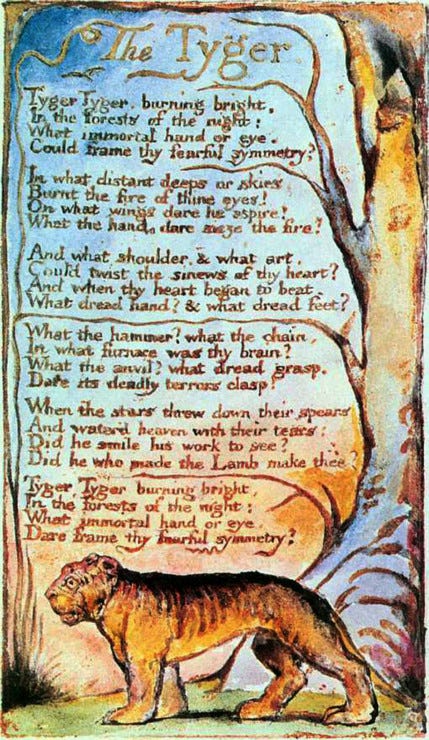
But the thing that really came through about William Blake was the fact that he claimed he saw fairies in his back garden at Felpham. Also, my eleven-year-old self would swear blind that William Blake, at a dinner party, said to a woman next to him: ‘Madam, I have been looking for a person who disliked gravy all my life; let us swear eternal friendship.’ Yet the only attribution I can find for the quote is Sydney Smith, an English clergyman born in 1771.
In any event, William Blake got through to a dreamy eleven-year-old boy who found most of school a massive yawn, and it did not come from a textbook. It came from a wonderful English teacher who adored his work.
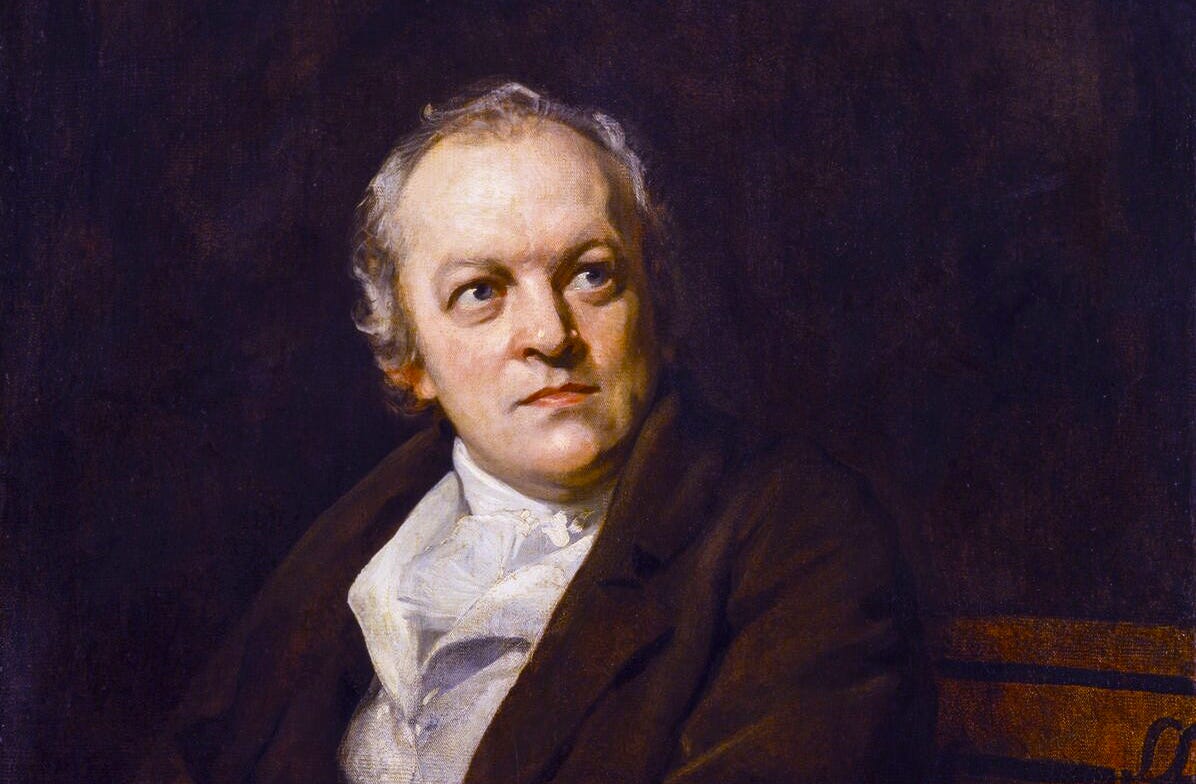
William Blake arrived in Felpham in September 1800 with his wife Catherine and very little else. He was forty-two, depressed, ground down by years of commercial engraving in London, and had been invited to the Sussex coast by the poet William Hayley. Hayley had commissions for him – engravings for his books, portraits for his library, illustrations for his ballads. It was bread-and-butter work, and Blake needed bread and butter. But it was another man’s vision, not his own, and the friction between the two would eventually help drive Blake back to London.
In the meantime, though, Felpham did more than lift Blake’s spirits. It set him on fire.
The cottage was small and thatched, and had been built for agricultural labourers. Blake thought the place was beautiful, and he and Catherine rented it and set to work – not just writing, but making. Blake was a poet, a painter, an engraver, and a printer. He did not just write poems and send them to a publisher; he carved them in reverse into copper plates, letter by letter. He and Catherine inked the plates, pressed them, and then hand-coloured every page – in watercolour.
This matters, because we have spent a century crediting William Morris with the idea that art and craft are not separate things. Morris was right, and he deserves the credit, but William Blake was doing it a hundred years before William Morris was born.
Blake and his wife stayed in Felpham for three years. He wrote much of Milton: A Poem in Two Books. He quarrelled with Hayley, and he had visions on the shore – angels in the trees, the whole of human history unfolding above the sea. And then, in August 1803, a soldier called John Scofield wandered into his garden and Blake, by Scofield’s account, cursed the King. William Blake was arrested and charged with sedition.
He was tried at Chichester, in the Guildhall, in January 1804, but was acquitted. He and Catherine went back to London, and he never returned to the little Sussex village of Felpham. But he never forgot it either. His Felpham years remained, by his own account, the most creatively charged time of his life.
And somewhere during those three years, in that cottage, he wrote a short preface to the Milton poem. It begins: And did those feet in ancient time / Walk upon England’s mountains green?
It would not become the hymn ‘Jerusalem’ for another century – not until Hubert Parry set it to music in 1916, so Blake never heard it sung. He wrote it by hand, carved it into copper, printed it on his own press, and Catherine coloured it. It is the most recognisable poem in the English language, and it was handmade in a village I grew up in, eight miles from a city that would train a teacher who would go on to shape the education of millions of children – Charlotte Mason.
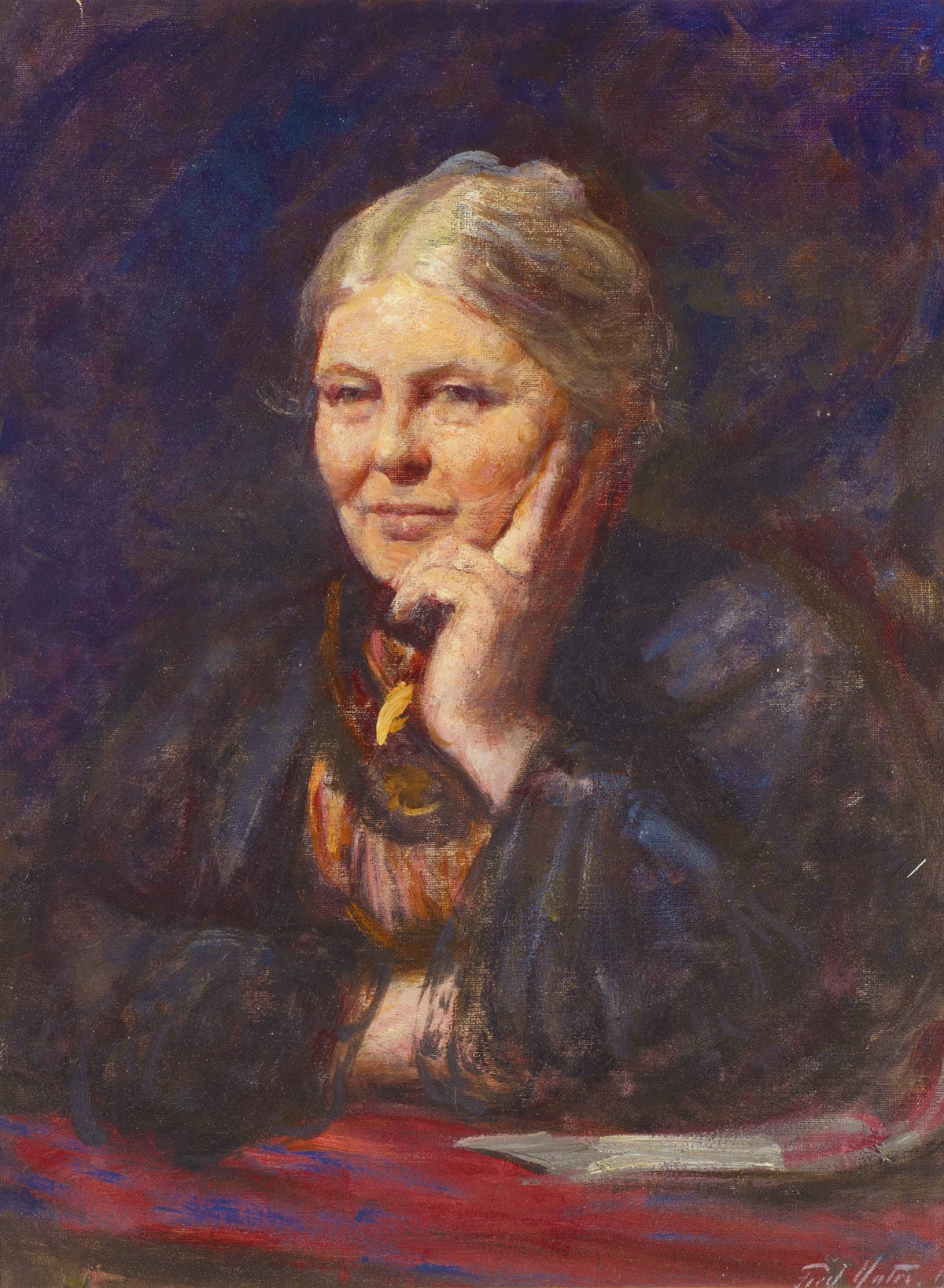
Charlotte Mason taught at the Bishop Otter College in Chichester. The same Chichester where Blake stood trial. The same small cathedral city, eight miles north-west of Felpham, where a poet had been hauled before a magistrate for saying what he thought, and a young woman would later develop a philosophy of education built on the conviction that children deserve the best that has ever been written and made.
Charlotte Mason was specific about Blake. In her writings on what children should encounter in poetry, she did not merely include him on a list. She named him as the standard. Let Blake’s Songs of Innocence represent their standard in poetry. Not a suggestion, not one option among several – the standard.
She knew what she was doing. The Songs of Innocence are not simple poems dressed up for children. They are poems that take children seriously – that speak to them without condescension, in language that is musical and strange and alive. They assume that a child can hold mystery. That a child can meet a lamb and a tiger in the same collection and not need the contradiction resolved. Charlotte’s entire philosophy rests on that assumption: that children are born persons, capable of encountering real things. Blake had taken children seriously a century before Charlotte Mason made it a philosophy. His reasons were not hers – he saw childhood as a visionary state, not an educational one – but the poems he made from that conviction refuse to condescend, refuse to simplify, refuse to explain the mystery away. That is what Mason recognised in them. That is why she chose them as the standard.
I don’t know if Charlotte Mason knew that Blake had lived eight miles from where she taught, and I don’t think it matters. What matters is the convergence – that the poet she held up as the standard for what children should meet, and the place where she learned to teach, and the village where he wrote ‘Jerusalem’, all sit within a few miles of each other in Sussex.
Enter, once again, Beryl Kingston. In the intervening years, Blake’s cottage sat in private hands, slowly decaying. During my school years, I remember ‘Mrs Kingston’ being quietly but continuously outraged about the state of the place. Many years later, still in touch with and taken by Beryl, a small group of us were invited into the house and garden. I remember it being small and pokey, and the smell of damp in one of the upstairs bedrooms due to the thatch being in such a poor state. My abiding memory of Beryl is that she laughed like my grandmother. That, and her continuous efforts to save Blake’s cottage.
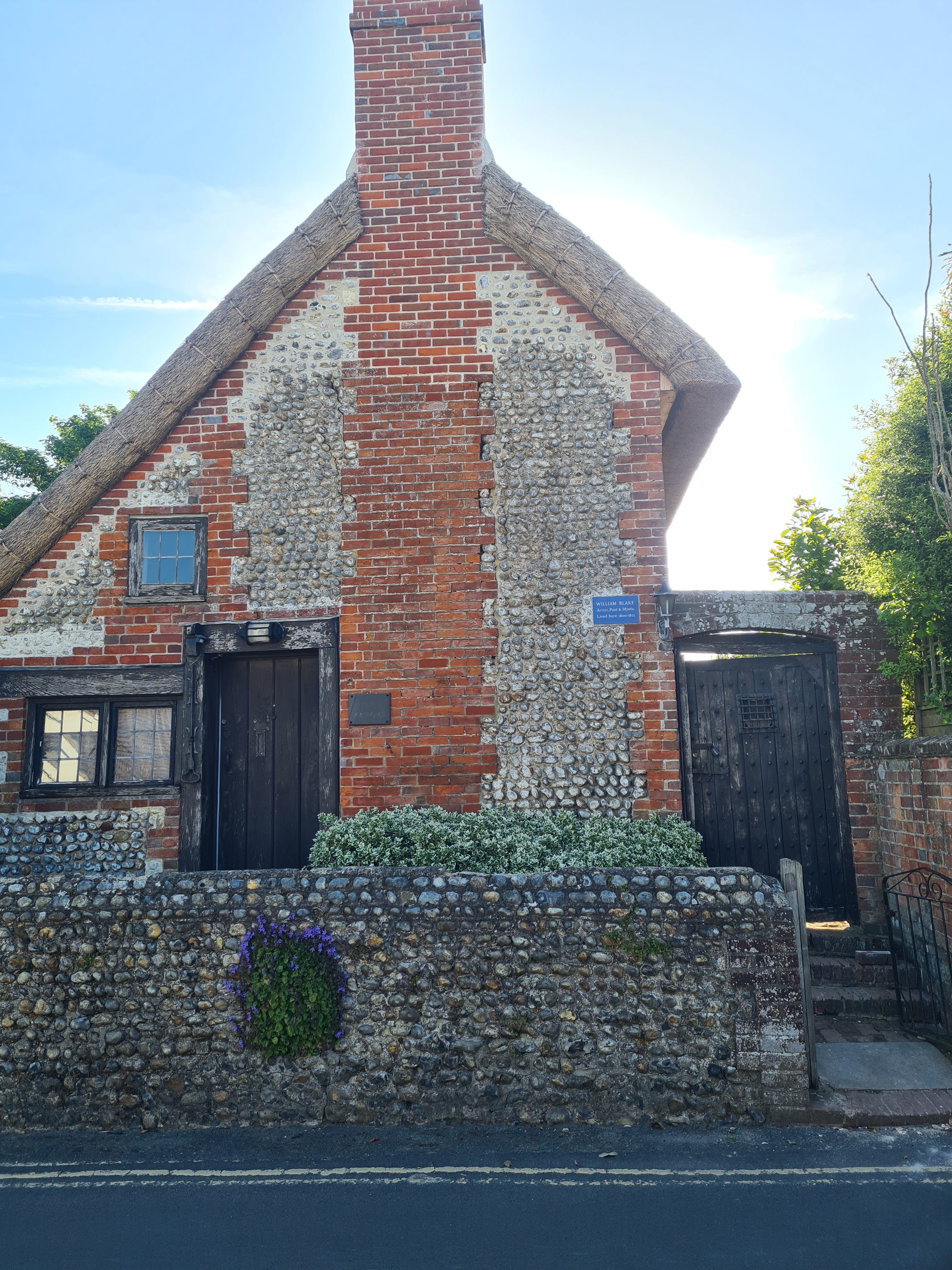
The cottage was bought by the Blake Cottage Trust in 2015, but restoration proved agonisingly slow. The building was placed on the Heritage at Risk Register. The roof – Blake’s ‘roof of rusted gold’ – was failing. Rain got in. Timbers rotted. There were plans and counter-plans, local opposition, frustration.
And through all of it, Beryl Kingston, my old teacher – by then in her eighties – would not stop. She wrote about the cottage on her blog, she spoke at local meetings, she called out delays and mismanagement by name. She was not about to watch Blake’s cottage collapse while committees deliberated. Beryl had written a novel about his years there – Gates of Paradise, published in 2006, her twentieth book – and she had won the Blake Society’s Tithe Grant Award in 2014. But it was not the literary connection that drove her. It was the building. The physical, actual, thatched and crumbling building where the work had been done.
Beryl Kingston did not campaign to preserve Blake’s reputation. His reputation is safe, she campaigned to preserve the place where he and Catherine had stood and made things with their hands, because she understood – as Blake understood, as Morris understood, as Mason understood – that the making and the meaning are not separate. Lose the cottage and you lose something that no collected edition can replace.
In early 2024, the roof was on the point of collapse. A new board of trustees formed. By the end of 2025, the roof had been saved – new timbers, new thatch – and the later extensions stripped back to the single storey the Blakes had known. The cottage is being restored for the bicentenary of Blake’s death in 2027.
That is how the tradition survives. Not in heritage plaques or national curricula. Not in institutions, which forget, or in movements, which rise and fall. It survives in the unplanned, unengineered way one person hands something to another and trusts it to find its way. A poet to a village. A village to an evacuee. A teacher to a boy in a school play.
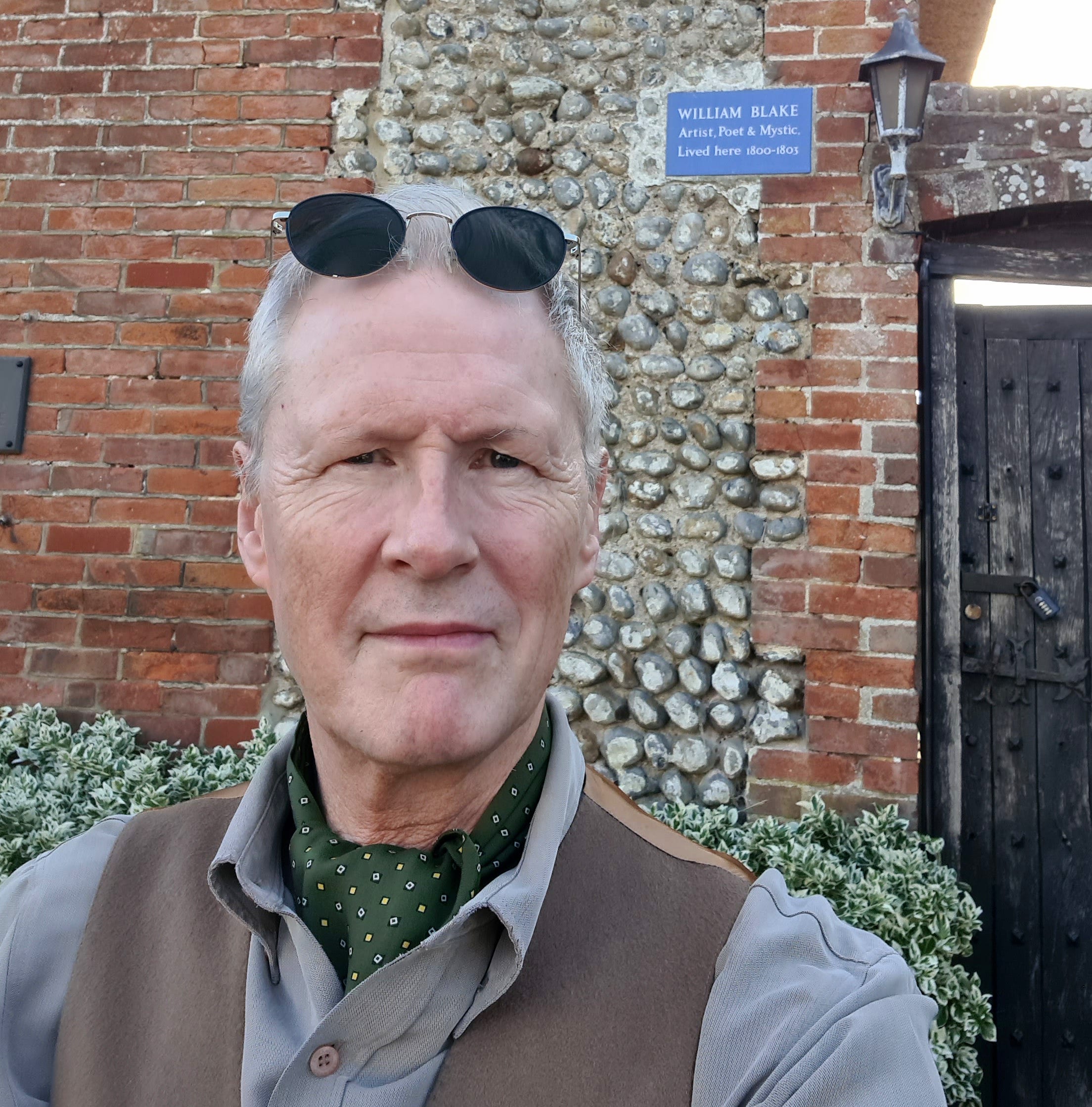
During my school days, I lived a few miles from a cottage where a man had made some of the most extraordinary work in the English language, and for much of the time I walked past it without a second glance. The TARDIS was already there, but at the time it looked like a cottage rather than a blue police box.
Beryl left Felpham long ago. She lives near me now, a twenty-minute walk from the village of Pagham, where I am writing this – in her nineties and still laughing like my grandmother, and still fighting for a roof of rusted gold she has never stopped loving.