

Crumpets, Tea, Telly and Jackanory
Why oral storytelling is making a comeback.

Crumpets, Tea, Telly and Jackanory
Why oral storytelling is making a comeback.
Written and read by Vincent Shaw.
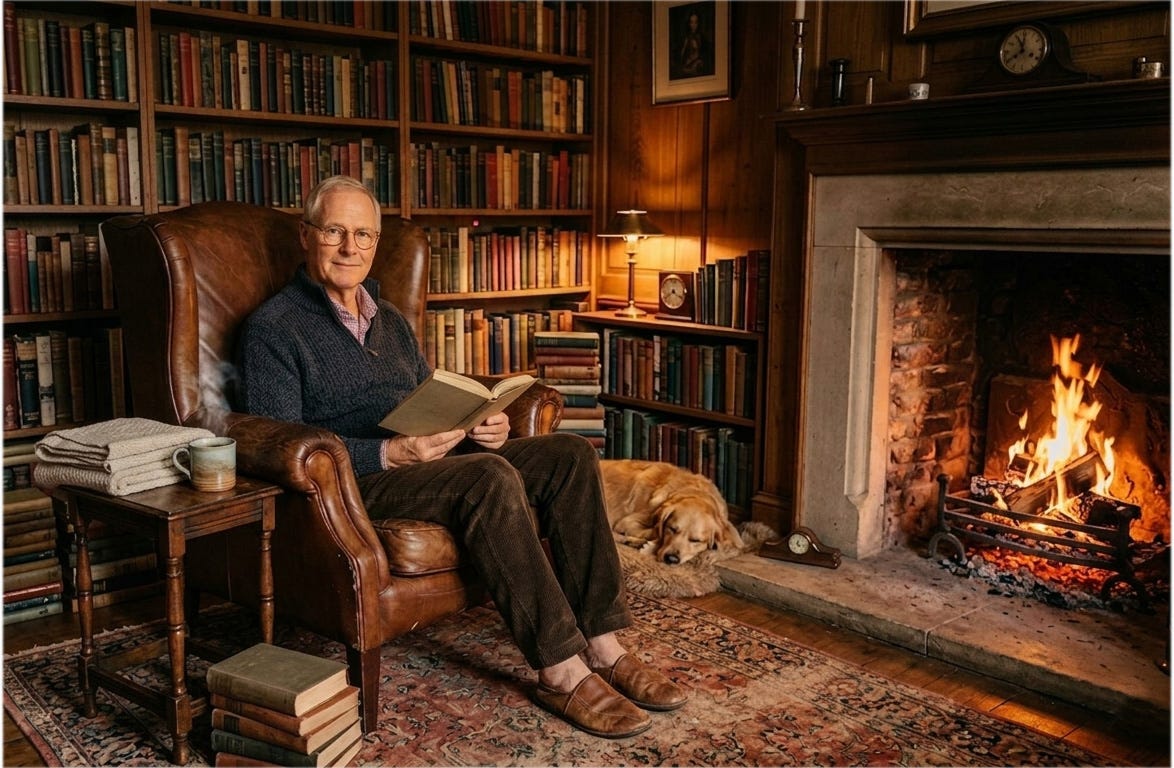
In the nineteen-seventies, Friday night was always my bath night, and Friday nights in winter are the ones I remember the most.
December. Cold, wet and windy outside. Warm, dry and snug inside.
After my Friday night bath I was always allowed downstairs in a towel to get dry in front of the fire. Back then it was a coal fire. By early evening it had been going for hours, thumping out its orange furnace heat into the living room, and by that time it was the warmest room in the house. A child, naked and towelling dry in front of a real fire, no inhibitions, no self-consciousness, just warmth.
Then, sitting cross-legged on the carpet, clean, warm, hair brushed and in fresh pyjamas. Crumpets toasted on the open fire, butter, jam, tea, telly and delicious munching. And then the best bit.
Jackanory.
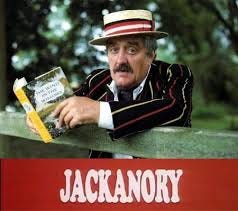
Jackanory was a BBC early evening children’s storytelling programme. Each week a well-known actor or personality would read a children’s book aloud, usually seated in an armchair, one chapter per episode across daily fifteen-minute slots. Its format was simple. One person in a very simple set and sometimes no set at all, just the storyteller and the chair. No special effects, no frantic editing, just old-fashioned storytelling.
The programme ran for thirty years, from 1965 to 1996, broadcasting around three and a half thousand episodes. Actors, comedians, even Prince Charles, as he was then, sat in that chair and read. But my strongest memory of Jackanory is of one episode in particular: it was December in the run-up to Christmas and the story was Alice Through the Looking Glass, told by Bernard Cribbins.
Actor Bernard Cribbins was Jackanory’s most well-known and best loved storyteller, appearing over a hundred times across twenty-five years. He was also Mr Perks in The Railway Children and the voice of the Wombles, but for me he will always be the first man, more than my own father, who told me stories.
The BBC’s original intention was to encourage children to read. The detractors at the time said it would do the opposite, that listening to a story would replace the effort of reading one. They were wrong. If anything, Jackanory lit the fire of wonder in children’s imaginations and sent them into books.
But something else was happening in that room, something older and deeper than literacy campaigns. Something that had been happening for thousands of years and long before anyone wrote anything.
Before there were books, before there were scrolls, and before there was any kind of written language, there was the spoken voice and oral storytelling.
We are very much a literate culture, but it takes very little imagination to understand what the world was like when nothing was written. When every story, every law and every warning about the dark forest only existed in the mind of the person who knew it, oral storytelling was of critical importance. It was the only way that tales and knowledge could be passed on.
Homer, for example, whoever he was, did not write the Iliad. He sang it. That great poem existed for centuries only as a handed-down performed story, shaped and reshaped by every performer across a thousand years.
Another example would be the great Welsh myths of the Mabinogion. They were told orally long before they were written down. Beowulf was a tale told around fires in ancient halls before it was ever set down on a page. The fairy tales we now read to children in neat illustrated editions were once told in kitchens by people who could not read, and did not need to.
The voice came first. The written word much later.
In 1987, Jim Henson, creator of the Muppets, created another of my favourite TV shows. The Storyteller.
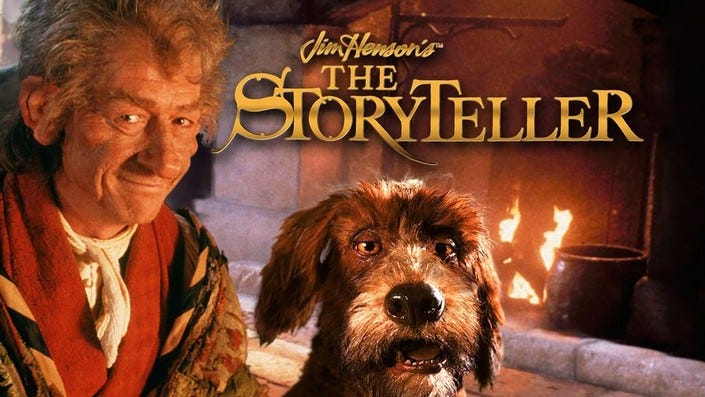
The Storyteller was filmed at Elstree Studios in the UK and aired on Channel 4 in 1988, and in the title role was actor John Hurt. Hurt sat by a fire, an old man in heavy makeup with enormous ears and a prosthetic nose, and he told European folk tales to his talking dog. The dog was sarcastic. The stories were dark. The production was visually sumptuous, but the engine of the whole thing, and the reason it worked, was John Hurt’s incredible voice simply telling a story.
Who could forget the show’s opening words:
‘When people told themselves their past with stories, explained their present with stories, foretold the future with stories, the best place by the fire was kept for the Storyteller.’
Henson himself, in his notes on the series, wrote something that I think about often. He spoke of his childhood, of family gathered at his grandmother’s table, of stories told, of laughter. And then this: the flow of information, and energy, and entertainment from the storyteller to his listeners as the storyteller calls upon them to meet him halfway, to create the story in their own minds.
And now today, in 2026, stories delivered via the spoken word are becoming more and more popular. I am convinced that audio will eventually become the fiction delivery medium of choice.
Audiobooks are now the fastest-growing delivery format in publishing. In 2019 they overtook ebooks in revenue for the first time, and they continue to gain market share.
In the US, in 2024, audiobook sales reached over two billion dollars, up fifty percent in five years. Over half of American adults have now listened to an audiobook. The global market is projected to more than triple by the end of the decade.
People are listening on their phones while they walk the dog, on their commute, while they cook, while they fold the laundry. Modern living demands more of everyone’s time and audio is becoming more popular than ever before, as it allows everyone to ‘read’ even when occupied by other tasks, but it’s more than that. Everyone simply loves to be told a good story.
And children were there first, and the commercial reality proves it.
In 2016, two fathers in Germany launched the Toniebox: a small, soft, screenless cube. You place a figurine on top and it plays a story. No screen, no swiping, just a voice, speaking to a child who has chosen to listen. In its first three months it sold 30,000 units. By 2017 that had risen to 148,000 units. By 2019, a million. Today, over 10 million Tonieboxes have been sold worldwide, with more than one 134 million figurines. In Germany, one in every two preschool households now owns one. Over a million have been sold in the UK alone, and North America is now the company’s biggest market. Revenue grew over 30% in 2025.
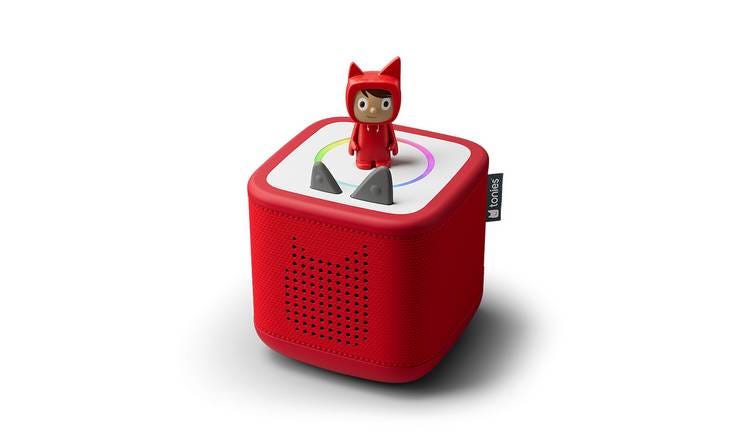
My three-year-old grandson takes his everywhere.
And then, this month, April 2026, the New York Times published its first ever Children’s Audio Bestseller list, and the fact that fourteen of its top fifteen slots are Harry Potter tells you everything.
In April 2026, in an era of limitless streaming content and algorithmic recommendation and short-form video, the most successful children’s book series of the last thirty years is conquering the bestseller charts again. Not as books. Not as films. As voices.
The wheel has come all the way back round again.
What Jackanory and The Storyteller both understood, and what the Harry Potter audio chart proves beyond argument, is that the human voice telling a story is not an obsolete form of storytelling. It is not a quaint relic of a pre-literate age. It is something we still hunger for, and in my view, more now than ever.
There is a reason that the bedtime story endures. There is a reason that grandparents who cannot remember what they had for breakfast can still recite the opening of a story they were told at five years old. There is a reason that two hundred and twenty eleven-year-old children and five teachers leaned forward whilst I read them a story.
It’s because all of us, young and old, love stories and vocal storytelling came first. Nothing we have invented has ever replaced it, and now, in 2026, we are returning to it.
Care & Craft. Why we all need something real, in a world dominated by digital.
Finding someone else who appreciates Jim Henson's The Storyteller is *delightful*. And three cheers for oral storytelling.
My 16 month old daughter has a TonieBox and absolutely loves it. My favorite part about the Tonie Box is the"Creative Tonies" that are blank and can be loaded with your own recordings. My husband is gone for a long while, and he was able to record an hour of stories for her. She calls the little figurine "Dada books" and we listen to it every single day. So special! Loved this piece, thanks for writing and sharing.