


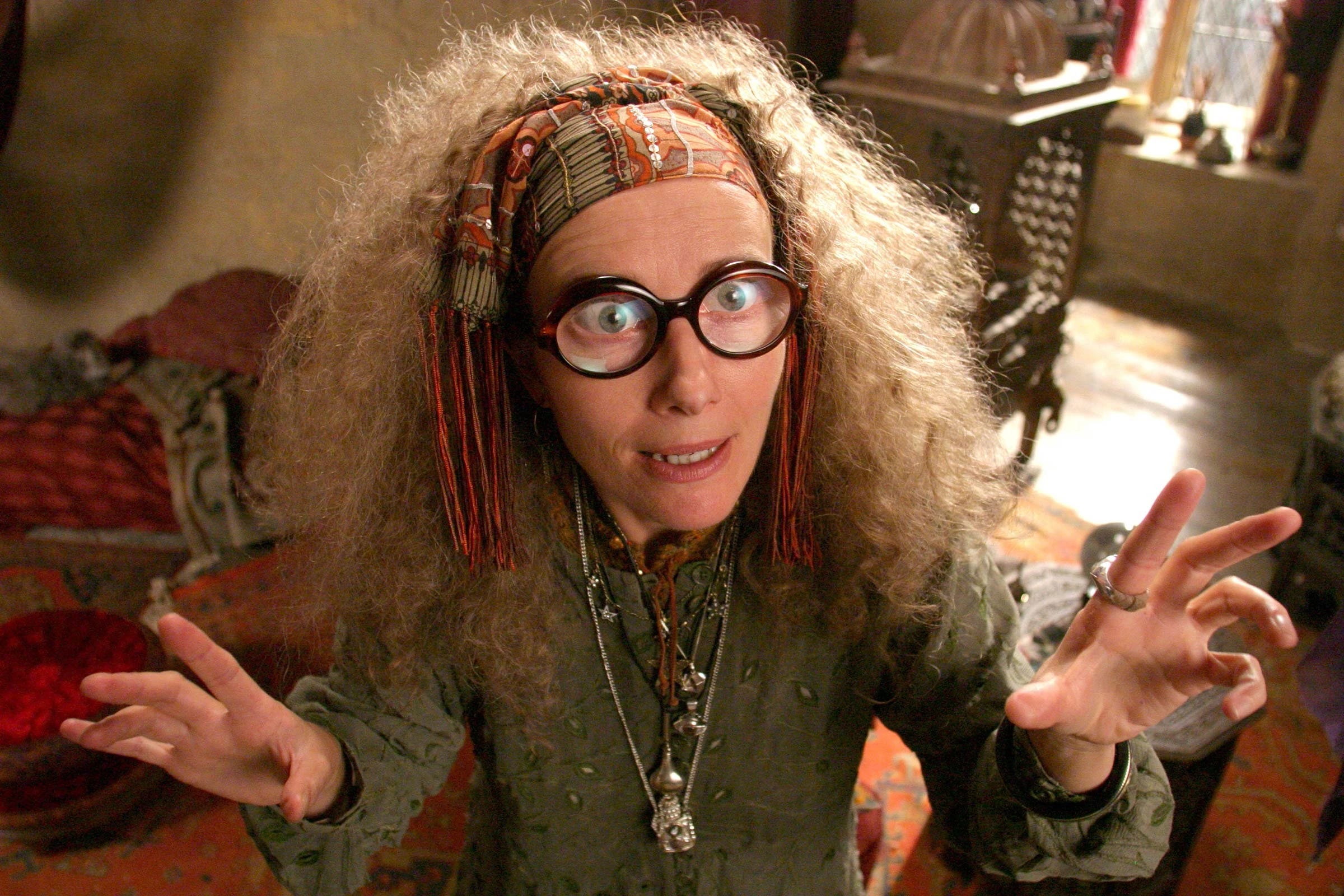
WARNING. This essay contains Harry Potter Spoilers.
My secondary school was brand new, and I was in the first year through it in 1974. Everything was new. The desks were new, the chairs were new, it smelt new, and all the books were new – including the free one to keep. The free one was a pocket Bible and we were all given one on the very first day of term. Gideons New Testament, burgundy in colour, about the size of a cigarette packet, with the lettering and Gideons emblem on the front embossed in gold.
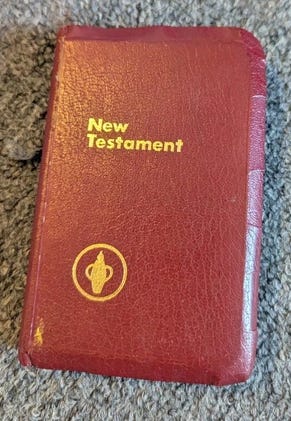
I was eleven years old and I read it from cover to cover straight away, and I read it because I read everything, and I still do.
I have two outstanding memories from that very first reading of the Bible. The first is the long stretches of boredom in it. Pages of it are one massive yawn, page after page of genealogies, page after page of letters and arguments I could not follow. But there was this amazing man called Jesus, the son of God, a man who preached forgiveness, love for one another. He was a brilliant wizard too, his miracles were fab.
He brought a man back from the dead, he healed people, he cured the lame so they could walk again, he turned water into wine, he spat on mud, and put it on a man’s eyes so he could see, and then after the Romans killed him, he came back from the dead, to spend time with his friends before being taken up into heaven in a cloud. Or was it a space ship? My eleven year old self can’t recall.
But then I got to Revelation, and it was terrifying. The end of the world, a dragon with seven heads and ten horns. A woman clothed with the sun, with the moon under her feet. Locusts that came up out of a pit with faces like men, hair like women and teeth like lions. Fire reigning down and a beast rising out of the sea.
Wow, what a story, it had wizards and magic and dragons and everything.
However, for my eleven year old self, there was a problem.
The Bible and everything in it is true – I was definitively and passionately told.
The Bible and everything in it is dangerous made up nonsense – I was definitively and passionately told.
What happened next was inevitable. I was left completely confused. How could these two opposing points of view both be true? They couldn’t be. One point of view had to be wrong and the weight of opinion was against the Bible, even Jesus and I liked him.
As an eleven year old I had no other option, and did what any child of that age would do with a contradiction that cannot be resolved. I put down the Bible, and I did not pick it up again for a very long time.
Many years later I returned to the Bible, this time as an adult and because a group of extremist Christians in the USA had started burning a book called Harry Potter. I was curious about both the Harry Potter book and again, the Bible.
Someone else decided to burn books in the 1930s, and I am immediately suspicious and distrustful of anyone who burns books because they don’t agree with the content or point of view. Book burning is a really bad idea and it usually ends only end one way – badly.
In any event, I read Harry Potter and the Philosopher’s Stone as an adult and with children of my own, and loved it. I looked at the Bible again, the Old Testament this time. It was just as dull as the New Testament, only more so. So many ephas of this, so many cubits of that, gold, oil, wine, bullocks, rams or whatever else, made as offerings. Death and destruction pouring down from a vengeful God on a stiff-necked people, real fire and brimstone stuff. Throughout, and just like the New Testament, the book was full of magic. It was everywhere. Staffs that swallowed serpents. A bronze snake that heals anyone who looks at it, the ark which is a terrifying weapon that emitted lightning and fire. Samson’s hair, Elisha’s bones which raised a dead man when he touched them. Balaam’s donkey which argues with him, and much, much more.
Hmmm.
What is so very different about Harry Potter to the Bible that justified book burning, after all, they both have magic in them?’
‘Anyone?’
‘Witches, the Bible is specific about witches. Burn the witch.’
‘And Jesus, and forgiveness, where do his teachings come in? Shouldn’t we forgive witches?’
‘Eeeerrrr.’
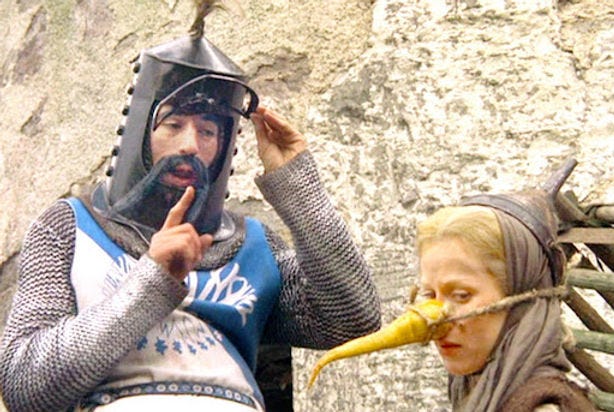
‘But what makes you think she is a witch?’
‘She turned me into a newt.
‘A newt.’
‘ I got better.’
‘Riiiigght.’
The King James Bible
The word witch is only mentioned twice in the entire Bible, and both times in the Old Testament.
Exodus 22:18 – ‘Thou shalt not suffer a witch to live.’
Deuteronomy 18:10 – ‘or a witch’,
is part of a list of abhorrent practices, including child sacrifice.
But what is a witch, according to the Bible, and the King James Bible in particular?
The word for witch in both places of the Old Testament is mekhashsheph in biblical Hebrew. It refers to a person who practises supernatural arts, such as sorcery, divination, or communicating with spirits – necromancy.
The spine of the argument is that the Bible forbids divination, but this is where the book burners’ argument simply falls apart.
In the Old Testament, God commands the creation of divination equipment for the high priest to discern God’s will. They are called Urim and Thummim, and are sewn into the breastplate for the express purpose of getting answers – acceptable divination.
Israel picks its first king by drawing lots – acceptable divination. Joseph divines with a silver cup – acceptable divination. Meanwhile the king of Babylon, King Nebuchadnezzar shakes arrows to choose his road and who to attack. That is condemned as an abomination – unacceptable divination.
Even raising the dead is seen as being both acceptable and unacceptable. A dead man is thrown into Elisha’s grave, touches the prophet’s bones, and stands up alive, and yet nobody condemns it or even comments on it.
So divination is forbidden in the Bible for some, yet acceptable for others. Like so much of the Old Testament it is a contradictory tangle.
But what of witches?
As I said earlier, the word witch appears only twice in the whole of the Bible. Once in Exodus and once in Deuteronomy.
Which (pun intended) brings us to the most quoted witch in the Bible.
The witch of Endor.
She is not a witch in the Bible at all, and the phrase does not occur anywhere in the text. Endor is a place, and the woman has no name, she is simply ‘a woman that hath a familiar spirit’, and she lives in Endor. Saul’s servants tell him where she can be found, and King Saul, who had banned mediums and soothsayers, asks her to bring back the dead prophet Samuel to advise him. He did so because he had already asked God for guidance by every approved divination route, dreams, the Urim and Thummim, the prophets, and God was silent. So he went down the unacceptable divination route, and it killed him.
The witch of Endor is not in any Bible verse. She only appears as a witch in the King James Version of the Bible, the most common Bible in the English language, and only as a chapter heading.
1 Samuel 28 - The Witch of Endor.
And here is the most important thing about King James the First of England. He had written a book on the subject of witches himself – Daemonologie, published in 1597. He took a close personal interest in witches and witchcraft, including the North Berwick witch trials, in which more than seventy people were accused and a number were tortured and killed. He arrived on the English throne with the subject of witches and witchcraft very much on his mind, and the Bible translation was begun within a year of his arrival.
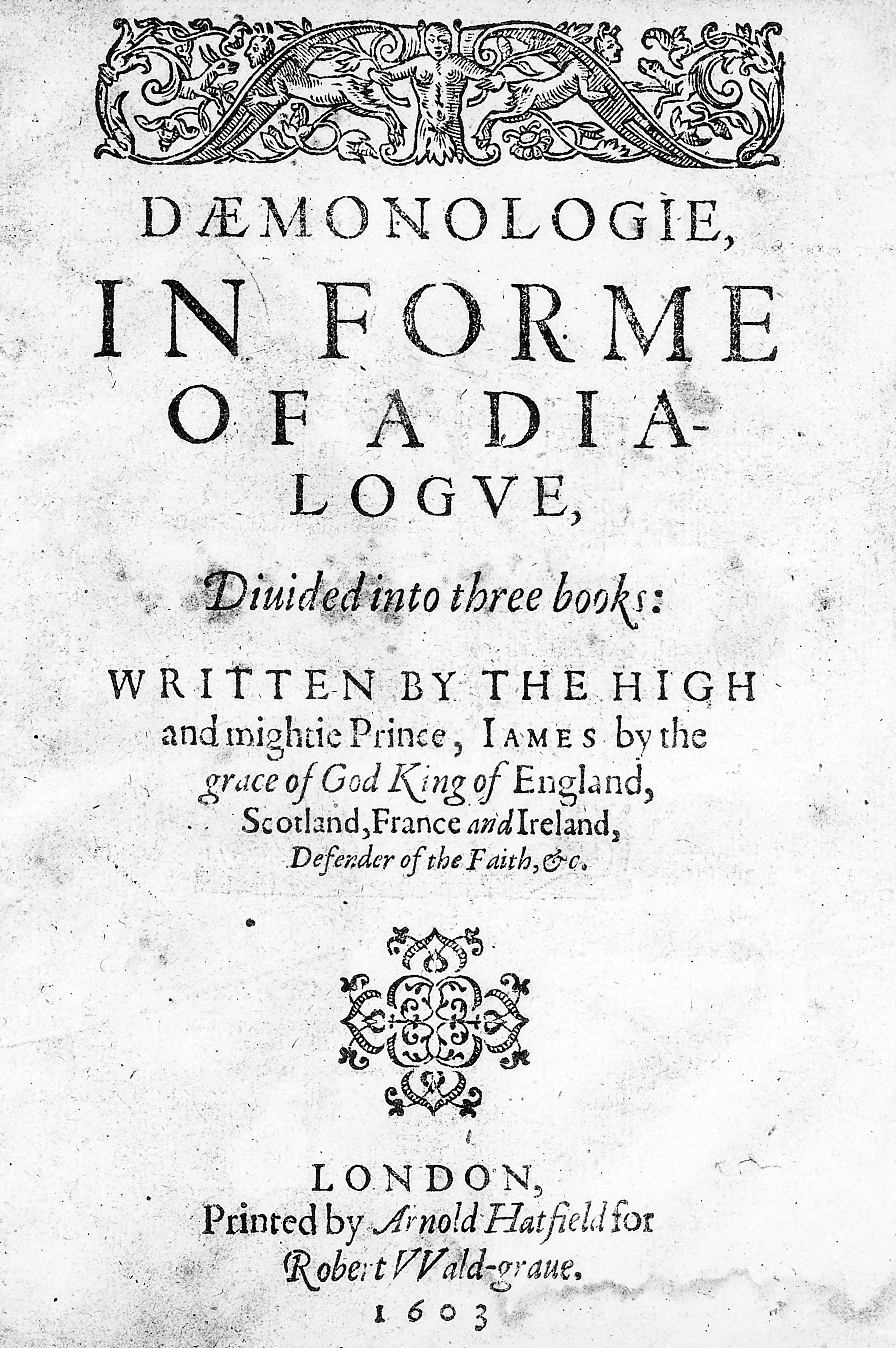
It is vital to remember that the most common English language version of the Bible, the King James Version, was written in a decade of English history when witchcraft was the subject of national panic.
And for me, this is the most important element of all. Remember that really kind wizard I encountered as an eleven year old, called Jesus, who performed amazing magic that we call miracles. Who said that he came to fulfil the law, not abolish it. Who summarised the core of the Old Testament law as loving God with all your heart, mind and soul, and who said you should love your neighbour as yourself, and who taught that God’s forgiveness requires people to forgive others. All of that was conveniently forgotten in the seventeenth century under King James when it came to witches and witchcraft, and far too many people were tortured and killed because of it.
Which brings me, decades later, back to the wizarding world of Harry Potter and book burning.
Magic in the Harry Potter books is inherited. You are born with it or you are not, and there is nothing whatever you can do about it either way. Nobody in the seven Harry Potter books acquires magic in the way the Bible forbids. You cannot ask to be a wizard or witch. You cannot earn or buy the ability, you either have it or you don’t, and a great deal of the series is about how unfair that is.
And what the children do with it, once they have it, is homework. They learn wand movements. They mispronounce things and get them wrong. Ron’s attempt to turn a rat yellow fails. The magic in Harry Potter is far closer to learning the violin in latin than to a necromancer rasing the dead at midnight.
The villains are a different matter entirely and justifiably so. Voldemort murders to divide his soul into pieces and stores the fragments in objects to cheat death – the Horcruxes. His resurrection in the fourth book requires bone of the father, flesh of the servant, blood of the enemy. This is abhorrent sacrificial black magic by any definition. Snape makes a binding magical pact with lethal consequences. These are transactions, expressly forbidden in the Bible, and JK Rowling resolves their use and the price you pay accordingly. The Horcruxes cost Voldemort his face, his sanity, and finally his life. The series does not pretend dark magical transactions do not exist or shy away from the consequences. Quite the contrary. It shows you what, detestable evil practices cost.
But divination, that is at the top of the Deuteronomy forbidden list in the Old Testament, is the running joke of the entire Harry Potter series. Professor Trelawney is a fraud with a drinking problem. Harry and Ron invent their prophecies to get their homework finished, and Hermione walks out of a lesson in disgust and never goes back. The single practice that most resembles what the Bible actually warns against is the one JK Rowling holds up for ridicule in all of the books
There is one moment that comes close to the line though. In the final book Harry turns the Resurrection Stone over three times and the shades of his parents, Sirius and Lupin appear. He speaks to them, and asks them to stay close. It is consulting the dead. But look at what Harry asks for. He does not ask for knowledge or advantage. He asks if dying hurts, and he asks them to stay with him while he walks into a forest to be killed. Harry is not summoning the dead for power. He is a frightened seventeen year old boy scared of dying, asking his mum and dad to stay with him. It tears your heart out, and if that is necromancy, as the Bible defines it, then the word has lost its meaning.
And then consider what he does with the Deathly Hallows.
Voldemort is trying to evade death. He splits his soul in an attempt avoid it, and every division leaves less of him, until by the end he is barely human at all.
Harry’s attitude is the opposite. He is given the three Deathly Hallows, that together promise mastery over death, and does something different. The cloak he keeps to treasure, but only because it was his father’s. The stone he drops in a forest and does not go back for. And the Elder Wand, the most powerful object in the wizarding world, already his by right of conquest, he puts back.
Between letting go of the stone and returning the wand, he walks into a forest to be killed, voluntarily, knowing what will happen, because it is the only way the people he loves will be kept safe.
The Harry Potter books are not about grasping for power. They are the opposite, and anyone who has read the New Testament will recognise the shape of it immediately.
And what about the ending. If this isn’t representative of the victory of God over Satan, I don’t know what is.
Voldermort is the Devil and the serpent. And the serpent in Harry Potter is Nagini. And Nagini is killled by Neville Longbottom using the Sword of Gryffindor, and very soon aftewards, Voldemort, the Devil, is defeated.
Now about those book burning extremist Christians. They were not acting in bad faith, quite the opposite in fact, but they were acting out of fear. Every generation or so somebody becomes frightened of what children are reading, and they are always sincere about it, but far too often they are blinded by fear and lacking in rational thinking.
And so I come back to myself as a confused eleven year old boy who read the New Testament because it was free, and who found a kind wizard called Jesus and a seven-headed dragon, and who could not get a single person to explain why that was permitted and another wizard (which for me at the time was Merlin) was not.
I tried to find my faith in my teens but failed. I joined a young Christian group at college, but only because I fancied one of the girls. I didn’t find my faith and I didn’t get the girl either. God was trying to tell me my motives were rather unsound I’m sure.
I did come to Christ eventually, but it took a lifetime. Now, I have a deep earnest faith and peace in life I have always longed for, but it was a long and difficult road. And since accepting Christ, I have had a number of small personal miracles in answer to prayer, which has only strengthened my faith further, but that is a different story.
And my journey to Christ has convinced me more than ever that magic very firmly belongs in children’s literature.
For me, it is not only acceptable in Narnia and middle-earth, but very much acceptable in the wizarding world of Harry Potter. The story is far closer to Jesus’s message of truth and love than many people realise.
Charlotte Mason encourages reading fairy tales that include both good and evil magic. It’s true that as parents we need to teach our children the difference between fairy tales and the occult. Harry Potter is just a modern day fairy tale. I’m excited to read it with my daughter (and other children) as she (they) grows up!
So.
I am a young Christian (3 years). I am 46. I was witch for 30+ years. And I have SCORES of baptists and KJV-only types tell me incoherently that Harry Potter is BAD and they have not read it. They tell me the magic is REAL.
Uhh. Well it isn't. NONE of it is real. And I was witch and sorcerer for 30 years, so I think I can tell the difference, thanks. Better off being worried about some modern day Christians who misuse the word apostle. Or V for Vendetta, which is a sigil created by a chaos magician, which activates every time you read it. And the ones who cry STAY AWAY xant tell me why Potter is no good but The Hobbit is fine.
Harry Potter follows a hero's journey, which is derived from the Bible.
So... thankyou for writing this. It is just fantasy, and ought to be enjoyed as such.
One of the other commenter pointed out that these works are vital for discipleship. If you exclude them, you have no basis for teaching what is occult and what is not. The Bible is exceedingly clear on the matter in my view, but also I have direct, lived experience where many do not.