


I turned to the right and went down the wooden stairs and emerged at one end of a low, narrow, dark and slimy passage. Ahead, and perhaps thirty feet away, was a quite literal light at the end of the tunnel.
The passage was no place to linger in, so I quickly walked to the end and out into the street.
I had been looking down into Knockturn Alley from the room above for twenty minutes, and I thought I knew what I was coming down into, but I was wrong. Looking down on a street is like reading about a country you have never visited. You get the shape of it, the general impression, but you miss everything that matters, the smell, for one. From the upstairs window, Knockturn Alley had looked dirty. From street level, it smelled worse than it looked, and it had looked terrible. There was the mud, which was not entirely mud. There was smoke, thick and sharp, not wood smoke or coal smoke but something that caught in the back of the throat and tasted of metal. River mud, horse dung, but also, of all things, fried onions, and a waft of that distinctive, sickly perfume smell of joss sticks that was trying and failing to mask the smell of a nearby sewer.
The buildings, from down here, looked even more tumbled down than they had appeared from above. They didn’t just lean toward each other, they loomed. The upper storeys jutted out so far over the street that the sky was almost gone, reduced to a thin, crooked line of grey. The timber frames of the buildings were black and swollen with damp, and between the beams the plaster had crumbled away in places to show the wattle underneath, dark and rotten, and nothing was straight. Every line was off, every angle wrong, as though the whole street had been built by someone who had heard what a building looked like, but had never seen one before.
Suddenly, and from behind me, I heard a loud, slow creaking sound, like a massive door being forced closed on reluctant hinges. But there was something else underneath it, a grinding, scraping of stone against stone – of weight shifting, and settling. At that moment, I knew I had made a dreadful mistake, and spun around, but it was too late.
The two buildings on either side of the passageway were moving quickly together. The passage went from being a few feet wide to a few inches in seconds, and then the passage was gone, as though it had never existed in the first place.
‘Oh no.’ I said it out loud, and to nobody. Trapped. Now what. I glanced about me.
The wall where the passage had been was, to look at, a wall like any other on the street. Black timber, blistered and dirty plaster with patches of bare brick showing through. I put my hand flat against it. It was warm. Not sun-warm, there was no sun to speak of, but warm in the way a kettle is ten minutes after it has boiled, and beneath my palm, very faintly, the wall ticked. It was stone, settling and sounded exactly like a car engine cooling on a driveway.
Idiotically, I knocked, not expecting anything to happen, and of course, nothing did. After five minutes of staring at the blank wall I finally concluded that there was no way back, at least not through the way I had come in. I just had to find another way out, and that meant looking for one. I stood a while longer with my hand on the warm plaster and then I turned my collar up and took stock – not that it took long. My phone, fully charged with no signal, not even one bar, as though the phone had already decided not to bother looking My wallet, containing two bank cards, and forty pounds in notes that were promissory and from a bank that, as far as this street was concerned, did not exist. And the keys to a house that was either sixty miles away or two hundred years in the future, I had no idea which.
I was, by any measure that mattered, destitute.
From the earlier window, the crowd had looked uniformly furtive, a street of turned-up collars and downcast eyes, and I had put it down to the weather, or the neighbourhood. From within it, it was quite different. Some people were indeed keeping themselves to themselves, moving quickly with their heads down and their business written in their stride and the set of their shoulders. Others were standing in doorways or on street corners. Some in twos and threes, and all of them watchful for the right opportunity – or the wrong one. Their eyes moved constantly, most of them furtively. They looked at everything and everyone, and when they looked at me they kept looking for an uncomfortably long time.
I assumed it was my clothes that were catching their eyes. I could not have been more conspicuously dressed. Everyone around me looked as though they had walked out of a Dickens novel, and one of the notorious London rookeries. Knockturn Alley was Bill Sikes territory, Fagin’s attic den emptied into the street. Except, of course, they hadn’t walked out of anything, I was the one who had walked in. And in my modern coat and clean jeans and trainers and all too clean face, I stuck out like a sore thumb. Two men leaning against a wall, broke off mid whispered conversation as I passed, as one nudged the other and nodded in my direction. I kept walking – quickly. But I had no idea where I was going.
Twenty yards later, I noticed out of the corner of my eye, that a large burly shadow had detached itself from a doorway and was following me. Not close, not hurrying, just there, at the distance a man keeps when he wants to see follow and hope you are unaware of it.
I stopped at a dark window and checked my reflection, on the reasonable theory that I had something on my face. The old glass gave me back a rippled, drowned version of myself, but it was recognisably me. And behind me, and also stopped was the burly shadow. When I glanced back, the man tipped his chin up briefly in acknowledgement, the way a bouncer does when he has decided you are his problem for the evening.
I started walking again and I tried very hard not to show that I was steadily increasing my pace, walking faster and faster. Left, then right. I glanced back. He was still there. Left, left again. Closer still. His own pace matching my own.
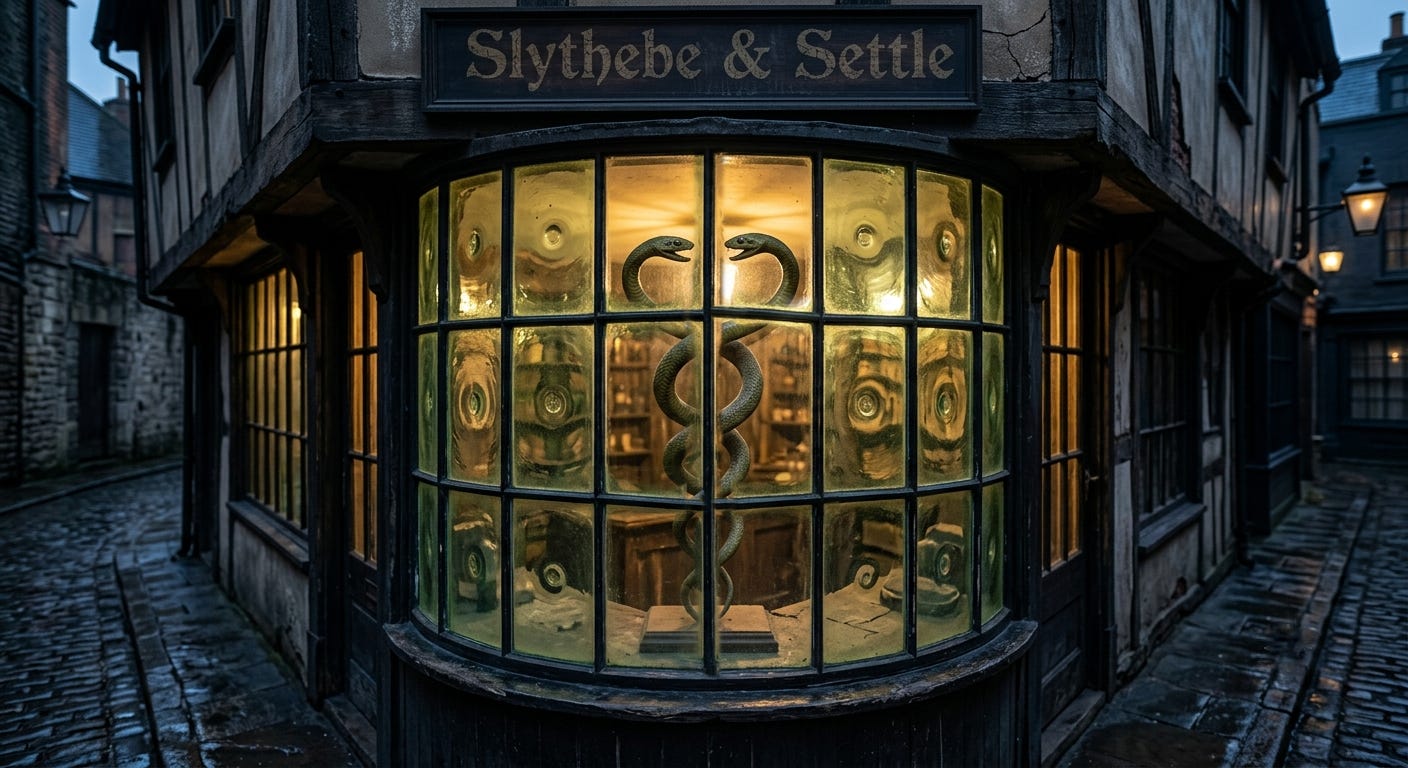
I tried not to break into a run, because running, would indicate fear, and I felt certain the man would smell it and catch up fast. Then, quite without warning, the street widened into a kind of court, and on my right there was a shop. I went straight in, the door opening with a cheerful ding that felt wildly inappropriate given the shop’s rather insalubrious location. I closed it firmly behind me, and then darted straight into one of the bay windows to look back at the way I had come.
The court was empty. No broad shadow, no bouncer’s chin, in fact, nobody at all. The man had gone, or stopped, or had never intended to follow me inside in the first place, which raised the question of what he had intended.
Then I jumped.
Right next to me in the window, only a few feet from my head, were two snakes coiled around a tall wooden staff, intertwined so tightly that at first I took them for one. They were enormous, thick-bodied, their scales a dull olive-green with darker bands running the length of them. They were, however, quite motionless, and after a couple of seconds I assumed them to be taxidermy specimens.
There was something about them, though. Something familiar that I could not place at first, the nagging half-recognition of a thing seen a thousand times in a context you have forgotten. Then I had it. I had spent several years working within the NHS and private healthcare services, and you cannot spend several years within medicine without seeing that image from time to time on lanyards, letterheads and signs. Twin snakes around a staff. A world wide recognised medical symbol, Greek in origin I think, that symbolised health and medicine.
Then the smell of the shop grabbed me. It was an extraordinary cocktail, like a cross between a chemist, a sweet shop and a florist. A kind of herby, almost disinfectant sweetness, as if someone had boiled eucalyptus in honey and then arranged flowers around the pot. Beneath that, something sharper and less pleasant, a chemical, mineral tang of things ground in a pestle and mortar. There was also a general soft hiss, not from the snakes, but from gas lamps set along the walls in brass brackets. The light they gave out was golden-brown and steady, and oddly enough, the place felt safe, if a little creepy, and I relaxed for the first time since I found myself trapped here.
Looking around I could see that the walls were covered in shelving, from floor to ceiling, and packed with glass jars, boxes, and bundles, all of them neatly labelled in a cramped, slanting hand. Some of the jars held dried leaves and flowers. Others held coloured and rather unsavoury looking liquids that were slow-moving, and shifting gently in the lamplight as though stirred by an invisible stick, whilst yet others held powders. On the counter sat a set of brass scales, a pestle and a stained marble mortar the size of a mixing bowl, along with a stack of small paper bags, folded and waiting. Behind the counter, rows of wooden drawers ran from waist height to the ceiling, each with a brass pull and a label. The place had the deep, settled quiet of a room where the same work has been done, in the same way, for a very long time.
There was nobody behind the counter, in fact, there was nobody in the shop at all, as far as I could see. Just me, the lamps, the jars, and the two stuffed snakes on the staff in the window.
‘Can I asssissssst you in any way, Ssssir?’
‘Hello,’ I called and walked to one end of the counter and looked towards an open door to a back room.
‘Hello,’ I said again.
‘Hello,’ said the same soft voice. It was behind me, and inexplicably, the hairs started to stand up on the back of my neck.
‘I don’t think the gentleman understandssssssss,’ said another, but very similar voice.
I spun round. The two snakes that before had been looking out of the window were now looking directly at me, their black forked tongues tasting the air, whilst two pairs of dark eyes were fixed upon me.
Wide-eyed, ‘Eeer, eer, eer,’ was all I could manage.
‘Ahhh,’ said one snake. It had partly uncoiled itself, but very much still at head height, it was leaning in towards me. ‘Would we be correct to assssssume you have never graced Sssssslythebe and Sssssssettle before?’
‘Eeer, eeer.’
‘I don’t think he hassssss, Mildred,’ said the other snake also now unwinding itself from the staff and also leaning in towards me with great interest.
‘No indeed, Mavissssss,’ said the other.
‘In fact,’ said the Mildred snake drawing the word out as if tasting it, ‘he issssss altogether sssssomething elssssse, I’m ssssssure.’
‘Indeed he issssss ssssssomething elssssse.’
Despite my consternation, Mavis and Mildred as the names of two talking snakes was not what I was expecting, not that I had been expecting the snakes to speak at all, I thought they were stuffed. Mavis and Mildred were names for ladies who played bridge on Thursdays and sent each other birthday cards with flowers on the front.
What happened next, I saw with my own eyes and yet I still don’t quite believe it.
The two snakes uncoiled from the staff, a slow unwinding of muscle, the only sound a dry whisper of scale against wood. But as they uncoiled, they seemed to pour themselves onto the floor and at the same time grow. Not quickly but with a sort of patient inevitability, the way a flower opens in one of those time-lapse films, except that what was opening here was not a flower. The olive-green of the scales paled and softened and became skin. The long bodies thickened, stretched, divided. I watched four arms emerge from what had been coils. I watched two faces form, from what had been flat, shovel-shaped heads, the jaws narrowing, the eyes rounding, the bone moving themselves beneath the surface.
It took perhaps five seconds, and at the end of it, two elderly women were standing in front of me, both of them smiling warmly.
They were not particularly tall, and they were both thin, lithe and tidy looking, with long necks that still held something of the way they had carried themselves as snakes a moment ago. They both had a slight forward tilt, and an attentive angle, as though they were always on the verge of leaning in to hear you better. Their faces were almost identical. High cheekbones, sharp noses, bright dark eyes set deep. Both had grey hair pulled back tightly and neatly, and both were wearing long dark robes of a deep bottle-green that I suspected was not a coincidence, given what the cloaks had been not a few moments ago. They women were old, certainly, but old in the same way that a well-made building is old, homely and comfortable in its own skin.
Up until this point, in the space of an afternoon, I had walked through a garden shed and come out in the wrong century, at least that is what it felt like. I had watched a passage close behind me like a healing wound. I had been followed through streets that smelled of the river and the middle ages. All of that, if I am honest, I could have talked myself out of as simply a vivid dream or hallucination, but I could not talk myself out of what I had just seen, because I had seen it from a few feet away in good light. Magic was real. It was standing in front of me and adjusting its cuffs.
The woman on the left spoke first.
‘There now,’ she said, in a voice that was still dry and precise but had lost its hiss entirely. ‘Much easier to talk like this. My name is Mildred Slythebe.’ She touched her chest lightly. ‘And this is my sister, Mavis Settle.’
‘We are,’ said Mavis.
‘The proprietors,’ said Mildred.
‘Of this establishment,’ said Mavis.
‘Slythebe and Settle,’ they said together, with the automatic harmony of a phrase spoken ten thousand times.
‘Apothecary,’ said Mildred.
‘And sundries,’ added Mavis.
The rhythm of it, that see-sawing completion of each other’s thoughts, had the quality of a parlour act performed so often it had ceased to be a performance and become simply how they spoke. I found myself nodding along to it, which was absurd, as I had not yet managed to produce a word.
‘And you are?’ said Mavis.
‘Eeer Vincent, Vincent Shaw.’
‘Well Mr Shaw, you look,’ said Mildred, studying me with her head tilted at that slightly serpentine angle, ‘if you will forgive me for saying so.’
‘Dreadful,’ said Mavis.
‘I was going to say cold.’
‘Cold and dreadful,’ completed Mildred.
‘Do sit down,’ said Mavis, gesturing towards a chair by the counter that I was certain had not been there a moment ago. It was old, deep-seated and upholstered in something dark, the sort of chair that elderly relatives keep by the fire and defend with their lives.
I sat. I sat because my legs had decided, independently of the rest of me, that they were finished with standing. The chair was wonderfully warm and smelled faintly of lavender.
Mavis had already moved behind the counter and was doing something with a small copper kettle and a jar of dried leaves. The way she moved through the shop had none of the hesitation you would expect from a woman her age. She knew where everything was without looking, her hands finding jars and stoppers and measures the way a pianist’s hands find keys.
‘Tea,’ she said. It was not a question.
‘I’m sorry, I have no money. At least, I have money, but I very much doubt it is money that would have any value here.’
The two sisters exchanged a glance. It was brief and it was practised and it contained an entire conversation that I was not invited to.
‘Did you hear that, Mavis,’ said Mildred. ‘Mr Shaw thinks we would charge a man who walks in off the street on a day like this.’
‘Looking like that,’ added Mavis.
‘Perish the thought,’ said Mildred.
‘Perish it entirely,’ said Mavis, setting a cup and saucer down in front of me. It was thick, white, chipped at the rim, and the tea in it was a deep reddish-brown and smelled of something I could not identify. I sipped it. It was not tea, exactly. Something older and grassier, with a warmth underneath it like cinnamon but not quite. It was rather pleasant.
Mildred had settled herself behind the counter, her head inclined towards me. Mavis remained standing on this side of the counter, one hand resting lightly on it. They were both watching me, and I had the odd sensation of being observed by two people who were looking at the same thing but seeing different bits.
‘Now then,’ said Mildred, in the tone of a woman who has stood behind a counter and listened to the troubles of strangers for fifty years.
‘What,’ said Mavis.
‘On earth,’ continued Mildred.
‘Has happened to you?’ finished Mavis.
I took a sip of the tea. It was extraordinary. Whatever was in it unknotted something behind my ribs that I had not realised was knotted.
‘Well, I got here by accident – kind of. I came in through a garden shed in Soho Square in London.’ It sounded ridiculous. ‘I went up some stairs that shouldn’t have been there, into a room that was too big, and looked out of a window at this street instead of modern London. There was a cupboard with a sign that said to knock and turn left or right. I turned right and came down and now the passage has closed behind me and I can’t get back.’
I stopped, because saying it all at once made it worse.
Mildred looked at Mavis. Mavis looked at Mildred, and something passed between them.
‘A garden shed,’ said Mildred carefully.
I said, ‘It looks like an Elizabethan building, white plaster and black timbers.’
‘In Soho Square,’ said Mavis, equally carefully.
‘In Muggle London,’ added Mildred. ‘And you say, that you came down the right-hand staircase.’
‘Yes.’
‘And the passage,’ said Mavis. ‘It closed.’
‘Completely. The buildings moved together. It’s just a wall now.’
‘Well you are not a Muggle, that much is evident,’ said Mavis.
‘Muggle?’
‘A non-magical person,’ answered Mildred.
‘And yet you do not appear to be magical, otherwise you would not have been surprised at our appearance.’
‘I used to like card tricks as a child,’ I offered.
The two sisters –I assumed sisters – once again passed one another that knowing look and then said in unison, ‘Something else.’
‘Which calls for tea,’ said Mavis, ‘Which you have.’
‘And kindness,’ added Mildred, her gaze returning to me, and for a moment something shifted in her face, something that looked very much like recognition being weighed against caution, and caution winning.
‘In any event,’ she said briskly. ‘You are here, you are cold and you are not dressed for this weather or indeed,’ she paused, ‘this neighbourhood. Mavis, do we still have that cloak?’
‘The grey one?’
‘The grey one.’
‘I believe we do.’
Mavis disappeared through the door behind the counter. I heard rummaging, the opening and closing of drawers, a muffled conversation with someone or something I could not see. She returned with a heavy grey cloak, long and plain and slightly moth-eaten, and held it out to me.
‘It has been here longer than we have,’ she said. ‘Which is saying something.’
I took it. The wool was thick and coarse and smelled of cedar and age, but it was clean. I put it around my shoulders and immediately felt warmer, and less conspicuous.
‘Thank you,’ I said. ‘You are very kind. Both of you.’
‘We are practical,’ said Mildred.
‘Practical and nosy,’ added Mavis.
‘Practical, nosy and not without some experience,’ said Mildred, ‘of people who find themselves where they did not expect to be.’
She said it lightly, but beneath it there was a weight I did not understand.
I drank my tea and looked at the two sisters and the shop around them. The gas lamps, the jars, the quiet. The brass scales on the counter, perfectly balanced, and waiting for something to weigh. Outside, through the thick window panes, the court was darkening and the street was emptying.
‘It is getting late,’ said Mildred, following my gaze. ‘Knockturn Alley after dark is not a place for.’ She stopped herself.
‘Not a place for a man in Muggle clothing,’ said Mavis, finishing the sentence with what I suspected was not the ending Mildred had intended.
‘We have a room,’ said Mildred. ‘Upstairs. It is small and it is not luxurious but it has a bed and a lock on the door, and you would be welcome to it. In the morning things will seem...’
‘Clearer,’ said Mavis.
‘I was going to say simpler.’
‘Nothing around here is simple, Mildred.’
‘No,’ said Mildred quietly. ‘I suppose it isn’t.’
I put down my empty tea cup. The chair was warm. The cloak was warm. The shop smelled of beeswax and eucalyptus and safety, and safety had become, in the space of an afternoon, a thing I could no longer take for granted.
And then, through the bay window, I saw the figure again. Still there, on the far side of the court, half-lit by the spilling apothecary shop light. Not the broad shadow from before, someone smaller, standing quite still in a doorway, facing the shop. Not threatening, not approaching, just present, in the patient way of a person who has been watching and waiting for some time and is prepared to watch and wait for considerably longer.
The two sisters were looking at me, waiting for an answer.
What to do next?