

Seventy Pairs of Hands
A story of clay and community

Just off the A3, a few miles south of Guildford, Surrey, England, there is a little-known Arts and Crafts gem: Watts Gallery and Memorial Chapel.
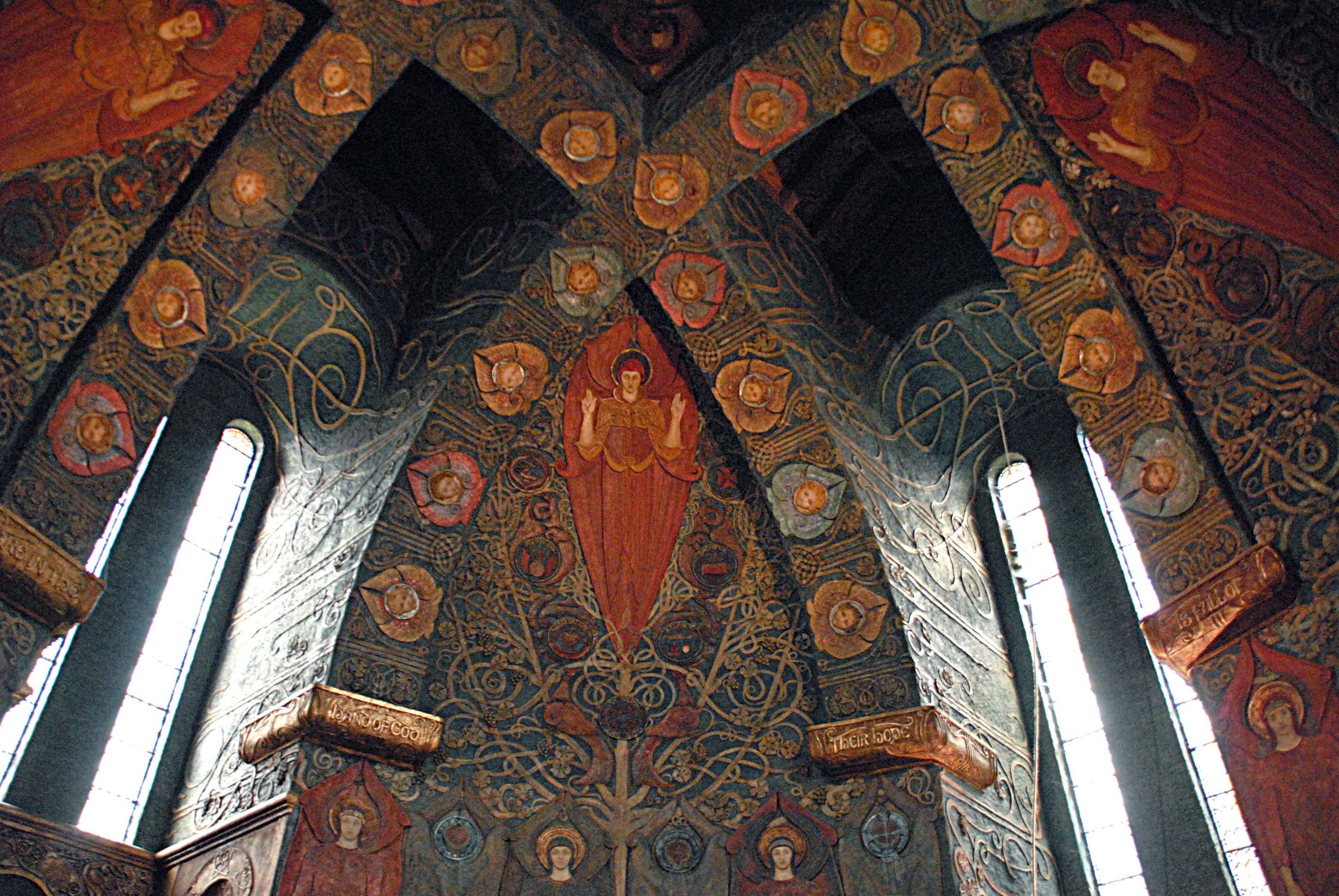
I first visited the place in the 1980s, whilst still in my twenties, and I was introduced to it by one of my oldest friends. In those days nobody really knew about the place. To reach it, you left the A3, turned off down a lane and almost immediately you came to Watts Chapel. Another two minutes along the lane was the Watts Gallery. Back then the gallery was in serious danger from lack of money for essential maintenance, and there was a real sense that the whole thing might simply be lost.
My friend, his mother and I had a private tour of the gallery with the then curator and G.F.Watts expert, Richard Jeffries. As we were the only visitors that day, and quite possibly that week, we had the place to ourselves. George Frederic Watts was one of the most celebrated artists of the Victorian age - known in his lifetime as ‘England’s Michelangelo.’ His work hangs in Tate Britain and the National Portrait Gallery. He painted Tennyson, Gladstone, Carlyle. But not only was he an accomplished painter, he was also a sculptor. But like so many of the great Victorian artists, he had fallen out of favour, and his gallery, tucked away in a Surrey lane, had been forgotten and was quietly falling apart.
But on that very first visit, it was the memorial chapel that stayed with me. I remember standing in the chapel and being completely overwhelmed. Every surface was alive, dense with colour. Deep reds, muted golds, blue-greens, gesso angels and Celtic strapwork and swirling tendrils of the Tree of Life. Angels of light facing outward. Angels of darkness facing the wall. Cherubs crowding the ribs of the vaulted ceiling. It was intense, enveloping, and completely unlike anything else I had ever seen, and was love at first sight. I walked out into the Surrey afternoon a different person, and although I did not know it then, that afternoon was the beginning of a lifelong interest for the Arts and Crafts movement, and (as readers of my first post will know, a connection that would turn out to run far deeper than I ever imagined).
Whilst in the chapel I learned that my friend’s mother’s aunt had been a close friend of Mary Watts, George’s wife, and had helped build and she had helped her decorate the chapel.
At the time I did not know who Mary Watts was, and today most people still don’t. She was, and largely remains, a footnote in her husband’s story. Even her own writing is self-effacing. We know more about George’s life from her pen than we do about hers.
But it is Mary who built Watts Chapel.
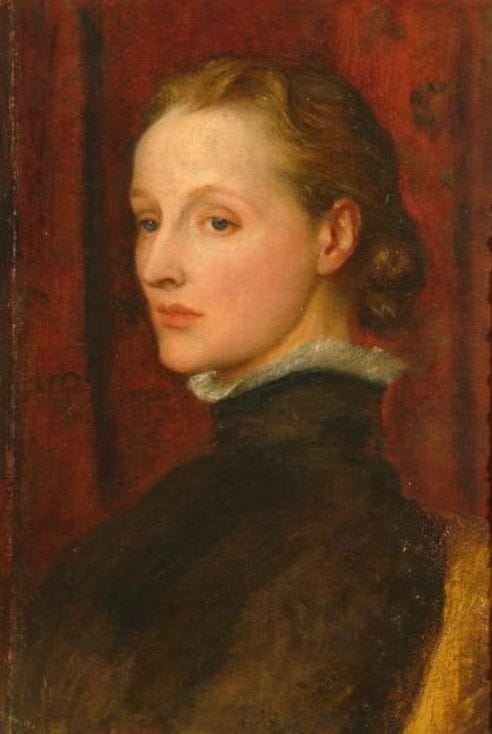
Born in India in 1849, the daughter of a Scottish aristocrat, Mary Fraser-Tytler grew up by the banks of Loch Ness, raised by her grandparents after her mother died when she was barely two years old. She drew and painted from childhood, and her family encouraged it.
Mary was naturally gifted. She studied art in Dresden, and then had formal training at the Slade School of Fine Art, one of the very first women to do so. She trained in sculpture under the celebrated Aimé-Jules Dalou and was exhibiting her work long before she met the man whose name would come to overshadow hers.
She married George Frederic Watts in 1886. She was thirty-six, he was sixty-nine. It sounds improbable, but by all accounts it was a genuine loving marriage, and they had a singular vision - an unshakeable belief that art existed not for galleries and collectors alone, but for everyone. ‘Art for all’ was their phrase, and it was not a slogan. It was a way of living.
In 1889, George and Mary came to stay with friends in Compton, a quiet village tucked into the Surrey hills just south of Guildford. They were looking for somewhere to escape London’s winters, its pollution, poor light and interruptions. George’s fame attracted a constant stream of visitors, and the couple craved time to simply work.
They fell in love with the area straight away, and by 1891 they had built a studio-home. Designed in the Arts and Crafts style by Sir Ernest George. They called it Limnerslease, from ‘limner,’ meaning artist, and ‘leasen,’ an old word for gleaning.
What had begun as a winter retreat quietly became their real home. As the years passed, Limnerslease took precedence over their London residence. Free from the interruptions of London society, the couple were able to work uninterrupted while becoming a celebrated part of the Compton community. George painted some of his most ambitious Symbolist works in his new studio, designed with his vast canvases and his need for good light in mind. But it was Compton village that became the centre of their lives.
The house became Mary’s canvas. She decorated the walls and ceilings in plaster and gesso reliefs. For her terracotta work she dug clay from the grounds. In September 1894, she wrote in her diary: ‘My hope is that terracotta shall be my future.’ She soon discovered, however, that the local rural community was in serious decline and this troubled both herself and Geroge deeply. However the Parish Council were seeking land for a new cemetery and Mary offered to build a mortuary chapel on the proposed site. Her offer was accepted. George financed the project whilst Mary designed and managed it.
On Thursday evenings, the drawing room at Limnerslease became a studio, and Mary set up free clay modelling classes, for anyone who wanted to come. The lessons focussed on making terracotta tiles, and these were used to decorate the exterior of the chapel.
Over seventy villagers, including children, made everything- from the chapel door hinges to small flower decorations on the inside. The chapel was consecrated in 1898, with the interior decoration continuing until 1904. Virtually every resident of the village had a hand in it.
Pause on that for a moment, because what Mary Watts did was not only admirable - it was radical.
Mary did not simplify her vision to accommodate untrained hands. She trained the hands to meet the vision. Mary believed, and proved, that ordinary people, given patient instruction and genuine interest, could make something extraordinary. As she once put it: ‘Giving money is one thing, but giving ourselves is the one great and necessary gift.’
Mary gave herself - her time, her patience and her knowledge.
My friend’s mother’s aunt was one of those seventy villagers. She stood in that drawing room. She put her hands in that clay. And decades later, I stood inside the thing she helped create not knowing any of this, just knowing that something about the place had stopped me in my tracks.
But here is the part of the story that moves me most. When the chapel was finished, the villagers did not want to stop making.
They asked Mary to keep teaching them. The Thursday evening classes had changed something in them. It had not just taught them a new skill, but fulfilled a creative need that I believe is deep inside all of us. The simple pleasure of making something with your hands, of shaping raw material into something beautiful.
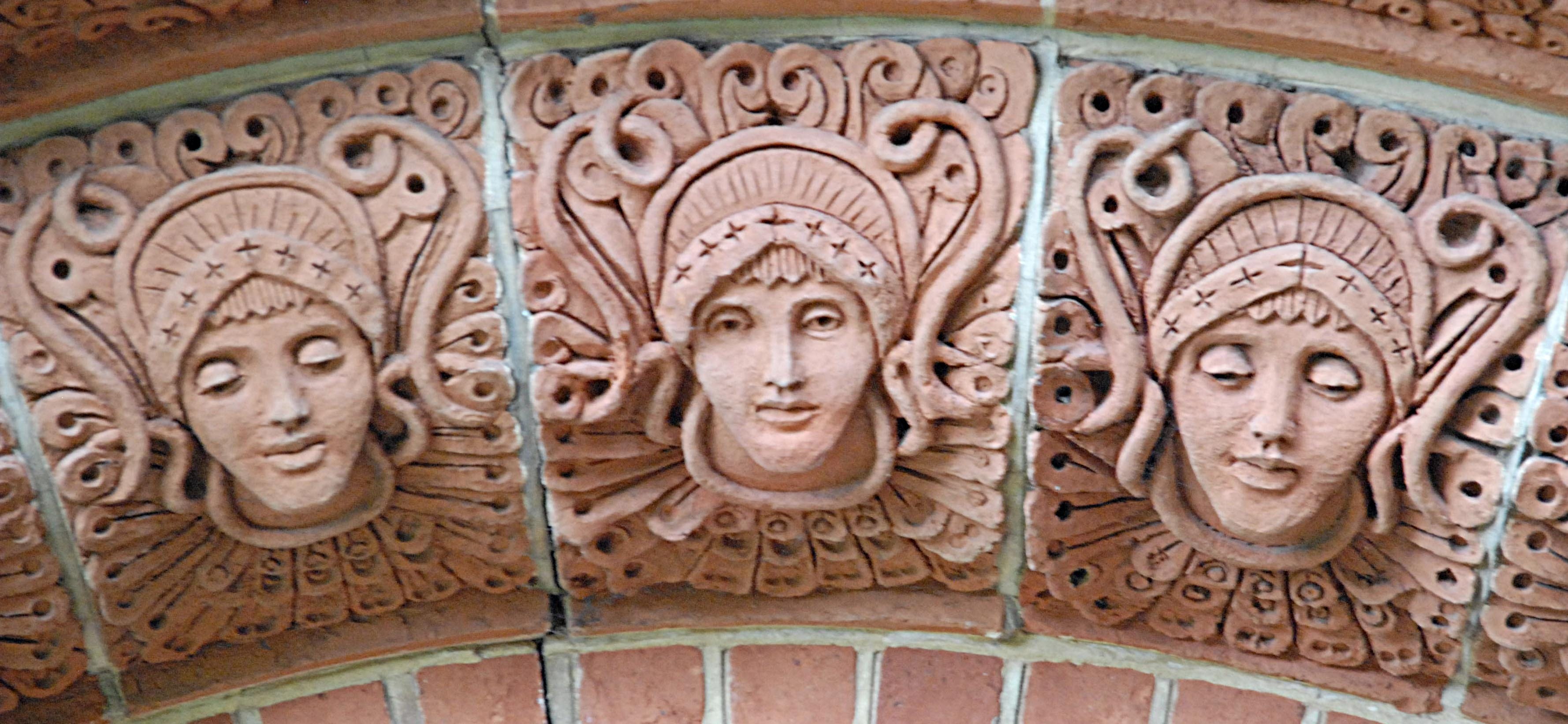
Mary gave the villlagers clay and villagers discovered themselves. That is what handicraft does.
Those Thursday evening classes became the Compton Potters’ Arts Guild. What started as a community project to decorate a chapel became a working pottery - producing terracotta garden ornaments, sundials, vases, bookends, and decorative pieces, and it helped revive the community. A kiln designed by William De Morgan was set up in the grounds of Limnerslease. By 1901 Mary had recruited a full-time pottery manager and a new premises was built across the road. She designed ranges for Liberty’s department store, and Liberty named her as their designer, against their usual policy of only selling under their own brand. The Guild won medals at horticultural shows, and the pottery ran for over fifty years, long after both George and Mary had died.
There is also a detail I keep returning to. Mary’s earliest teaching was not in Compton but in Whitechapel, London. In the 1880s, years before her marriage, Marry taught clay modelling to boys at a club in the East End - shoeblacks and street children with nothing. She later described the purpose simply: to give them ‘the pleasure of making something in their leisure time.’
Not to train them. Not to improve them. Not to fix them. Just to teach them the pleasure of handicraft and making something with their hands.
I think about that a great deal. The pleasure of making something. It is so plain, so unassuming, and it is what Care and Craft is about.
What Mary Watts understood, and what we are danger of losing, is that the act of making is sometimes more than just a hobby - it is often a human need.
Mary did not preach this. She simply opened a door, set out the clay, and let people discover it for themselves.
George Frederic Watts died in 1904. He did see the chapel completed however and painted The All-Pervading for its altar just three months before he died.
With George’s death, Mary made Limnerslease her permanent home. She managed the pottery and continued to run the gallery she had built to house George’s work. She wrote The Annals - the biography she published on the life and thoughts of her dear husband. She championed women’s suffrage, becoming President of the Godalming branch of the National Union of Women’s Suffrage Societies. And she continued, always, to make.
She watched the chapel settle into its landscape. ‘It is growing every day less red,’ she wrote, ‘and the green enfolds it all so beautifully now, the trees are in leaf. A sweet resting place.’
Mary Watts died at Limnerslease in 1938. She and George are buried together in the cemetery, a few yards from the chapel she built with the people of Compton. Some of the craftspeople who helped make that chapel are buried there too, their graves marked with terracotta headstones made by the Guild, and around sixty of the stones still stand in the cemetery today.
The place I walked into in the 1980s, half forgotten and gently falling apart, is not the place you will find today. Watts Gallery and Artists’ Village has been restored, reimagined, and brought back to life. But what strikes me most is not the restoration, it is that Mary’s legacy has not only been preserved, it is still very much alive.

Today, Watts Gallery and Artist’s Village is still a place of making and handicraft. There are pottery workshops and clay courses. There are family days where children put their hands in the same local clay that Mary and the villagers did over a century ago. There is an artist-in-residence programme. There is a community learning programme they call ‘Art for All’ - the very phrase both Mary and George lived by. Mary Watts did not just build a beautiful memorial chapel, she built a community of craftsmen.
If there is a place that embodies everything Care & Craft is about and everything I personally believe in, it is Watts Memorial Chapel - a story of clay and community.
Care & Craft ‘Why we all need something real in a world dominated by digital.’
Watts Gallery — Artists’ Village is in Compton, near Guildford, Surrey, England. The gallery is open Wednesday to Sunday. Watts Cemetery Chapel is open daily and free to visit.