

The Gormenghast Trilogy
A Lineage of the English Grotesque

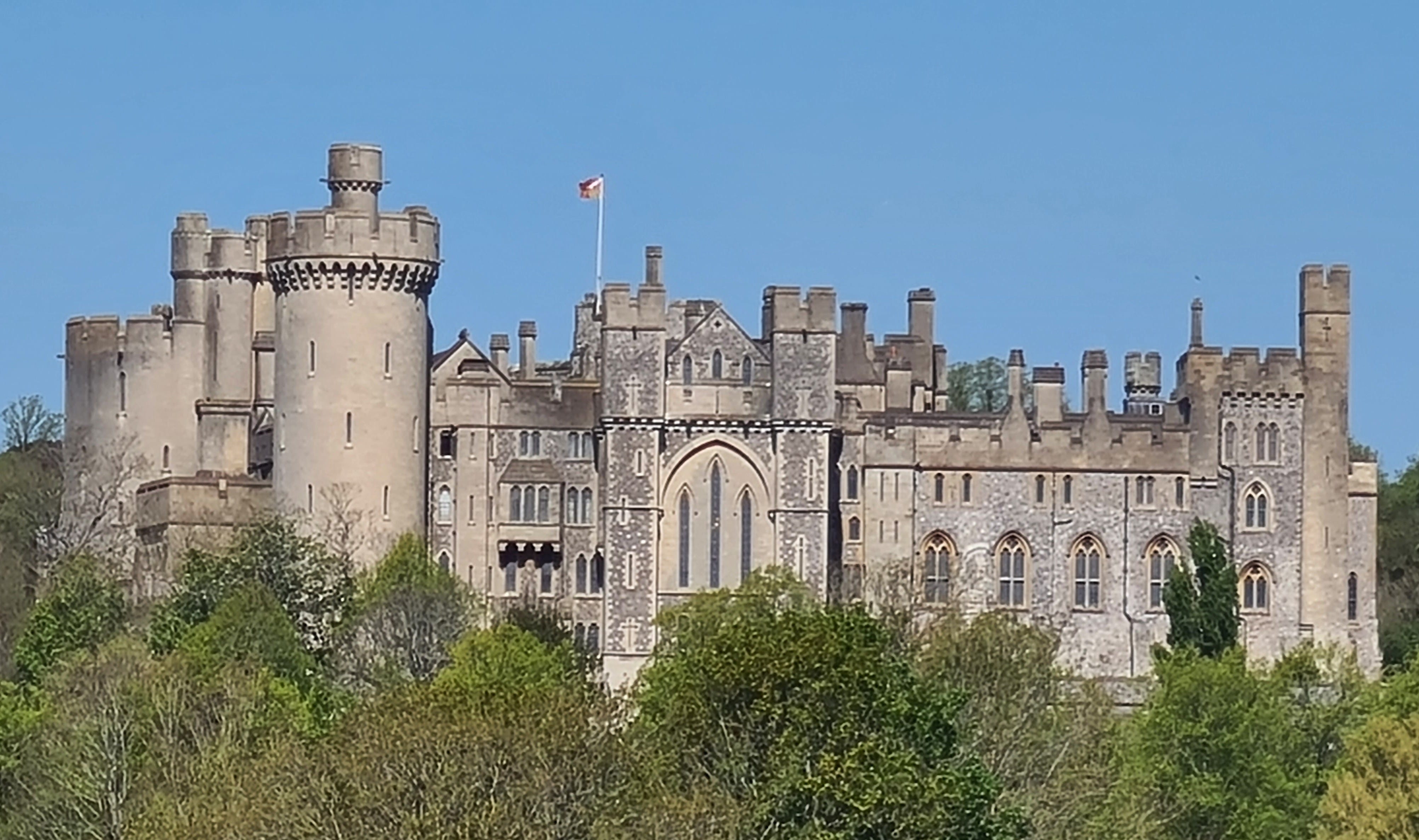
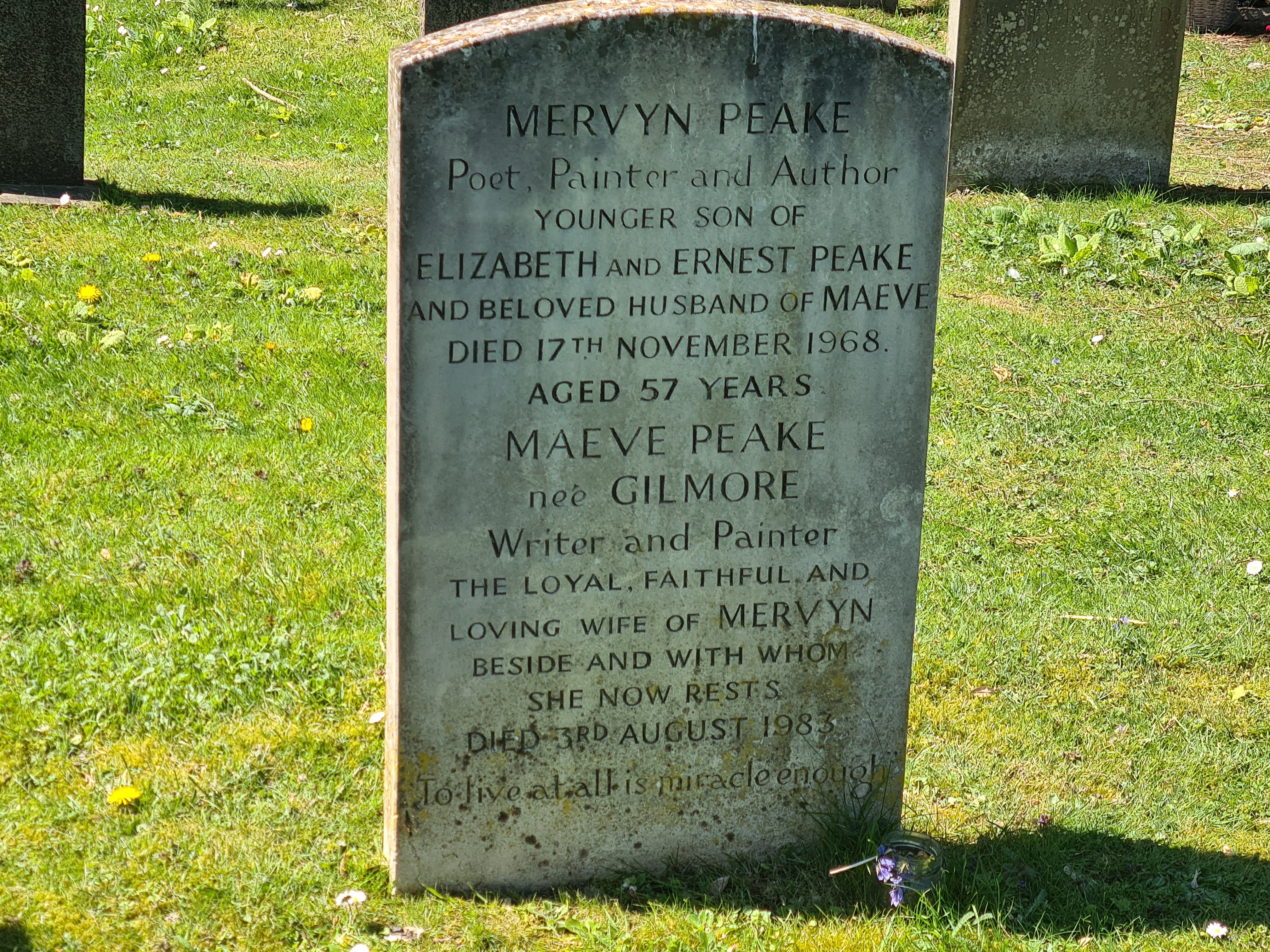
Nestled comfortably in the South Downs, a couple of miles north-east of the town of Arundel, is the very pretty Sussex village of Burpham, and for the first time in over twenty years, I went to seek out the grave of one of my literary heroes, who sadly passed away in 1968 when I was only five years old and he was only fifty-seven.
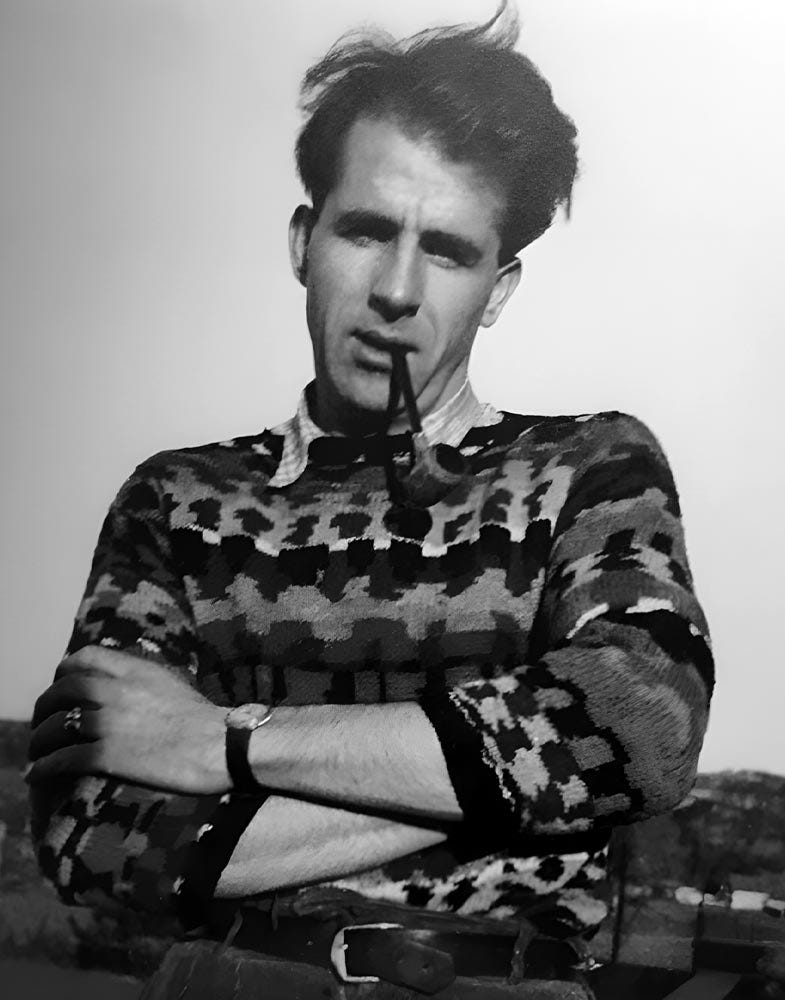
The writer is Mervyn Peake. Not only was he a writer, he was also a poet and artist. His grave is in St Mary the Virgin churchyard in Burpham, an eleventh-century church in a village that is so quiet and tucked away that you could miss it entirely. Also in the grave is his wife Maeve Peake. She died in 1983.
I have loved Mervyn Peake’s work since my twenties when I was first introduced to the Gormenghast trilogy, and I also have the added bonus that he is, and was, local to me. Arundel is only half an hour’s drive away from where I live on the coast. Over many years, I have walked the same countryside and seen the same views of Arundel Castle that, in my mind, were the catalysing element in Peake writing the Gormenghast books. But more on that later.
In July 2011 and for the centenary of Peake’s birth, a conference was held at the University of Chichester. ‘Mervyn Peake and the Fantasy Tradition.’ One of the speakers was Sebastian Peake who spoke about his father and about how life experience affects and artist. The author Joanne Harris was also one of the speakers. There was an exhibition of his work in the The Otter, and Pallant House galleries.
Peake’s work is glorious in its distorted ugliness.
Now I don’t say this lightly, or to denigrate his magnificent body of work – far from it. I celebrate his drawings for their ugliness. They are a celebration of the English grotesque, and I would argue that although not quite anglomythic in nature, Peake’s work is very much in the same lane.
I have written a few articles now on Tolkien and Middle-earth, and as much as I love the Lord of the Rings, I would be hard pressed to decide if Lord of the Rings or the Gormenghast books were my favourite books. I love them both equally, but for quite different reasons.
Tolkien’s world reaches upward. Middle-earth is built on a moral architecture, and his prose lifts you toward something divine and sacred.
Peake’s world reaches inward.
The saying ‘Beauty is only skin deep, but ugliness goes right through to the core,’ is very true of the Gormenghast books. There is no quest, no dark lord, no moral axis. Gormenghast itself is a vast castle so huge and ancient that it has become its own weather system, its own physics, its own reason for existing. Unlike Tolkien, the work does not lift you, it pulls you in and fills your mouth with the finest wine of fantasy prose.
Where Tolkien’s language serves something beyond itself, Peake’s language ‘is’ the thing itself. You don’t read Gormenghast for what it means. You read it for what it tastes like.
Tolkien built a mythology. Peake built a world that needs no mythology because the language itself is the experience.
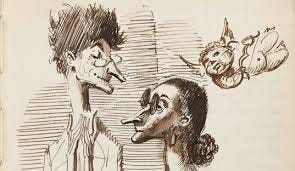
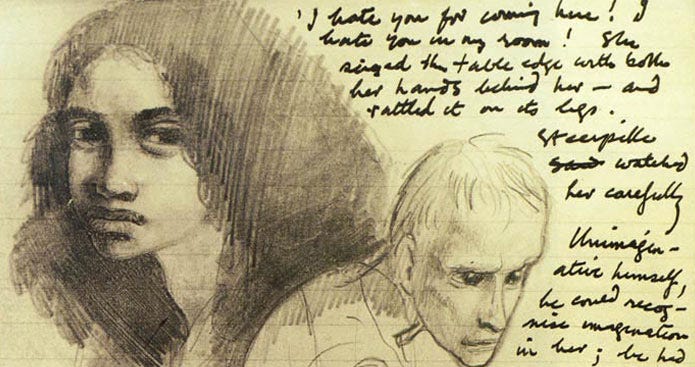
Like Tolkien, Peake was a creator in the fullest sense of the word. Writer, poet, painter, illustrator. He once said he turned to writing because he could not find a canvas big enough to paint the castle he had inside his head, and it is only now, as I write this article, that I wonder if I have a similar sensibility. He drew in the margins of his manuscripts, the characters appearing beside the sentences that described them, the pictures and the prose emerging from the same hand at the same moment. He designed costumes. He wrote plays. He illustrated Treasure Island, The Rime of the Ancient Mariner, the Alice books, Bleak House, the Brothers Grimm.
If you have never read him, what follows should tell you why you need to. Take your time and savour the language, as outside the story itself, it is an experience to be lingered over and savoured. It is also wonderful to read aloud.
What follows is the opening of the first chapter and a short extract from further into the chapter – just a taste.
The Hall of the Bright Carvings. Chapter 1 of the first book – Titus Groan.
Gormenghast, that is, the main massing of the original stone, taken by itself would have displayed a certain ponderous architectural quality were it possible to have ignored the circumfusion of those mean dwellings that swarmed like an epidemic around its outer walls. They sprawled over the sloping earth, each one halfway over its neighbour until, held back by the castle ramparts, the innermost of these hovels laid hold on the great walls, clamping themselves thereto like limpets to a rock. These dwellings, by ancient law, were granted this chill intimacy with the stronghold that loomed above them. Over their irregular roofs would fall throughout the seasons, the shadows of time-eaten buttresses, of broken and lofty turrets, and, most enormous of all, the shadow of the Tower of Flints. This tower, patched unevenly with black ivy, arose like a mutilated finger from among the fists of knuckled masonry and pointed blasphemously at heaven. At night the owls made of it an echoing throat; by day it stood voiceless and cast its long shadow.
And further on into the chapter.
Entering at seven o’clock, winter and summer, year in and year out, Rottcodd would disengage himself of his jacket and draw over his head a long grey overall which descended shapelessly to his ankles. With his feather duster tucked beneath his arm, it was his habit to peer sagaciously over his glasses down the length of the hall. His skull was dark and small like a corroded musket bullet and his eyes behind the gleaming of his glasses were the twin miniatures of his head. All three were constantly on the move, as though to make up for the time they spent asleep, the head wobbling in a mechanical way from side to side when Mr Rottcodd walked, and the eyes, as though taking their cue from the parent sphere to which they were attached, peering here, there, and everywhere at nothing in particular.
At the 2011 conference, Sebastian Peake spoke about what life experience does to an artist. He spoke about his father’s arrival at Bergen-Belsen concentration camp in June 1945, commissioned as a war artist to record what the liberating forces had found. Sebastian spoke about what his father saw there, what he drew, and how he carried it with him for the rest of his life.
I believe that knowing a writer’s biography is pivotal in understanding their work, and more importantly, enjoying their work. Not every detail or in an academic manner, but the broad shape of who they were and what they lived through. Lived experience informs a writer’s work whether they intend it to or not.
Mervyn Peake.
Mervyn Peake was born in 1911 in Kuling, a hill town in China, where his father was a medical missionary. He spent the first eleven years of his life there, in a compound surrounded by a wall, with China on the other side. The teeming streets of Tientsin, the Forbidden City in Peking with its pagodas and temples, the dark gorges of the Yangtze, the camel trains outside the city walls, the rituals that still dominated Chinese life. All of it entered a boy’s imagination and stayed there.
Peake came to England at the age of twelve, and went to art school where studied at the Royal Academy. He lived and painted on Sark in the Channel Islands, taught at the Westminster School of Art, married Maeve Gilmore and exhibited in London galleries.
For nearly twenty years, all that material sat in his subconscious, unwritten and waiting.Then in 1940, he and Maeve moved from London to a small cottage in Burpham, Sussex, rented from the Duke of Norfolk. And there, dominating the skyline to the southwest, was Arundel Castle. Vast, brooding, disproportionately large, a permanent presence. He began writing Titus Groan – the first of the Gormenghast books – that same year.
He joined the Royal Artillery, and was given special dispensation to continue writing his novel. In June 1945, he was sent to Germany as a war artist and entered Bergen-Belsen concentration camp.
Mervyn Peake drew the dying. There is a charcoal drawing of a girl and wrote a poem called ‘The Consumptive, Belsen 1945.’
Titus Groan was published the following year. The second book, Gormenghast, written in the years immediately after, deepens into tragedy, cruelty, and violence in ways the first book only hints at.
I often think about Peake besides Tolkien. Tolkien was at the Battle of the Somme in 1916. He lost all but one of his closest friends. He came home and began building Middle-earth. He called the act of creating an imagined world ‘sub-creation,’ and its purpose ‘recovery’: the restoration of a clear view of the world, achieved not by looking at reality more closely, but by looking at it through the lens of the imagined.
Peake never used that word. But I think he was doing exactly the same thing.
Both Tolkien and Peake experienced the worst violence and atrocities that human beings are capable of ,and came out of their experiences carrying the weight of what they had witnessed, and both responded by making. Whether we call that recovery, or therapy, or simply what artists do, the result is the same – the work contains the experience without being consumed by it. Both responded not by writing about what they had seen directly, but by building fantasy worlds as their own unique and individual ‘recovery.’
Whilst Tolkien’s world reached toward the divine, toward grace and light and the possibility of redemption. Peake’s world was a complete contrast. Peake reached towards wickedness, the pointlessness of existence as personified under the suffocating weight of ritual and stone. He delights in the absurd and grotesque. It is not a ‘funny’ set of stories, but I firmly believe they are supposed to be amusing, via their characters. And within character is where the roots of the English grotesque can be found.
It begins, for our purposes, with William Hogarth. His eighteenth-century engravings are savage, comic, overpopulated and merciless. Every face is exaggerated, distorted. Every exaggeration tells a truth. Hogarth does not caricature for laughs alone. He caricatures because the distortion reveals something the polite portrait would conceal. The drunk, the vain, the corrupt, the desperate – Hogarth draws them all as though the outside of a person should be forced to confess what is happening on the inside.
Then comes Dickens. The teeming streets of London, and the wonderful, names of the characters. And the names ‘are’ the character.
Pecksniff, Bumble, Quilp, Wackford Squeers – the comic-horrific character portraits where a man’s body becomes the outward expression of his soul. Dickens’s London is overpopulated, filthy, grotesque, and teeming with life, death poverty wealth, liberation and oppression. You name it, it can be found in Victorian London, (which is why I think it is so fascinating, but that’s another essay). Every room smells. Every face twitches. The comedy, the horror and the pathos often sit side by side in the same sentence, and none of them apologises for any of the others.
Peake knew Dickens intimately. His wife Maeve read Bleak House aloud to him in the evenings while he worked at his drawing board. He went on to illustrate Bleak House himself, and those illustrations were later described as Gothic exaggeration in which the comic is always the close companion of the sinister – as natural to Peake as it was to Dickens. When preparing his illustration style, Peake deliberately studied Hogarth alongside Cruikshank, Dürer, Blake, Doré, and Goya. The lineage was not accidental. He chose it.
But how many of you reading this have ever heard of Vivian Stanshall?
If you have not encountered Sir Henry at Rawlinson End, it is worth seeking out, (the audio version rather the the film). Stanshall’s creation is the crumbling English country estate populated entirely by grotesques, where the language itself has become drunk on its own excess. Every sentence staggers magnificently under the weight of more adjectives than it can reasonably carry. The house is falling apart. The inhabitants are monstrous. The whole thing is simultaneously hilarious and unbearable. Stanshall takes the Dickensian grotesque and removes the city entirely, trapping it inside a decaying building where the rituals of English life have long since lost any connection to their original purpose.
Intentional or not, Sir Henry at Rawlinson End is Gormenghast on steroids, comedy and all.
The tradition did not end there. Gerald Scarfe’s savage political caricatures carry the same Hogarthian conviction that the illustrated, exaggerated face, tells a deeper truth than the photograph. And in children’s books, Cressida Cowell draws and writes in the same hand; her manuscripts for How to Train Your Dragon are filled with scratchy, urgent illustrations inseparable from the story they tell. I would argue that like Peake’s illustrations, hers are also wonderful in their unashamed ugliness.
But in my view, Peake goes further than any of them.
Gormenghast exists nowhere. It is not England, although it feels English. It is not China, though the walled Forbidden City are definitely in its bones. It is not any place that has ever existed. It is its own self-contained world. Where Dickens dreamed a city, Peake dreamed a castle. Where Hogarth satirised a society, Peake invented one from scratch and populated it with characters who are the fantasy.
And like Dickens, the names are a banquet and delight for the senses. Rottcodd. Swelter. Prunesquallor. Flay. Steerpike. Barquentine. Sepulchrave. They are all quite wonderful, but they are not names that belong to human beings. They are names that belong to, and are part of Gormenghast castle, as though Gormenghast itself has not only named, but given birth to its inhabitants. Dickens would have recognised all of them instantly.
This is the English grotesque at its fullest flowering. Not cruelty for its own sake. Not ugliness as provocation. But the understanding that truth sometimes wears a twisted face, and that the exaggerated, the absurd, and the monstrous can carry an emotional honesty that the polished and the beautiful cannot.
I said earlier that I believe Arundel Castle was the catalysing element in Peake writing the Gormenghast books. Let me explain what I mean by that.
Sebastian Peake was careful to say that Arundel should be seen as just one of many candidates for the inspiration behind Gormenghast. He believed the castle formed but one of many visual memories retained from his father’s colourful and exotic upbringing. And he was right, as far as it goes.
But I would argue something slightly different. I do not think Arundel Castle inspired Gormenghast. I think it unlocked it.
For twenty years, all that childhood material from China, the swarming streets, and the Forbidden City, had been sitting in his mind for twenty years with nowhere to go. And then, most influential of all, Bergen Belsen Concentration camp. Peake was a painter, an illustrator, and a teacher, but he had not yet found the form that could contain what his mind was carrying. I would argue that when he moved to a cottage in the shadow of a castle, the form arrived. You could even argue that he may have had a J.K. Rowling moment. Hers was a delayed train when Harry Potter popped into her head. His may have been the first sight of Arundel Castle.
Read the opening of Titus Groan again. ‘The mean dwellings swarming like an epidemic around the castle walls.’ That is the compound in Tientsin, walled off from the swarming streets beyond
The Hall of the Bright Carvings, where wooden sculptures are seen in narrowing perspective like the highway for an emperor. That is the Great Spirit Way, the stone animals lining the road out of the Forbidden City. The rituals that nobody in Gormenghast understands any longer, performed with obsessive precision by people who have forgotten their origin. Those are the eternal rituals that still dominated Chinese life and were still ever present within the Forbidden City itself until the ejection of the last Emperor Puyi in 1924.
China gave Peake the content, Belsen gave him the darkness and finally, Arundel Castle gave him the shape. Titus Groan was already underway before Peake entered the camp in June 1945. But the second book, Gormenghast, was written in the years that followed, and it is a darker, crueller, more violent work than the first. Steerpike’s malice sharpens. The deaths become more intimate. The suffocating weight of the castle presses harder. It would have been impossible for Peake to walk through Bergen-Belsen and return to his writing unchanged. The experience alone did not create Gormenghast, but it deepened it. It gave the stone its coldest, cruellest temperature.
And Maeve, who walked the Downs above Burpham with him every day while he talked through characters and names and ideas, later said that the only three things she would save if their cottage caught fire were the baby, the nappies, and the manuscript.
There is something else in Gormenghast that I think anyone who cares about creativeity will recognise, and it is this: Gormenghast is a world where craft long ago became become hollow ritual.
The castle runs on ceremony. Ancient observances are performed at precise times, in precise ways, by people who have long since forgotten why. The Master of Ritual, Barquentine, enforces traditions whose origins are buried so deep in the past that not even he knows what they once meant. The Bright Carvers who live against the outer walls spend their lives creating wooden sculptures of extraordinary beauty and skill, and every year, only three of those carvings are carried into the Hall of the Bright Carvings, inspected, and stored. They are never looked at again, and those not selected – burnt. The making continues. The meaning has gone.
This is the dark mirror of everything I believe about craft. I have argued throughout this publication that making things with our hands and imaginations, that the act of creation is one of the most human things we can do, that craft carries meaning and memory and connection in ways that nothing else can. Gormenghast shows us what happens when that connection is severed. When making becomes obligation rather than expression. When ritual survives but purpose does not. When the hands keep moving but the heart has left the building.
It is, I think, a warning that sits uncomfortably close to our own time. We live in an age of content – of things made too quickly and too cheaply, because the corporate balance sheet demands it. The great ‘almost’ flood, as I called it in an earlier essay, is upon us. Gormenghast’s hollow rituals are not so very far from Western society’s own.
But Peake himself was the opposite of hollow ritual. He was a man who could not stop making. He wrote, he drew, he painted, he carved, he designed, he performed. Everything he made carried the full weight of his attention and his experience. The castle he created may be a place where craft has lost its soul, but the act of creating that castle was itself a triumph of craft at its most alive.
Why, then, is he not more widely known? Why does Gormenghast not sit on the same shelf as the Lord of the Rings and the Chronicles of Narnia?
I think the answer is that Peake refuses to make it easy for you. Tolkien gives you a quest. Lewis gives you an allegory. Peake gives you a castle and says: live in it. There is no ring to destroy, no wardrobe to step through, no clear axis of good and evil to orient yourself by, and more importantly, no way out. There is only the stone, the ritual, the grotesque.
Gormenghast does not travel as easily as Middle-earth because it does not offer the consolations that Middle-earth offers. There is no eucatastrophe, no eagles arriving at the last moment, no return of the king. There is only Titus, born into a world he did not choose, bound by rituals he does not understand, who eventually walks away from the castle entirely – and finds that the world outside is no less strange than the world within.
Perhaps that is why those of us who love these books love them so fiercely. They do not comfort or reassure, and they will not tell you that goodness will prevail. They simply show you what it is to be human – far too often trapped against our will inside structures and rituals we did not choose.
Peake was never able to finish the story he had begun. His illness, originally diagnosed as Parkinson’s disease and now understood to have been dementia, took his ability to write and draw long before it took his life. He died in 1968, aged 57. The third book, Titus Alone, was published in 1959 but had been heavily edited against his wishes, and a fuller version compiled from his early drafts was not issued until 1970. He had planned further books. They were never written.
But Maeve wrote.
In the years after Mervyn’s death, Maeve Gilmore sat down privately and began writing a continuation of her husband’s story. She called it Search Without End. She never seriously tried to publish it. She wrote it as an act of grief, of love, of her won recovery – that word again – working through the loss of her husband by continuing the journey of his most famous character – Titus.
In her version, Titus travels through landscapes that echo the places Mervyn and Maeve had lived in together, but in reverse order, as though Titus were walking backwards through their marriage. And gradually, without ever naming him, Titus moves toward a figure who is unmistakably Mervyn Peake himself. A widow writing her husband back into existence through his own character.
Maeve died in 1983 without telling anyone what she had done. The manuscript lay in the family attic for almost thirty years until, in January 2010, Peake’s granddaughter found four composition books in a box. Titus Awakes was published in 2011, the centenary year, the same year as the Chichester conference.
Sebastian Peake is gone now too. He is buried near Arundel, close to his father and mother. The Peake family and this Sussex landscape are bound together in the ground as firmly as they were ever bound in life.
At the base of Mervyn and Maeve Peake’s grave are the following words.
‘To live at all is miracle enough.’
Do not be put off by the bleak prospect of the books, which may be the impression given by this essay. I personally don’t find them at all depressing, they are the most glorious banquets of words I have ever read. If you love Dickens, you’ll love the Gormenghast books.
If you do read the books, take your time with them. Read them aloud if you can, and let the language fill your mouth and savour every morsel.