

The Knight at the Edge of the Thicket
Edward Burne-Jones and the moment before.

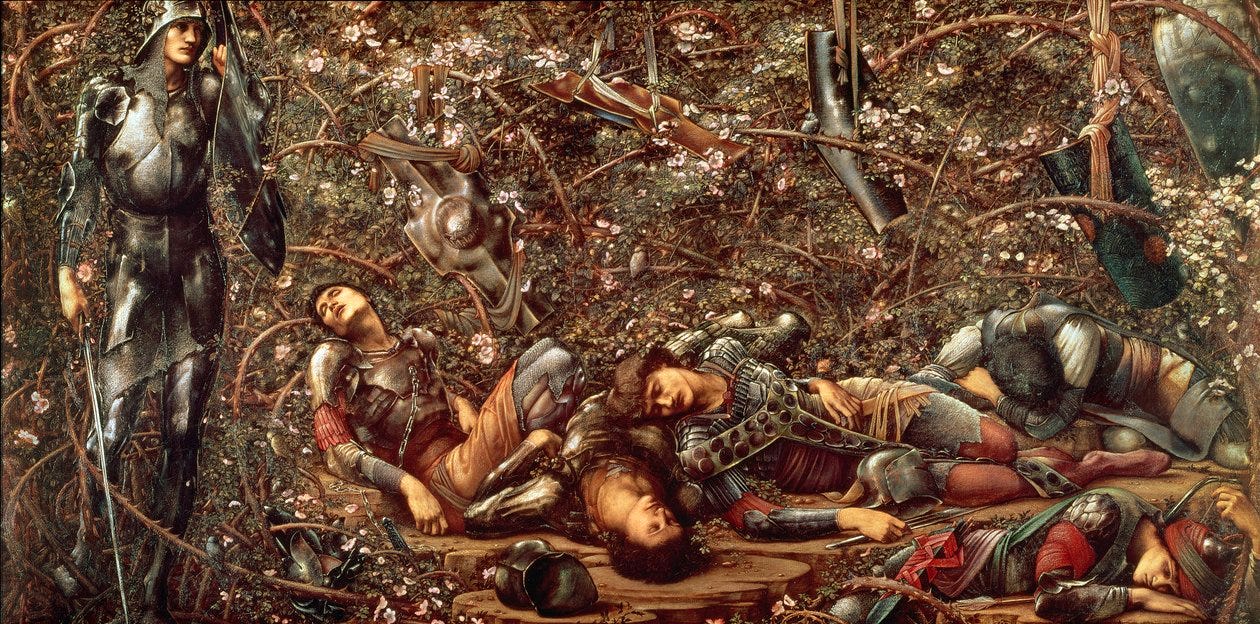
Earlier this year I wrote an essay called The Sixpenny Fairytale, about how fairy tales learned to dream. You can read that essay here. The essay opens with a place I have long wished to visit – Buscot Park in Oxfordshire, to see the Briar Rose paintings by Edward Burne-Jones.
Well, in July this year I made my pilgrimage.
The only problem was that I visited the place right in the middle of a thirty-four degree heatwave. I am used to living a few yards from the sea where it is nearly always cooler than inland, and thirty-four degrees in landlocked Oxfordshire is hot.
But there was an advantage to the heat. No people.
I spent the morning at Kelmscott Manor, William Morris’s house, and in the afternoon drove the few miles to Buscot to see the paintings I had wanted to see for decades. No doubt because of the heat, the house was virtually empty, and I had the Saloon and the Briar Rose paintings to myself.
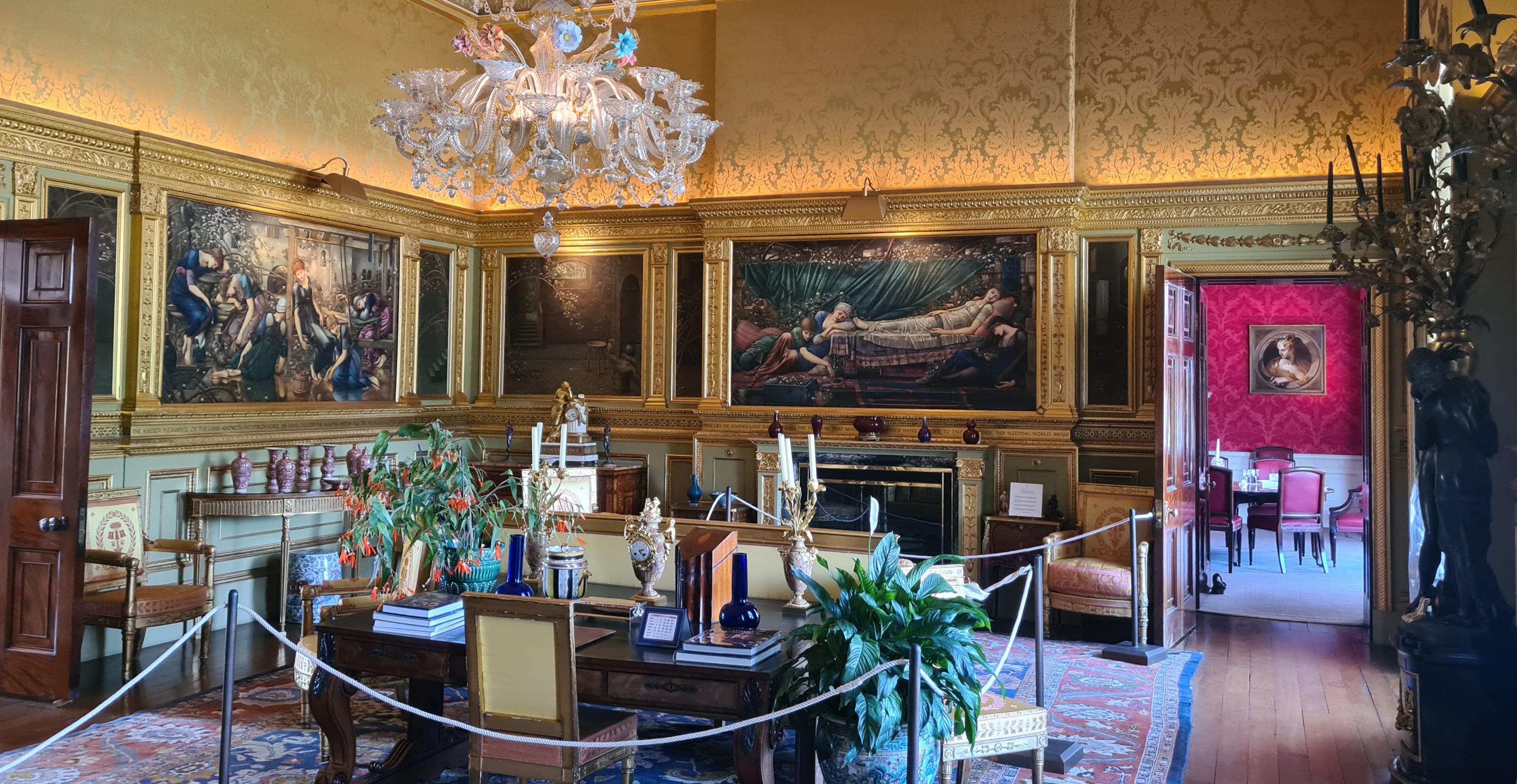
I have known these paintings all my adult life, four canvases telling the story of Sleeping Beauty: the knight in the thicket, the sleeping king and his council, the women fallen asleep at the loom, and the princess herself. Burne-Jones finished them in 1890, and Alexander Henderson, later Lord Faringdon, bought them straight out of their exhibition at Agnew’s in Bond Street.
They had always been intended as decoration for the drawing room at Buscot, but when Burne-Jones came to see them not long after they were hung, he thought the room was unsuitable and suggested they be moved to the Saloon. He was not happy about the frames either, or about the gaps between the paintings, plain intervals of wall where the story simply stopped. So he went back to work. He designed a frame of carved and gilded wood to bind the four panels together into a single narrative, and for the spaces between them he painted narrow panels of briar and thorn, continuing the rose motif, so that the thicket runs unbroken from the first canvas to the last.
Standing in the room, you understand the decision immediately. The briar panels link the paintings into one continuous narrative.
I moved back and forth in front of them for half an hour, trying to absorb the place. And what struck me, more than the beauty of the paintings, was the temperament of the man who painted them. Here was a man who had been painting this one story, on and off, for twenty years. He had exhibited the paintings to enormous acclaim, sold and delivered them, and then looked at the finished work hanging in Buscot and decided the job was not done. There was nothing wrong with the paintings themselves, he just felt that the story was not quite complete.
He did the same thing with the six panels of The Days of Creation. He designed the single enormous frame himself, wrote the inscription along the top, and then glued a small card to the back of each painting stating that the picture was not complete in itself, that it was one of a series of six, and that he desired they should never be removed from the frame he had made for them.
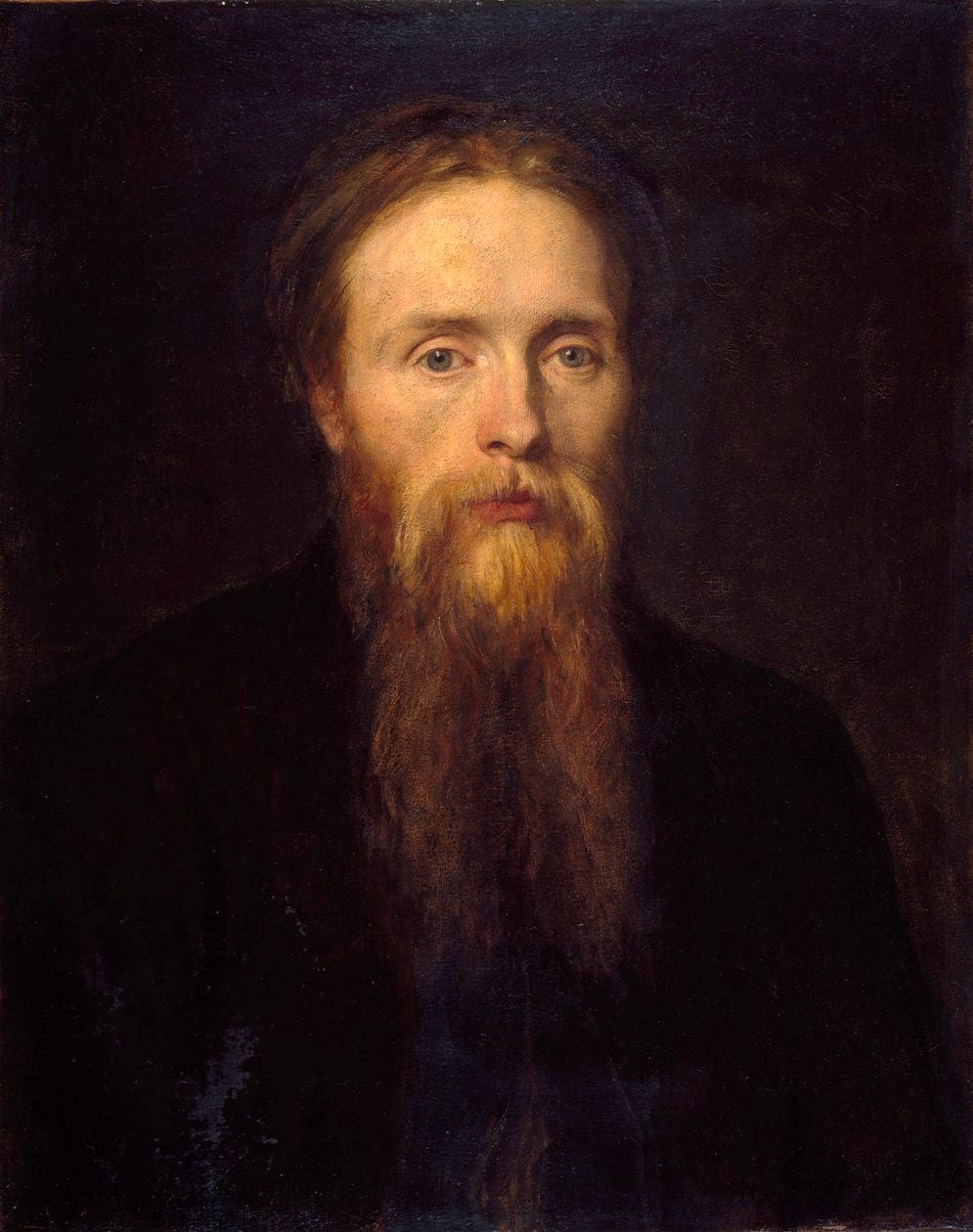
Edward Coley Burne-Jones was born in Birmingham on the twenty-eighth of August 1833, in a room above his father’s shop on Bennett’s Hill. His father was a carver and gilder, and made picture frames.
Edward grew up above a shop where his father created beautiful frames, and he learned that a painting, its frame and its setting were one and the same thing.
Six days after Edward was born, his mother died, and his father never recovered. He would look at his son, remember his dead wife, and weep. Edward was raised by the housekeeper, Ann Sampson, whose devotion to him was fierce, close, and suffocating. He was small for his age, and when he started at King Edward’s School he had a miserable time of it as he was terribly bullied.
Along with the bullying and a school he dreaded, he had a grieving father who was emotionally detached, a caring but smothering mother figure, and a city that made ugliness by the ton and cared nothing for beauty, and so, to escape the harsh reality of life, Burne-Jones read – voraciously. The Romantic poets, Byron and Keats especially; Coleridge; the Arabian Nights; Percy’s Reliques and the old ballads; and Sir Walter Scott’s romantic medieval work, which for a boy of that generation was the standard way into the romance of the Middle Ages. Also Ruskin, and by the late 1840s he was reading Modern Painters.
In 1853 he went up to Exeter College, Oxford, to read theology, intending to be ordained and become a priest. Within days he had met William Morris, who was there for the same reason, and they recognised something in each other at once. Both were drawn to the high Anglican revival then sweeping Oxford – to incense, vestments, ritual, plainsong. It was beauty smuggled back into English religion under cover of doctrine.
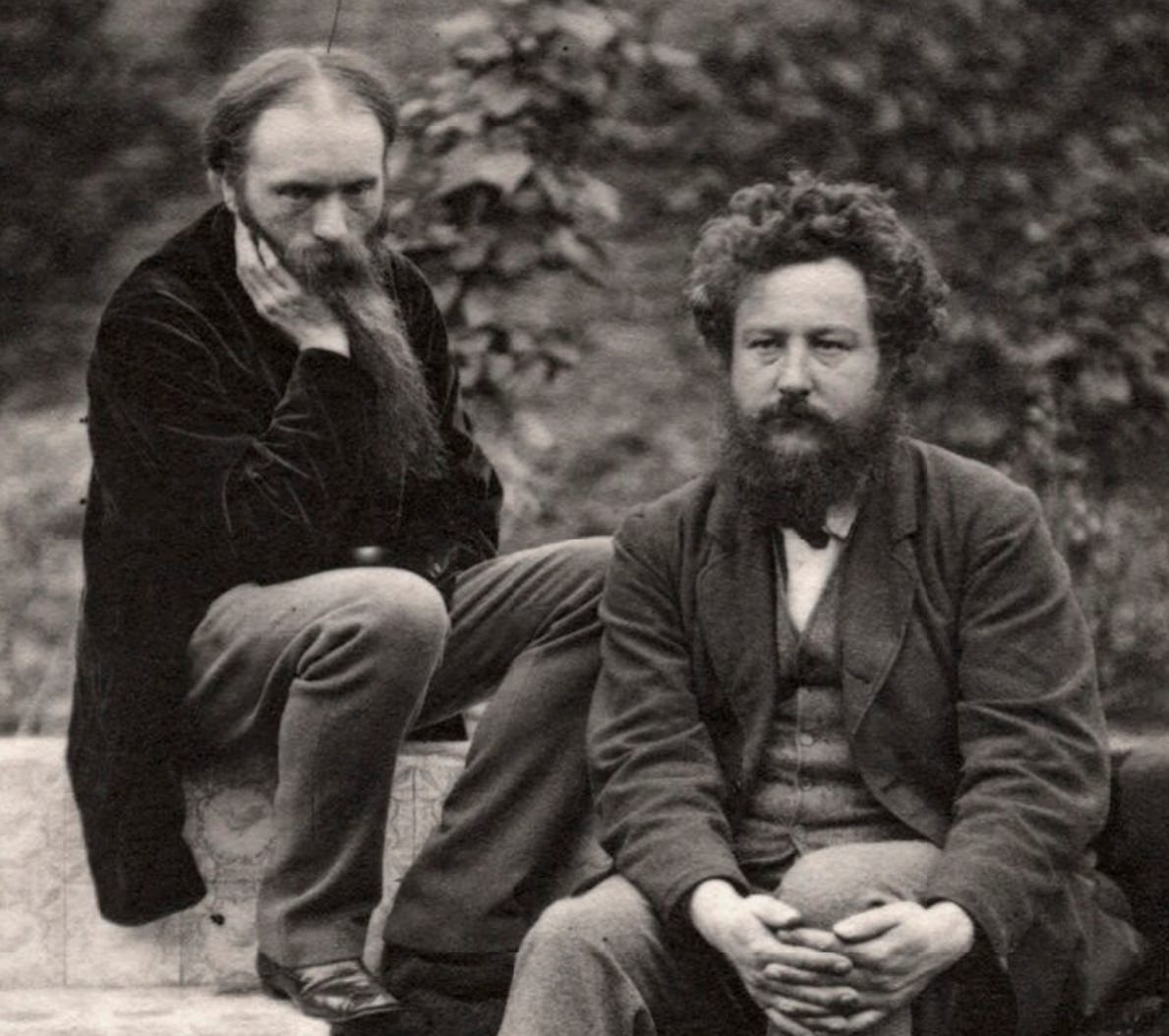
Together they planned a brotherhood which was to be half monastery and half workshop. They gave it a name: the Order of Sir Galahad.
In 1842, Tennyson had published his Arthurian poems, which Morris new by heart. Ruskin was preaching that Gothic work was morally superior to anything the nineteenth century could produce, and in his book Past and Present, Carlyle had set a medieval monastery against industrial England and found the present age wanting. Burne-Jones and Morris had arrived at a beautiful university of spires and plainsong at precisely the moment when England was inventing a romantic vision of the Middle Ages.
And then Morris came across and bought Southey’s edition of Malory’s Le Morte d’Arthur, a book Burne-Jones could not afford but Morris could, and after only a short time both men knew it virtually off by heart, reading it to one another in the evenings.
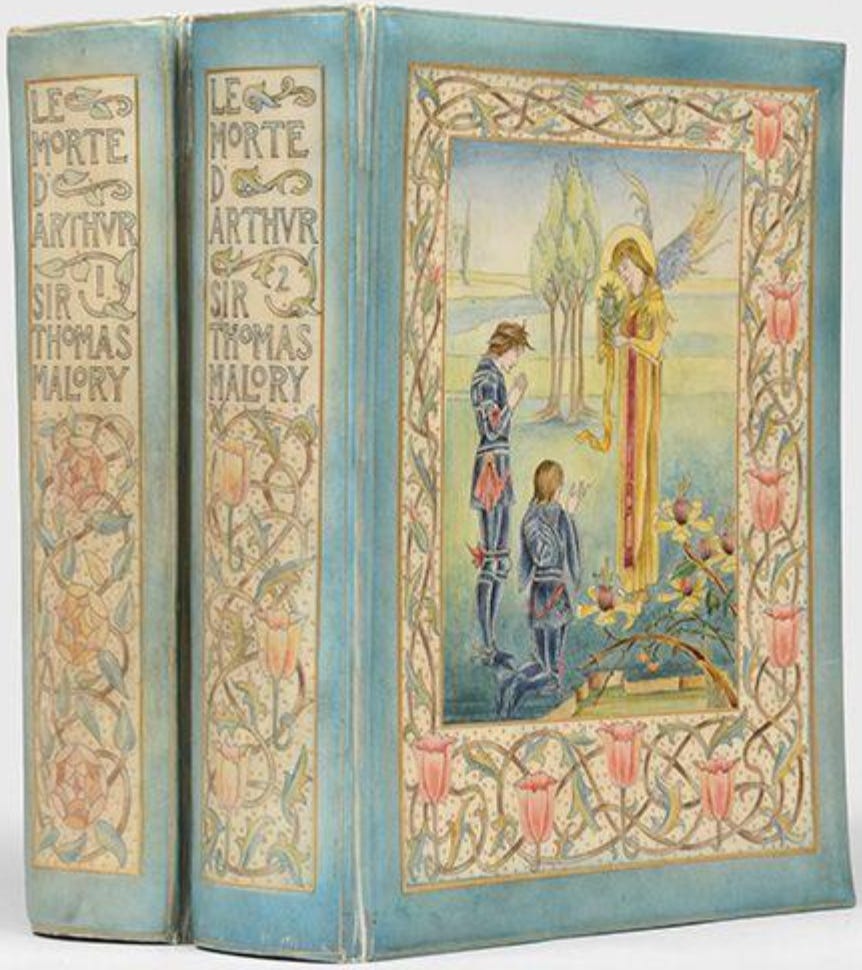
Then, two years later, at the end of a long walking tour of the French cathedrals, Burne-Jones and Morris stood on the quay at Le Havre and decided to abandon the church altogether. Morris would be an architect and Burne-Jones would be a painter. Fom that evening until Morris died forty-one years later, the two men would work closely together and remained very close friends.
Burne-Jones was twenty-two when he decided to become a painter, but he had never had a drawing lesson in his life. What he had instead was a habit of drawing constantly and an absolute conviction about the kind of world he wanted to paint. That world was myth, legend, and above all, King Arthur.
Le Morte d’Arthur had given him a world made by hand. A world where loyalty costs something. A world of quests, a beautiful romantic world rather than the harsh ugly reality of 19th century industrial England. Burne-Jones had found the world he longed for, and he stepped into it for the rest of his life.
From 1861 he worked for Morris’s firm, Morris, Marshall, Faulkner and Co, and once he started he never really stopped. Something close to a thousand stained glass designs over forty years, most of them going into quiet parish churches around the country. Tapestries, including the Holy Grail series woven for a Staffordshire businessman’s dining room. Tiles, embroideries, mosaics for a church in Rome. Painted cabinets and piano cases. Costumes and scenery for Irving’s King Arthur at the Lyceum. Eighty-seven illustrations for the Kelmscott Chaucer, which he called a pocket cathedral. And the paintings, always the paintings, some of them so large they outgrew the rooms they were meant for.
Galleries, houses, churches, the theatre, books. Burne-Jones was prolific and his romantic vision could be found everywhere.
And he knew exactly what he was doing. A picture, he said, is a beautiful romantic dream of something that never was and never will be, in a light better than any light that ever shone, in a land no one can define or remember, only desire.
And there is one more thing, which I keep coming back to.
Burne-Jones went up to Oxford intending to found a brotherhood named after Galahad – the pure knight, the one permitted to see the Grail. It is exactly the sort of thing a devout, bullied, motherless young man might name his hopes after.
But it was not Galahad he painted.
He painted Merlin, the enchanter trapped by his own longing for a woman who wanted only his power. He took him as his subject in the summer of 1857, up a ladder in the Oxford Union and, before he could properly paint, and he came back to the subject twenty years later for The Beguiling of Merlin.
He painted Lancelot asleep on the chapel step, shut out by his own failings, with the thing he most wants shining on the other side of a door he cannot go through.
He painted a knight who has stopped at the edge of a thicket of roses and never crosses it, and a princess who never wakes.
Burne-Jones almost never paints the moment itself, he paints the moment just before. In my view he preferred the moment before because he was a born storyteller. The moment before holds the maximum amount of emotional suspense, which by it’s nature, makes the painting more captivating. The viewer, unconsciously or not, is already asking the question – what happens next?
Which brings me to The Last Sleep of Arthur in Avalon, which I was lucky enough to see at the Tate in 2008.
Nothing had prepared me for the size of it. It is over six metres wide, with King Arthur lying on a bier beneath a great gilded canopy and surrounded by his court.
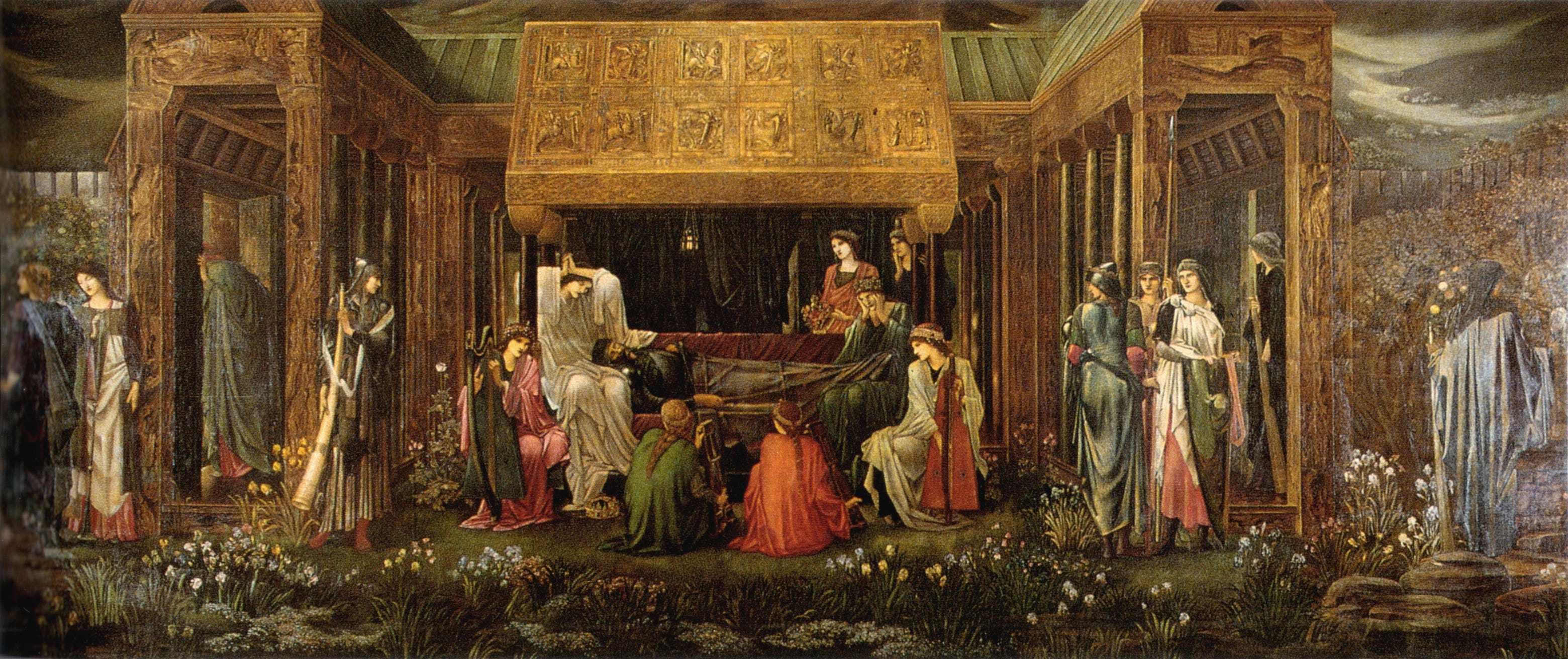
Burne-Jones began it in 1881 as a commission and the painting grew until it had outgrown any room that might have held it. He worked on it, on and off, for the last seventeen years of his life, and said of it that he needed nothing but a hill and a sky, and that Avalon had become the place he went to when the world became too much for him. The painting was quite literally a world he could escape to. Towards the end of his life he went out to the studio not so much to work on it as to step into it, and be gone for the afternoon. He was still working on it when he died, on the seventeenth of June 1898, at the age of sixty-four.
Consider what the legend actually says. Arthur is not dead. He is sleeping in Avalon, and one day, when the need is great enough, he will come back. Alone among the stories England tells itself, it is built entirely out of the moment before.
Edward Coley Burne-Jones created a medieval romantic vision around the moment before, a vision that people are still drawn into today, be it in a gallery in London, in a parish church on a Sunday morning, and or in an empty Oxfordshire house on a sweltering July afternoon.