

The Woman Who Painted Charlotte Mason's England
What J.R.R. Tolkien and Helen Allingham Have in Common

What does J.R.R. Tolkien have in common with a Victorian watercolourist most people have never heard of?
More than you might think. And the answer matters – not just for those of us who care about art and literature, but for anyone trying to understand what we lose when we stop paying attention to ordinary, everyday beauty.
In 1895, a three-year-old boy arrived in England from South Africa with his mother and brother, visiting family in Birmingham. His father died before he could follow them, and the small family settled at a cottage in Sarehole, a rural hamlet four miles from the centre of the city. The green fields and woods of Worcestershire – after the hot, dry veldt – made an impression that never left him. The mill on the river. The lane full of bluebells. The old cottages with their deep-set windows and climbing roses. He would later call it ‘a kind of lost paradise,’ and would describe those years as ‘the longest-seeming and most formative part of my life.’ His name, of course, was J.R.R. Tolkien, and from that countryside paradise he would build the Shire.
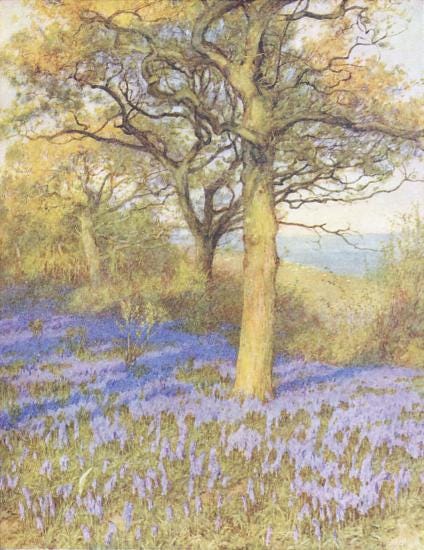
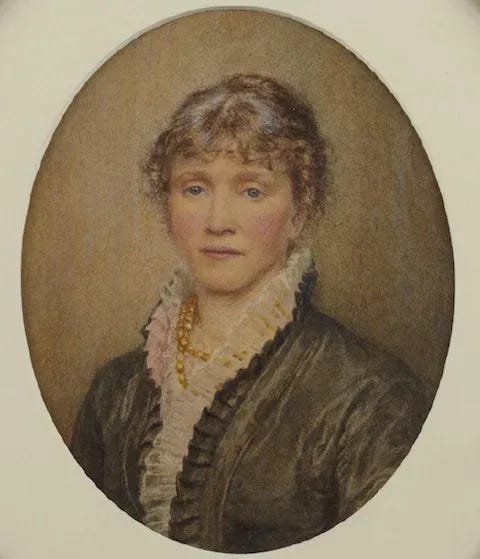
Thirty years earlier, a teenage girl called Helen Paterson arrived in Birmingham from the other direction. Helen was fleeing grief, not seeking adventure. Her father and three-year-old sister Isabel had died in a diphtheria epidemic, and she, along with her remaining family moved to the city to live with relatives. Helen enrolled at the Birmingham School of Design, and from there she went on to study at the Royal Academy Schools in London. In time she would become one of the most successful artists of her age.
She married and became Helen Allingham, and she spent her life painting exactly the kind of England that Tolkien would later mourn in prose.
Here is what connects them: what they loved was vanishing before their eyes. Tolkien revisited Sarehole in 1933 and found it swallowed by suburbia – red brick everywhere, the bluebell lane full of motor cars, the hamlet swallowed by modern development. Allingham had watched the same process unfold decades earlier in Surrey, where the old timber-framed cottages were being demolished to make way for modern development. Tolkien built Middle-earth as an act of memory. Allingham did something remarkably similar in her art, by painting cottages that were being knocked down, sometimes even restoring them in watercolour to their original state, undoing on paper what could not be undone in life.
I would argue that The Shire is an Allingham painting rendered in words. If you want to see the countryside idyll of Tolkien’s childhood, look at Helen Allingham’s work.
In all likelihood, and especially if you grew up here in Britain, you have probably seen her work and simply dismissed it. It is ubiquitous on biscuit tins and jigsaw puzzles, on greeting cards and calendars, on the covers of books about English country gardens. A thatched cottage half-buried in roses or a child at a gate with late afternoon light falling across a garden path.
That is both Helen Allingham’s legacy and her problem. She has been so thoroughly reproduced, so completely absorbed into the visual wallpaper of Englishness, that the woman behind the images has become invisible. And with invisibility came dismissal. Chocolate-box. Sentimental. Merely pretty. The word ‘merely’ has done a great deal of damage to Helen Allingham’s reputation, and it is time to put that right.
Helen Mary Elizabeth Paterson was born in 1848 in Swadlincote, Derbyshire, the eldest of seven children. After the family tragedy that brought her to Birmingham, she trained at the School of Design and then, following her aunt Laura Herford, (the first woman ever admitted to the Royal Academy Schools) Helen went to London to study.
What followed was a career of quiet but extraordinary distinction. As a young illustrator, she became one of the founding staff members of The Graphic – and the only woman. She illustrated Thomas Hardy’s Far from the Madding Crowd for its first serialisation in the Cornhill Magazine in 1874. Vincent van Gogh, studying English illustrated journals as he developed his own art, was struck by her work and wrote about it to his brother Theo. She was not a minor figure. She was at the centre of things.
In 1874 she married the Irish poet William Allingham, who was nearly twice her age and moved in the literary circles of Cheyne Walk – Tennyson, Carlyle, Rossetti, Ruskin. John Ruskin became an admirer of her painting. When she showed him a gentle portrait of Carlyle in his garden, Ruskin asked why she had drawn the philosopher as a lamb when he should be drawn as a lion. Her reply, recorded by her biographer Marcus Huish, was that she could only paint him as she saw him.
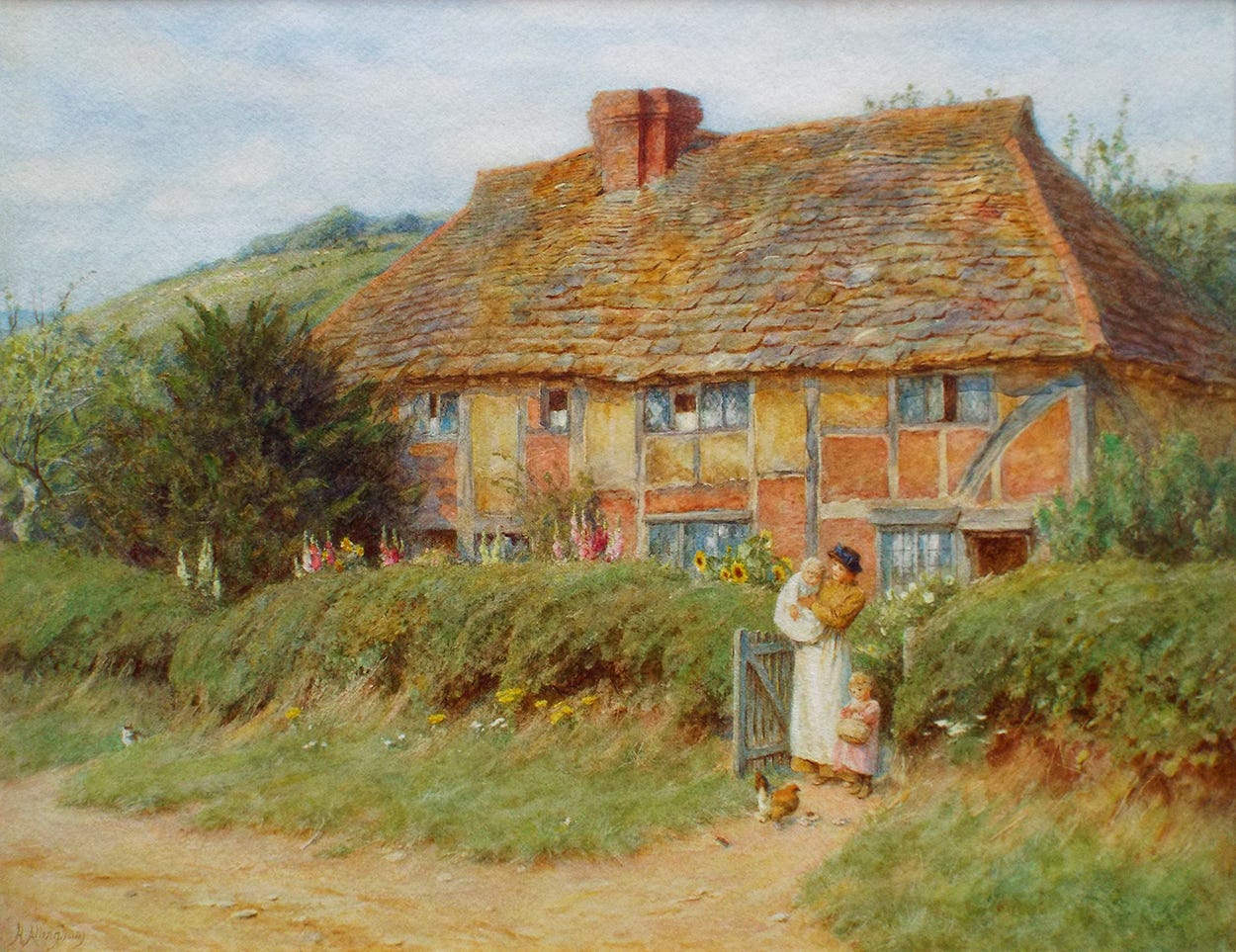
Free from the daily need to earn a living through illustration, she turned fully to watercolour – her true love. The family moved from Chelsea to Sandhills, near Witley in Surrey, and there she found her subject. The cottages, gardens and timber-framed farmhouses with their deep thatch and tangled hedgerows, along with the women and children who lived in them.
In 1890, she became the first woman admitted as a full member of the Royal Watercolour Society. She exhibited constantly, collaborated with Gertrude Jekyll (painting the famous garden at Munstead Wood), and moved in a Surrey circle that included the watercolourist Myles Birket Foster, the illustrator Randolph Caldecott, her lifelong friend Kate Greenaway, and the naturalist Alfred Russell Wallace.
Unfortunately, Helen was widowed at forty-one, and with three children to support, she did so through her painting. She was prolific, professional, and commercially astute. She was not, despite a century of condescension, a lady dabbler painting pretty pictures for parlour walls.
So why the dismissal?
Because she painted ‘pretty’ cottages and gardens. Because she worked in watercolour, the medium that polite Victorian society considered ‘suitable for a woman.’ Because her subjects were domestic, rural and quiet. Because her paintings looked ‘easy,’ as though capturing light falling on a garden wall required no skill or intelligence to render.
But most damning of all, because her work was beautiful. Beauty, in the critical vocabulary of the twentieth century, became suspect. If something was beautiful, it must be shallow. If it was popular, it must be unsophisticated. If it made people feel nostalgic, it must be dishonest.
But Helen Allingham was not dishonest. She was doing something far more honest than simply reaching for nostalgia.
She was recording. The cottages she painted were being demolished – torn down by landlords, replaced by modern buildings, lost to the advance of development that was slowly eroding the English countryside in the decades either side of 1900. Helen Allingham knew this all too well. She painted the cottages and countryside precisely because they were disappearing. In some cases, she even painted cottages back to their original condition, removing later alterations and showing them as they had been before the changes began.
This was not sentimentality, it was an act of preservation – the same impulse that drove Ruskin, Morris, and the Arts and Crafts movement, the same impulse that built the National Trust. The fact that she did it with a palette of soft colours and in watercolour does not make it any less valid. If anything, the gentleness of her method has obscured the urgency of her purpose.
One reviewer at the Watts Gallery, which mounted a major Allingham retrospective in 2017, put it well. Allingham painted not just the destruction of the buildings but ‘the way of life, a world when man, or more often woman, and nature were as one.’
That is the world that Tolkien saw being lost in and around Sarehole.
Which brings us to Charlotte Mason.
Mason, born in 1842, was Allingham’s almost exact contemporary. They lived through the same decades, watched the same changes, breathed the same air of Victorian England as it tipped into the modern age. There is no evidence they ever met. Mason was an educator in Ambleside; Allingham was an artist in Surrey. Their paths did not cross, but their convictions did.
Charlotte Mason believed that children should be surrounded by beauty – not as a luxury, but as a necessity. She believed in what she called ‘picture study’: the careful, unhurried contemplation of great art, one painting at a time, until the child could hold the image in memory. She wanted every child to leave school with ‘whole galleries of mental pictures’ and ‘at least a hundred lovely landscapes’ hanging in the halls of their imagination.
She also believed in nature study – in training children to see what was actually in front of them. Not just to glance, but to look. Not just to look, but to attend. To notice the way light changed across a field. To draw what they saw, carefully, in a nature journal. To learn the names of things and the habits of things and the seasons of things.
Allingham painted that curriculum. Her watercolours are picture study and nature study fused into a single image. They teach attention. They reward close looking. They show the beauty of ordinary things – a garden gate, a flowering hedge, a child standing in a doorway – rendered with the kind of patient, precise observation that Mason spent her life trying to cultivate in children.
And yet Helen Allingham does not appear on any Charlotte Mason picture study schedule I can find. The major homeschool curricula that follow Mason’s method – Ambleside Online, Simply Charlotte Mason, and others – have assembled careful lists of artists for children to study, term by term, year by year. Turner is there. Constable is there. Millet, Monet, Vermeer, Rembrandt, Van Gogh. All worthy. But not Allingham.
This is, I think, an oversight worth correcting. Not because Allingham is better than any of those artists – she would not have claimed to be – but because she is closer to what Charlotte Mason actually described. When Mason talked about children learning to see ‘the common sights of life’ through art, she was describing what Allingham had spent forty years painting.
There is a pattern here, and it runs through everything I write about on this Substack.
We dismiss the things that are closest to us. We overlook the art that looks like life. We assume that beauty must be dramatic or exotic or difficult to be worth our attention, and in doing so, we lose sight of the beauty that is right in front of us, the beauty of an old cottage, a well-tended garden, a child playing by a gate.
Helen Allingham spent her career insisting that this beauty mattered. She was called sentimental for it. She was reduced to a biscuit tin. But the cottages she painted are gone, and her watercolours are what remain – not as decoration, but as testimony. She saw what was vanishing, and she put it down on paper before it was too late.
If you want to see Tolkien’s childhood playground, seek out Helen Allingham’s work.
Tolkien, Ruskin, Mason, and Allingham all in one article! This was a treat to read. Thank you for sharing. I’m going to look into getting some of Allingham’s work into my school curriculum. I work at a classical Christian school and we are Charlotte Mason-art study lovers!
Have you considered reaching out to a publisher about bringing out a set of Helen Allingham prints for picture study?