

Why Adults Queue for Butterbeer
On imagination, reading, and the magic we are in danger of losing

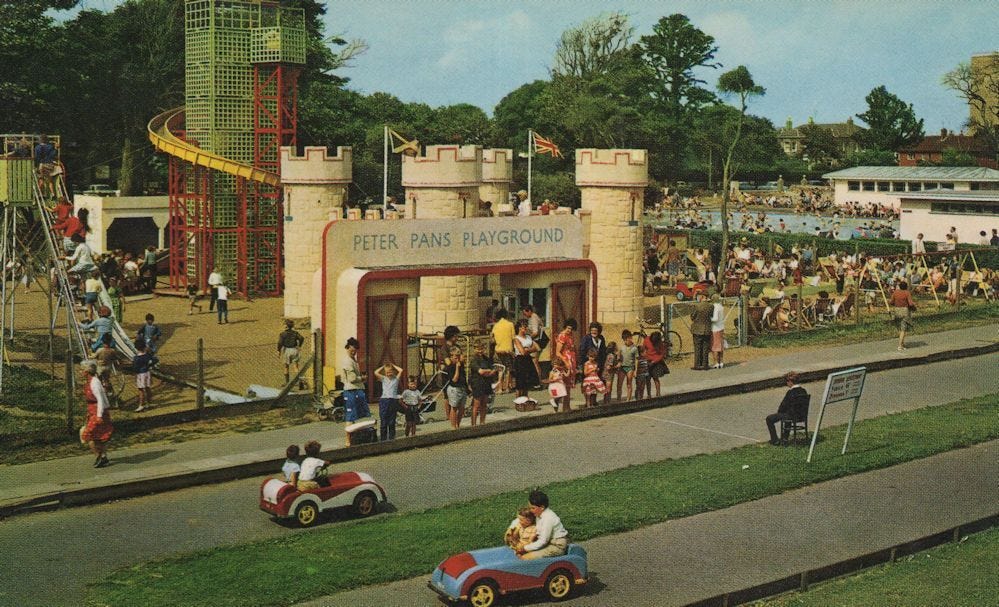
Why Adults Queue for Butterbeer.
On imagination, reading and the magic we are in danger of losing.
There is a photograph of Peter Pan’s Playground in Worthing that I found some years ago, a faded colour postcard from the early 1970s. In it, children queue at a turnstile beside a small white castle with four towers, one at each corner. Pedal cars circle a track in the foreground. A helter-skelter rises behind. It is a perfectly ordinary seaside playground of its era, and to anyone else that is all it is: a postcard, a curiosity, a glimpse of a Britain that no longer exists.
But to me, it is a door back in time.
I must have been six or seven years old. My parents were early risers, the kind who arrived at destinations long before anything has opened, or in fact before the rest of the world has even had breakfast. We had driven down to the Sussex coast from London in the half-dark, and I had slept most of the way curled under a blanket in the back seat, waking with a start as we pulled into a large and empty car park. It was a cool, clear June morning, still early enough that the light still had a thin, sliver quality that spoke of the hot summer day to come.
And there, across the empty tarmac, was a castle. The castle. My castle.
That was what caught my eye. In a moment I was out of the car and running over to it, but the playground was still closed and wouldn’t open for another hour or two. There was no gate, just a ticket booth and a simple turnstile, hardly a barrier at all. A small child could easily have slipped beneath it, and that is exactly what I did.
Inside, the play ground was covered in thick white sand, and the first thing I did, as I always did, was kick off my sandals. I can still remember the cool, slightly damp sand between my toes. The castle was only made of wood and painted plaster, and the towers smelled faintly of pee from one too many child accidents, but I didn’t mind. I didn’t see wood and plaster; I saw something far grander, bigger, older. I had no interest in the rest of the playground; it fell away, replaced by a kingdom of my own. I was a knight, a wizard, and a king all at once, defending my stronghold from imaginary dragons, rescuing damsels imprisoned in towers, or casting spells and mixing potions. The faint scent of paint and timber became, in my mind, the warm, sun-baked smell of ancient stone - the smell of wee, the stinky potion in a cauldron, and for me it was all completely real.
Across the car park, I could see my parents beginning to move about, my mother making breakfast on the car bonnet - cornflakes and tea in a plastic thermos cup, that was too hot and always tasted of plastic. My father looking towards the castle, My castle.
I didn’t wave. I hid.
I had an overwhelming desire to stay hidden, not out of mischief but out of something more instinctive. I knew, with a certainty I couldn’t have articulated, that the moment they saw me the spell would break. That a kingdom requires, above all things, that no sensible adult is watching. Eventually my father’s eyes found me, and I dutifully returned to the car and to breakfast.
I went back to that castle every time we spent a day in Worthing. But it was never quite the same as that first illicit morning, alone in the early light, when the castle belonged to me and I was king.
What was the infant me, over fifty-five years ago now, actually experiencing in that castle? Was I just using my imagination? Just playing make-believe?
I want to stop at those words, because I think they matter more than we realise.
Take imagination first. We celebrate it - up to a point. It is on the curriculum, art, drama, creative writing, the school play. World Book Day. The children’s publishing industry, worth billions, is entirely predicated on imagination being valued. Nobody, in 2026, would openly argue that children shouldn’t have one.
But there is a particular kind of imagination that gets no timetable slot and earns no marks. The unstructured, solitary kind. The child alone in a castle at dawn, defending a kingdom that exists only in their head. An afternoon lost entirely in a world of their own making, doing nothing that could be measured or assessed or put in a report. That kind of imagination, the kind that requires only a cardboard box and permission, is the one that gets quietly squeezed out as the demands of measurable achievement accumulate. Imagination is all to often only celebrated in sanctioned forms and subordinated everywhere else.
Make-believe is worse. It is a compound word that contains its own diminishment - the make suggesting fabrication, the believe immediately qualified by the make that precedes it. We have built the scepticism into the language itself.
But the most damaging word of all, in this context, is just.
Just pretend. Just make-believe. Just playing. Just imagination.
That single word does enormous damage - and importantly, not to the child, but to the adult who says it. In using it, the adult simultaneously acknowledges and diminishes whatever the child is doing, as though their inner world is of lesser importance than whatever the practical world requires of them next. More damagingly still, in saying just, the adult is projecting their own disenchantment onto the child, assuming that growing up means growing out of imagination, because that, somewhere along the way, it is what happened to them.
What was happening in that castle was not a lesser version of engaging with reality. I was not just playing make- belive. For my six year old self, it was reality - processed through the most powerful and precious instrument a child possesses: an imagination running at full capacity, entirely unencumbered and doing precisely what it is meant to do.
The castle was wood and plaster, and it was ancient stone. Both of these things were simultaneously true. A child holds this contradiction without effort, without embarrassment, without any need to resolve it. The ordinary world doesn’t disappear, it gets promoted. Transformed into the substrate of something larger. The deckchairs didn’t cease to be deckchairs. They became guards who happened to look exactly like deckchairs.
This is not a failure to perceive reality accurately. It is a sophisticated act of creative perception, and it is one that not only more and more adults have lost, but that younger and younger children are steadily losing too.
But then if something is lost, it can also be found again.
Consider The Wizarding World in the Universal theme parks.
The Wizarding World lands have drawn around ten million visitors a year since opening in 2010, consistently the most visited areas in any of their parks. Interactive wands, priced at up to eighty-five dollars each, are among the highest-selling merchandise items in theme park history. The precise number sold over fifteen years is not publicly known, but even a conservative estimate - twenty per cent of visitors, across fifteen years - puts the figure somewhere between ten and fifteen million wands, and the revenue somewhere between half a billion and a billion dollars from wands alone, before a single ticket, butterbeer, or broomstick is counted.
How did a corporate giant sell a billion dollars’ worth of plastic sticks?
I suspect the demand was never primarily driven by children. It was driven by adults who read those books at ten, twelve or fifteen, and discovered twenty years later that the hunger was still there. Still intact. Still looking for somewhere to go. The wands are not toys. They are a pass key - permission that allows the adult to revisit the child they once were, and to experience, briefly and at considerable expense, the magic they remember.
Disney understood this long before anyone else. The genius of their parks - the genuine genius, beyond the logistics and the economics - is that they are built to the precise specifications of adult longing. They are not designed for the children who are present. They are designed for the children those adults once were. Every detail calibrated to the moment when a story first became real. The castle at the end of Main Street is not a children’s attraction. It is an act of collective memory, and the adults weeping quietly as they walk toward it are not being sentimental, they are remembering something true and what they perceive, (probably subconsciously), as their own childhood selves.
The hunger for imagination doesn’t leave us. It simply gets lost, buried under the weight of ordinary life, waiting for permission to re-emerge.
Both Disney and Universal are extraordinarily clever at finding that buried longing, reawakening it, and charging admission to reach it. I don’t say this with cynicism, the experiences and joy is genuine, and I understand completely the adult queuing for butterbeer with an expression of barely suppressed joy. I am that adult. But there is something worth naming in the distance between what we needed then and what we are told we need now.
I was fortunate enough, at six years old, to have my own castle, at least for an hour, of wood, plaster, (and pee). At home, cardboard boxes and dining room tables and blankets thrown over chairs did the same job. The imagination was the thing, the props almost nothing.
Fast forward to today, and we are told the only way back is through licensed intellectual property, a twenty-minute queue, and an officially sanctioned butterbeer. Corporate appetite has monetised the longing, and — more worrying - convinced far too many people that their imagination can now only be accessed at the turnstile.
It was never true.
It still isn’t true, as somewhere right now, a child is proving it with a cardboard box and a blanket.
So what happened between that child in the castle and the adult in the queue?
The world got louder. Responsibility accumulated. The hundred practical things that constitute adult life crowded out the frequencies on which imagination thrives. We lost the habit of tuning in, but lost, not destroyed. That is the crucial and more importantly, hopeful distinction.
There is also, I think, a particular British cultural discomfort around being caught believing that makes this worse for us brits than for those in the USA. In the UK, the adult imagination is only tolerated in certain licensed contexts, fiction, film, games, the safely bounded space of a theme park. These are the approved channels, the places where believing is permitted.
We learn, somewhere between childhood and adulthood, that the deckchairs are just deckchairs. That seeing them as guards is charming in a six-year-old and alarming in a thirty-year-old. We become, in the truest sense of the word, disenchanted, not in a single dramatic moment but in a long, quiet erosion, the imaginative frequency still present, but now lost.
And yet I firmly believe there is a way back. There always has been. It runs, as it always has, through books.
Books remain enormously popular. They are delivered differently now, more often via screen, or as spoken word through earphones on a commute - and the industry has adapted accordingly. But the deeper habit of reading for pleasure, the private act of surrendering to a story for its own sake, is in trouble. Most alarmingly, it is in trouble among the young.
Here in the UK, The National Literacy Trust surveys over one hundred thousand children and young people every year. Their 2025 findings make for uncomfortable reading. Just one in three children aged eight to eighteen said they enjoyed reading in their free time, the lowest level recorded in twenty years. Fewer than one in five said they read anything daily, a figure that has fallen by nearly twenty percentage points since 2005. The steepest declines are among those aged eleven to sixteen - the precise ages at which a child’s relationship with reading tends to be formed for life.
A thirty-six per cent decrease in reading enjoyment since 2005 is a terrifying collapse.
Sit with that for a moment before moving on.
A child who does not read is a child whose imagination is being starved and replaced with unfulfilled longing, and who, in twenty years time, queue for the theme park because no one ever offered the cheaper, richer, more portable alternative, and who will need the billion-dollar infrastructure because the cardboard box was never offered.
The imagination doesn’t require a wand at eighty-five dollars. It requires a story, told well, given freely, at the right moment.
The reasons for collapse in reading numbers are not mysterious, and they are not the fault of children. Children, (as well has adults), have always chosen the path of least resistance when left to their own devices, this is not a moral failing, it simply evolution. The question is what we, as adults, have placed in their path.
And what we have put in their path, with increasing sophistication, is a screen.
I want to be careful here, because the screen debate has become so laden with guilt and counter-guilt that it is almost impossible to say anything useful. Screens are not the enemy. A child watching a beautifully made film, or playing a game that demands problem-solving, or listening to an audiobook in the car, is not the problem.
The problem with screens, specifically in the context of reading and imagination, is not that they are harmful. It is that they are frictionless.
A book requires something of you before it gives anything back. You have to decode the words, construct the world, populate it with faces and voices that the author has only sketched. The effort is the point. That slight resistance, the gap between the words on the page and the world in your head - is precisely where the imagination does its work and becomes stronger. It is where the castle gets built.
A screen removes that gap. It hands you the faces, the voices, the world, pre-constructed and fully rendered. There is nothing wrong with receiving a story this way. But it is a different transaction. The imagination is a passenger rather than the engine, and like any faculty that goes unused, it quietly loses its tone.
The compound effect of a childhood spent almost entirely in the passenger seat is what the National Literacy Trust data is measuring. The child who reads, who has always read, who was given books early and often and enthusiastically - arrives at adolescence with an imagination that has been exercised daily, strong, supple, and capable of building kingdoms from almost nothing. The child who has not read arrives at the same point with the same innate capacity, but untrained, unexercised, less confident in its own existence.
And here is the cruelest part: the longer the gap, the harder the return. A child who has not learned to find pleasure in the friction of reading by the age of eleven or twelve is unlikely to discover it alone. The steepest declines in reading enjoyment, as the Trust’s data shows, fall precisely at the ages when phones become ubiquitous and social media becomes consuming, when the comparative effort of reading a book becomes, without support, simply too much to ask.
We have not made screens too appealing. We have made books for children far less appealing and in turn, too easy to put down.
The solution is not to remove the screens. It is to make the books impossible to resist, which means putting well written and imaginative books in the hands of adults who still believe in them. Adults who remember what it felt like when a story became somewhere you actually lived. Adults who have not entirely forgotten the cardboard castle.
There is something particular that happens when an adult who still has access to their own interior world of imagination sits down with a child and a book.
I don’t mean reading aloud, necessarily, though that is its own kind of gift. I mean credibility and conviction that an adult with their own rich and active imagination brings to a story. Children are extraordinarily sensitive where adults are concerned. They can detect, with an accuracy that should unsettle us, the difference between an adult who is performing enthusiasm and an adult who genuinely feels it. The performed version is kind, well-intentioned, and goes almost entirely unnoticed. The real version lands, it is infectious and stirs the child’s own imagination into action.
When an adult has not entirely forgotten what it felt like to be a child reading, that enthusiasm shines though, the child feels that the adult in the room is not merely facilitating access to a book. They are a fellow traveller. Someone who has been to these places and knows they are real.
This is not a skill you can acquire by reading about it, you have to recover what is lost in yourself by occasionally, slipping under the turnstile yourself and and playing in the wooden castle.
A child handed a book by an adult who is merely being dutiful will put it down the moment something easier appears. A child handed a book by an adult who genuinely believes, who leans in and says this one, with quiet certainty, will open it. And once a child is truly lost in a story, lost in the way that makes the words disappear and allows the world to inhabit their imagination, has something alight inside them that does not easily go out.
In the United Kingdom, 2026 has been named as the National Year of Reading.
It would be easy to let this pass as a governmental initiative, a well-intentioned campaign, a thing that teachers put on classroom walls. It is all of those things, but is also something quieter and more significant: an official acknowledgement, arriving in the careful language of policy, that something real is at stake. That the habit of reading, begun early and sustained through childhood, matters enough to be named publicly, to commit to, and to ask the whole country to think about.
What the initiative understands, and what is difficult to say in the language of policy but which Care & Craft exists precisely to say plainly, is this: a child who reads is a child whose imagination been released. Who will not, in later life, need a billion-dollar theme park to feel wonder, because wonder was given life and room to grow early, at low cost, through the simple and revolutionary act of a story well told.
The castle in Worthing is gone now. Peter Pan’s Playground closed long ago and the site is a now a swimming pool complex. The white towers with their four corners and their faint smell of paint, pee and adventure exist only in a postcard and in the memory of a sixty-something year old man who once slipped under a turnstile in the early morning and discovered that he was king, knight and wizard.
But that magic was never entirely lost.
For me, a happy and fulfilled life, came from the magic of my imagination and that was never lost to begin with, due to parents who loved books and who loved to read.
But that very first spark, that very first moment of permission to have and to treasure my imagination began in a tatty wooden castle that smelled of wee.
Thanks for this. It was excellently written. As a father of a five-year-old, it touches on a lot of things I’ve been thinking about. I buy a lot of children’s fairytale books from charity shops and what I’ve noticed is that the ones from the 80s and 90s are beautifully illustrated (I mean actually stunning) and the stories carry a fully enchanted charm that you can feel holds the weight of times past. But the ones from the 2000s started to change: their illustrations are childish (in the worst sense) they are overly practical, focusing on simple sentences to help reading, and ultimately, and sadly, something foundational was stripped out of them.
What a beautiful post - I see those same changes through my lifetime. But I also see more and more people coming back the simple things which somehow spark our imaginations - I’ve written about some of them - Bagpuss, Old Bear, the model village to name a few - I hope that in time, this might filter into the generations to come 🌿