

Charlotte Mason’s England - The Sixpenny Fairytale
How Fairy Tales Learned to Dream

I live on the Sussex coast, and history and beauty is everywhere. From the stunning South Downs and Arundel Castle, to Watts Gallery and Memorial Chapel. (You can read about Watts Memorial Chapel here.)
I have visited these, and many other beautiful places, many, many times.
But there is one place to which I have not yet been, and I am desperate to go, and in my mind’s eye it has become a kind of pilgrimage yet to be undertaken – Buscot Park in Oxfordshire.
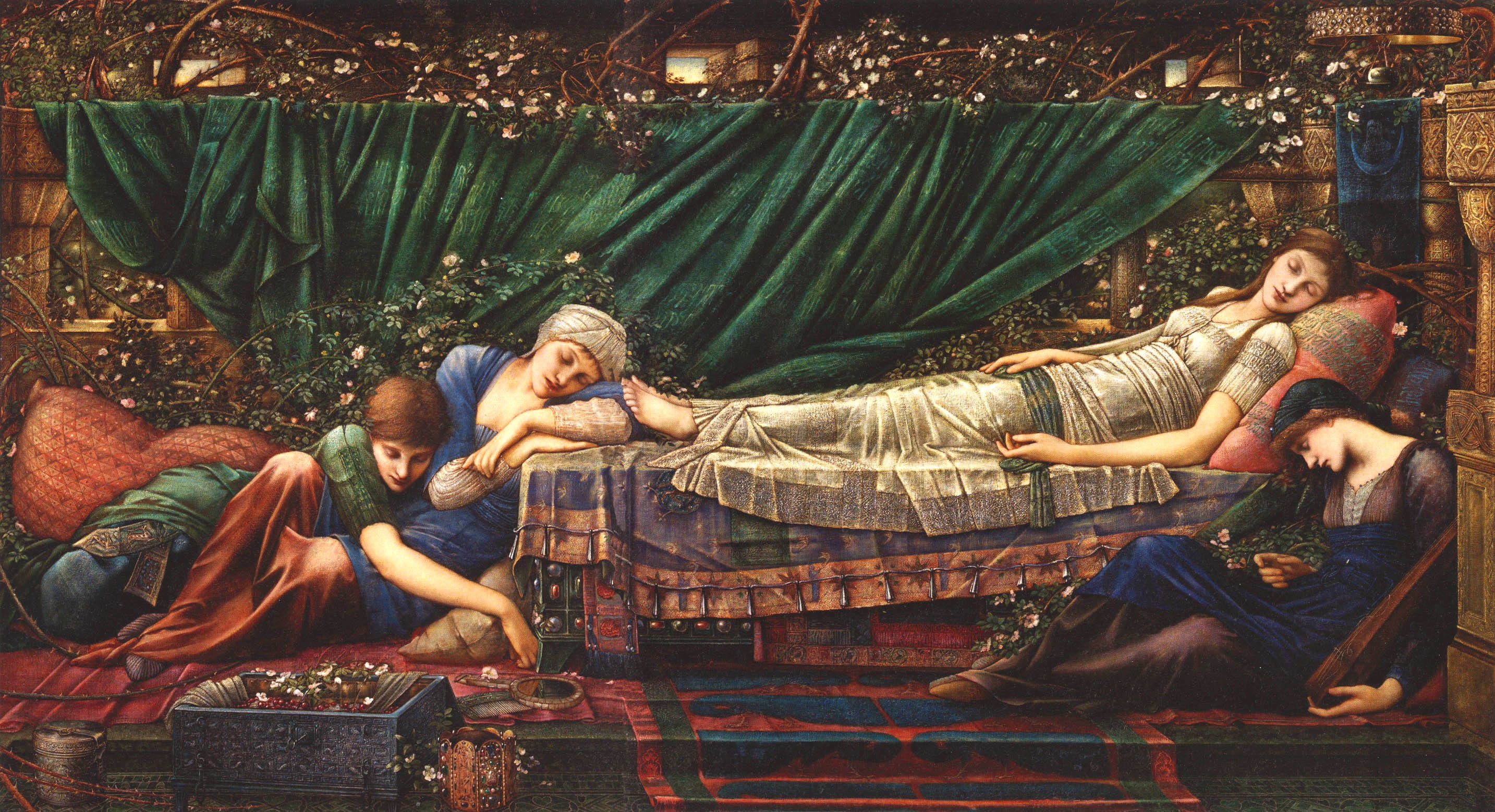
Buscot is a National Trust house, but it is not the house that is the destination of my pilgrimage. It is just one room within – the Saloon. This room contains four beautiful, iconic paintings by Edward Burne-Jones. The paintings tell the story of Sleeping Beauty – The Legend of the Briar Rose – a subject that consumed Burne-Jones for nearly twenty years, from his first painted version in 1871 to the completion of the Buscot canvases in 1890.
Lord Faringdon purchased the paintings in 1890, shortly after their highly successful public debut at Agnew’s Gallery in London, specifically for this one room.
When Burne-Jones was staying with his great friend William Morris at nearby Kelmscott Manor (another place on my pilgrimage list), he visited Buscot and was disappointed with how the paintings looked in the room. He went on to paint additional panels and designed carved gilt frames to complete the panorama.
William Morris – who my great-great-grandfather knew, (you can read about that here) – wrote some beautiful verses to go with the paintings.
The Briar Wood
The fateful slumber floats and flows
About the tangle of the rose;
But lo! The fated hand and heart
To rend the slumberous curse apart!
The Council Chamber
The threat of war, the hope of peace,
The Kingdom’s peril and increase.
Sleep on, and bide the latter day,
When Fate shall take her chain away.
The Garden Court
The maiden pleasance of the land,
Knoweth no stir of voice or hand,
No cup the sleeping waters fill,
The restless shuttle lieth still.
The Rose Bower
Here lies the hoarded love, the key
To all the treasure that shall be;
Come fated hand the gift to take,
And smite this sleeping world awake.
I have seen the paintings in reproductions; I have read about them, but I have never stood in front of them, and I long to do so, and I recognise that longing, that ache, and it is not simply about seeing the paintings.
Even though I have not yet seen them in the flesh, they are to me the embodiment of the romantic fairy tale.
Those paintings always wake up a dormant, but ever-present feeling that I have had for my whole life – the sense of something beyond this world, a world that I desperately want to reach and become part of.
Burne-Jones spent his whole life reaching for that world, a world beyond – and he brought it to life with paintings of luminous enchanted forests, sleeping princesses, and knights frozen at the threshold of something they could not quite enter. He painted that reaching, that longing for the world beyond, over and over again.
‘I mean by a picture, a beautiful romantic dream of something that never was, never will be – in a light better than any light that ever shone – in a land no one can define, or remember, only desire.’
Edward Burne-Jones
In my view, Burne-Jones is using fairy tale as a metaphor for the divine world we all hope for, and I wonder if that is why the Briar Rose paintings are, for me, more than beautiful. In them, Burne-Jones transforms the fairy tale from stories of darkness and terror to stories of light and divine hope, of the world yet to come.
But fairy tales were not always like this. They were not always enriching and beautiful. For most of their history they were dark, brutal, and often horrific stories with terrible endings. Somewhere between those ancient fireside warnings and the luminous world that Burne-Jones painted, the fairy tale was transformed.
How and why did this happen?
To understand, you have to go back further than you might expect – not to the stories themselves, but to the children, or rather the lack of them. There weren’t any.
On the face of it, this sounds absurd, but it is historically precise. There were young people – small humans who grew into bigger ones – but the idea of childhood as a distinct and protected phase of life, separate from adulthood, simply did not exist.
Children dressed as adults. They worked as adults. They were tried and punished as adults. A seven-year-old was not a child in the way we understand the word. He was a small man, and he was expected to fully understand the world in the way a fully grown man understood it.
And the oral fairy tales of that world made perfect sense. They were not children’s stories, because children, and in turn children’s stories, did not exist. They were dark stories because the world was dark. Forests were genuinely dangerous. Wolves were real. Famine was common. The tales carried the weight of all of this – warnings dressed in metaphor, survival lessons wrapped in narrative, and they did so because they were needed.
Little Red Riding Hood gets eaten because in the world that produced those tales, girls who wandered into forests alone did not come back.
It would be easy to assume that the darkness in these tales was moral – that the wolf punishes disobedience, that the forest swallows the wicked, that the old stories carried the same message as the Sunday school primer: behave or suffer. But that is to read them backwards, through a lens that did not yet exist.
In many cases, these folk tales were older than Christianity itself. The wolf in Little Red Riding Hood is not a symbol of divine judgement. It is a wolf – or a predatory man. The forest that swallows Hansel and Gretel is not a metaphor for the consequences of sin. It is a forest, and behind it stands the spectre of famine, parents who could not feed their children, and used abandonment as a last resort. These tales helped people navigate a genuinely dangerous world. They gave shape to real dangers so that the listener might recognise those dangers when they encountered them.
The moral tract tradition of fairy tale emerged from a different direction entirely, beginning in the seventeenth century with books like Janeway’s Token for Children in 1671 – a deliberate product of Puritan England, stories and catechisms written specifically to frighten children into piety and obedience, drawing their authority from the doctrine of Original Sin.
Sherwood’s Fairchild Family carried the tradition well into the nineteenth century, and the Religious Tract Society, founded in 1799, industrialised it. This was the tradition that Charlotte Mason would later call twaddle at its most fire-and-brimstone. It ran alongside the folk tales, drew on some of the same fears, but for its own purposes. It is the worst kind of allegory – the kind that Tolkien himself hated and warned against.
The older folk tales were darker, stranger, and more honest than the moral tracts. They did not pretend that obedience would save you. Sometimes the wolf wins. Sometimes the forest does not give the children back. Those old stories were terrifying, and deliberately so, to serve as a warning.
Charles Perrault, writing in the salons of Louis XIV’s France in 1697, was the first to commit these oral tales to paper for a literary audience. He took peasant stories – tales he had heard from servants and nurses – and rewrote them for the aristocratic salons of Versailles. He polished the language, added wit, attached neat verse morals at the end. His Cinderella got her glass slipper. His Sleeping Beauty got her prince.
But his Little Red Riding Hood also got eaten, because a hero does not come to the rescue. The wolf wins.
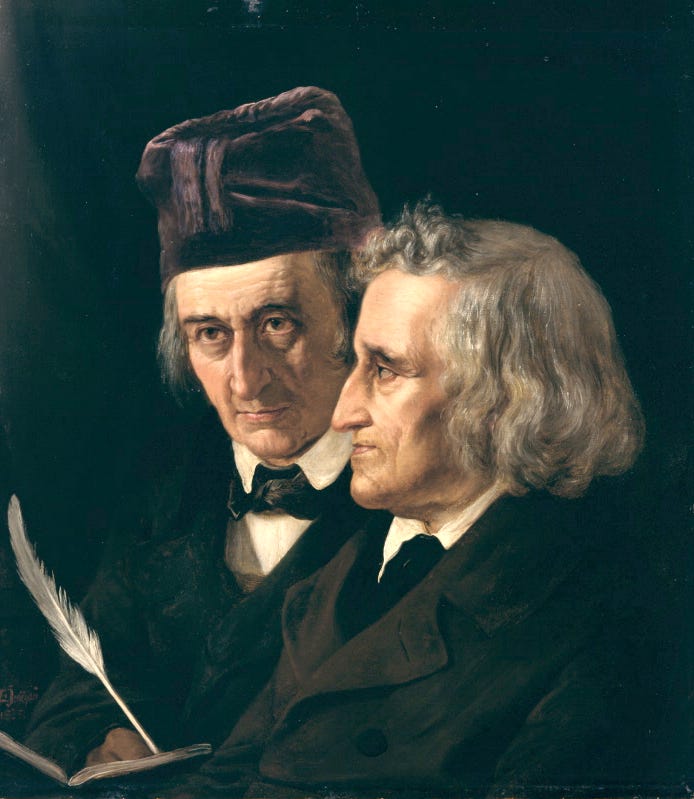
A century later, the Brothers Grimm collected tales in Germany – a scholarly project to record the oral folk tradition before it vanished. The first edition of Grimm’s Fairy Tales in 1812 was faithful to what they had heard, and what they had heard was horrific. Snow White’s mother – her biological mother, not a stepmother – orders a huntsman to bring back her daughter’s lungs and liver so she could eat them. Cinderella’s stepsisters hack off parts of their own feet to force them into the slipper. Rapunzel’s repeated visits from the prince leave her visibly pregnant.
So how did these horror stories become the gentle fairy tales we know and love today?
The fairy tale changed because the world changed. The dangers that had produced the tales – famine, wolves, plague, the vulnerability of the powerless – were receding. An increasingly literate Europe no longer needed survival stories.
And at the same time, the man who would go on to transform how Europe thought about, and defined, children published a book about education.
In 1762, Jean-Jacques Rousseau published Émile, and his argument was revolutionary. Children are born innocent and good – they are not fully formed, already morally corrupted adults in little bodies.
This was a direct assault on the doctrine of Original Sin, which had shaped European thinking about children for over a thousand years. And it changed everything – not just education, but the stories that a culture soon came to believe its children deserved.
Rousseau’s idea travelled from France into English Romanticism, and the Romantic poets carried it further. Wordsworth wrote of children arriving in the world ‘trailing clouds of glory.’ Blake saw innocence and experience as two fundamental states of the human soul, and innocence was the one closest to the divine. Childhood, for the first time in European thought, became not a deficiency to be corrected but an innocent, sacred condition to be protected.
And once you accept the fact that children are innocent, that their imaginative life is closer to God than an adult’s weary rationalism – then the stories you tell them must change. You cannot give an innocent child a tale in which the wolf wins and the girl is eaten. That story belongs to a world in which danger was real and children needed warning. In a world that had started to believe that children are born whole yet innocent, you need a different kind of story.
The Brothers Grimm felt this shift in attitudes towards children in real time. After the first edition of their collected tales in 1812, they were criticised – not for the quality of their scholarship, but for publishing material that was unsuitable for children. And over seven editions, spanning forty-five years, they responded. Biological mothers became stepmothers – because a world that now sentimentalised motherhood could not bear the idea of a mother ordering her own child’s death, and so the wicked stepmother was born. Sexual elements were quietly removed. Christian morality was threaded throughout, violence softened and endings sweetened. By the final edition of Grimm’s Fairy Tales in 1857, the tales were recognisably the versions we know and love today.
But something crucial was also happening. In the middle of the nineteenth century, a new market was emerging for the first time in history.
Books made specifically for children, designed to delight rather than instruct, to enchant rather than warn. The conditions were all in place – rising literacy, a growing middle class with money to spend, the emerging Victorian conviction that childhood was precious and must be furnished with beautiful things – and publishers responded.
They needed content. They needed illustrations. They needed beauty. And they needed a way to get these new, gentler tales into the hands of children, beautifully illustrated. But how?
The answer came in London in 1865. Edmund Evans, a colour printer, worked out how to do it for sixpence.
Evans developed a technique called chromoxylography – colour printing from wood blocks – to a level of quality and affordability that nobody had achieved before. His ambition was simple and radical: he wanted to produce children’s books that were beautiful and cheap. Not beautiful for the wealthy and cheap for everyone else. Beautiful and cheap, together, in the same book for all children – the sixpenny toy book.
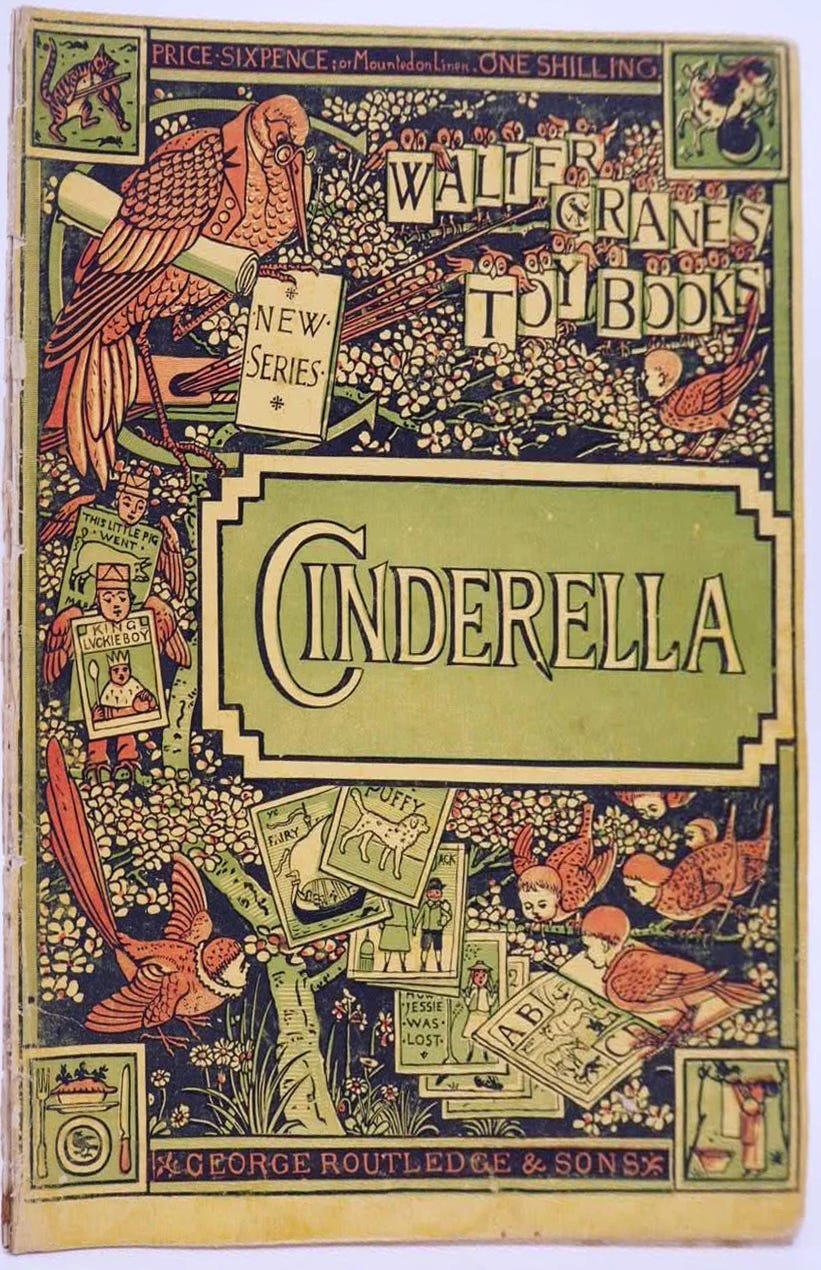
In 1865, Evans hired a young artist called Walter Crane – and between them they lit the fuse that would ignite the Golden Age of Illustration.
Crane was twenty years old and had just completed an apprenticeship under W.J. Linton, where he had studied the work of Dante Gabriel Rossetti and John Everett Millais. He had absorbed the Pre-Raphaelite conviction that beauty was not decoration but a moral imperative – the same conviction that John Ruskin had been preaching for decades and that William Morris was about to build an entire movement around. Crane would go on to found the Arts and Crafts Exhibition Society in 1888. He would work with Morris at the Kelmscott Press. He was, in every sense that mattered, a Pre-Raphaelite artist for the nursery.
And Evans put him to work illustrating fairy tales.
Between 1865 and 1886, Crane and Evans produced over fifty toy books – short, beautifully illustrated children’s books of nursery rhymes and fairy tales, sold for sixpence each. Sixpence. Before Evans, a colour-illustrated book was an expensive luxury object. After Evans, it was something most middle-class families could afford. The technology did not simply reproduce the art – it democratised the dream.
Crane brought to these little books the same romantic, medieval-inflected sensibility that Morris brought to his wallpaper and Burne-Jones brought to his paintings. His fairies had the grace of Botticelli. His forests had the density of a Rossetti illustration. His princesses existed in a world that owed more to the Middle Ages than to the Victorian nursery. And because Evans could print in colour – real colour, faithful to what Crane had painted – children could see that world for the very first time.
And this is where the fairy tale finally evolves into the fairy tales we know today.
Before Crane and Evans, a child encountered a fairy tale as a told thing – heard from a parent or a nurse, imagined privately, coloured by whatever the child’s own mind could supply. After Crane and Evans, a child encountered a fairy tale as a seen thing – illustrated, coloured, made visible by an artist who believed that what children saw mattered as much as what they heard.
And what Crane showed them was not the dark forest. It was the enchanted bower.
Perhaps the surest proof that the revolution was complete is that in 1870s, even the Religious Tract Society – the organisation founded to frighten children into piety – Mason’s fire-and-brimstone twaddle – was publishing sixpenny toy books. The world had changed so thoroughly that the tract publishers themselves had to change with it.
And so this essay comes back to Burne-Jones who understood the enchanted bower better than anyone.
His Briar Rose series – the four paintings waiting for me at Buscot – took the story of Sleeping Beauty and turned it into something that no fairy tale had ever been before: monumental art. Each canvas is over two and a half metres long. The sleeping princess, the frozen court, the knights tangled in thorns, the prince standing at the threshold – all of it painted with a luminosity that makes the everyday world outside the frame feel like the illusion.
Burne-Jones drew his inspiration from the Grimm version and from Tennyson’s 1842 poem ‘The Day-Dream,’ but what he painted was neither a warning nor a moral. It was a vision. The thorns in the Briar Rose are not a punishment. They are a threshold. The prince is not defeating danger – he is entering a dream. The sleeping princess is not a victim awaiting rescue. She is beauty itself, held in suspension, waiting for someone brave enough to cross over.
That is what happened to the fairy tale. It evolved into a place you longed to enter, not a dangerous place to run from.
Crane, Morris, and Burne-Jones were all part of the same movement – men who looked at what industrial England had built and found it spiritually bankrupt, and who reached back into the medieval world to find what their own age had thrown away. Beauty. Romance. The conviction that making something with care and devotion was itself a moral act. And when they turned their attention to the fairy tale, they remade it in that image – not illustrating the dark horrific stories as they had been, but reimagining them as visions of the world they believed in.
Then came the generation that inherited both their sensibility. Arthur Rackham, Edmund Dulac, Kay Nielsen – the great triumvirate of the Golden Age of Illustration, working roughly from 1880 to 1930. By now, photozincography had replaced the wood block. An artist could paint in watercolour and know that the printed reproduction would faithfully capture what they had created – every wash, every gradient, every translucent layer of colour. For the first time in history, the child holding the book also saw what the artist saw.
Rackham gave fairy tales their twisted trees and moonlit glades, of ancient forests alive with watching things. Dulac gave the tales jewelled colour and an orientalism borrowed from Persian miniatures. Nielsen kept the shadows – his illustrations of Andersen and the Grimms are among the most melancholy and beautiful ever created, full of love and loss and the darker edges of enchantment.
None of them painted warnings, they painted dream worlds.
And every one of them was steeped in the same traditions – Pre-Raphaelitism, Art Nouveau, the Arts and Crafts movement. The line runs directly from Ruskin through Morris and Burne-Jones, through Crane and Evans, to Rackham, Dulac, and Nielsen. It is a line of conviction: that beauty matters, and most importantly, that children deserve it, and that the fairy tale is the vessel that carries it from one generation to the next.
And of course, Charlotte Mason knew this.
Charlotte Mason – the Victorian educator whose philosophy of education has become the foundation of the homeschooling movement on both sides of the Atlantic – placed fairy tales at the centre of her curriculum for young children. Grimm. Andersen. Perrault. She included them all. And she wrote with clarity:
‘Let children have tales of the imagination, scenes laid in other lands and other times; heroic adventures, hairbreadth escapes, delicious fairy tales, even where it is all impossible, and they know it, and yet they believe.’
But here is the thing that I find remarkable. The fairy tales Charlotte championed were not the dark originals. They were the fairy tales that had already been transformed – softened by the Brothers Grimm across forty-five years of careful revision, made visible by Crane and Evans in their sixpenny books, made luminous by Burne-Jones and Rackham and all the artists who believed that what children saw shaped what they believed was possible.
Charlotte Mason arrived at the end of that evolutionary chain. She saw fairy tales as living books – stories that treated children as persons capable of wonder, not as problems requiring correction. And she was right to see it that way, because by the time the fairy tale reached her schoolroom, it had been shaped by a century of people who held exactly the same conviction she did: that beauty is a birthright, not a luxury, and that children deserve the real thing.
A Beautiful Book.
One of my favourite books that contains fairy tale illustrations is by Kinuko Craft.
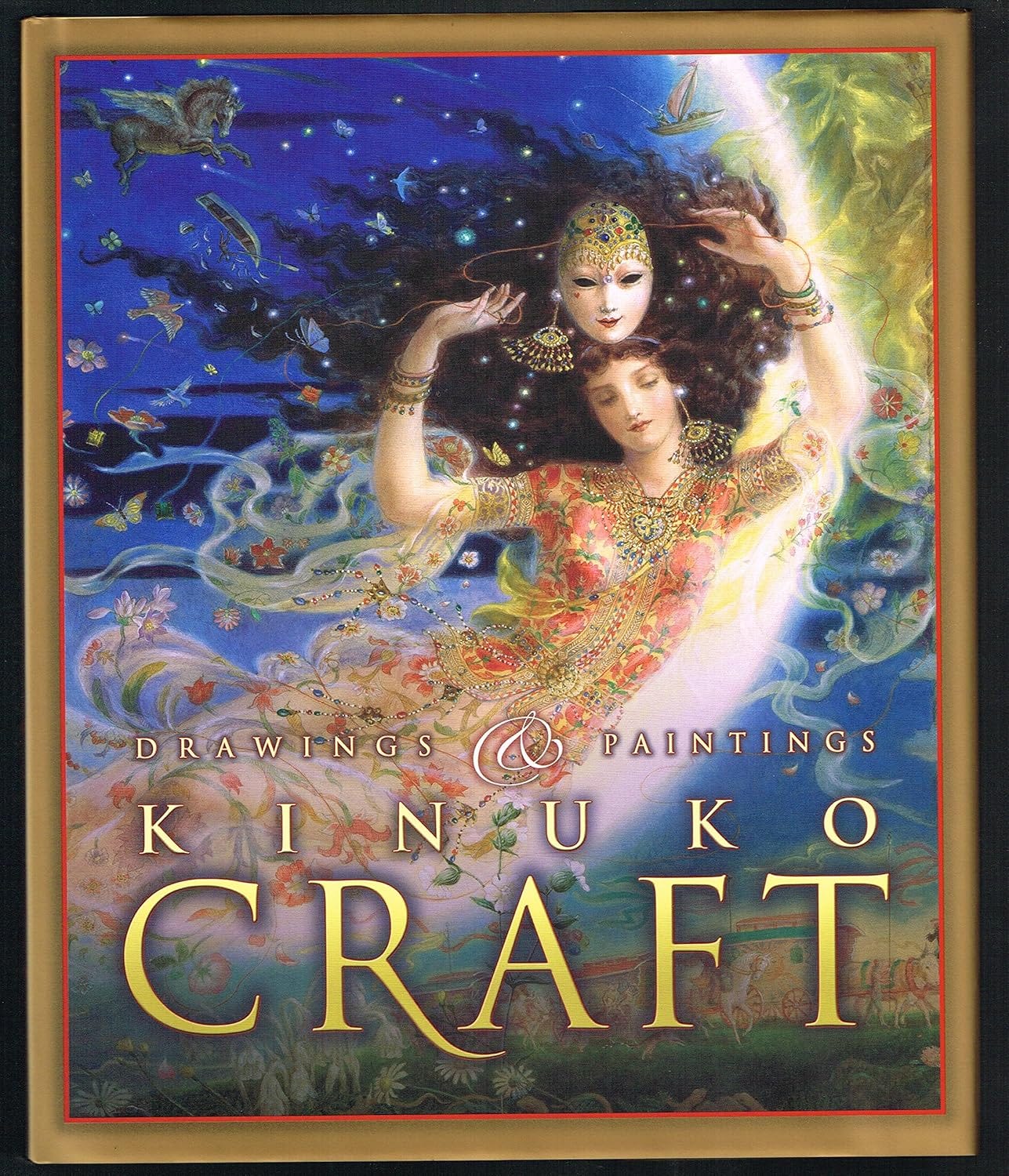
Craft is a Japanese-born American artist who paints fairy tales in oil over watercolour – layer upon luminous layer, with a precision and devotion that belongs to the Renaissance as much as it does to the Golden Age of Illustration. Her Sleeping Beauty is a direct descendant of Burne-Jones’s Briar Rose – the same enchanted stillness, the same conviction that the dream is more real than the waking world, the same refusal to treat the fairy tale as merely a story for children.
The line that runs from Burne-Jones through Crane and Rackham runs directly to her – a woman that painted Sleeping Beauty in the twentieth century with the same care that a Victorian artist brought to four enormous canvases in a room in Oxfordshire over a hundred years before.
I hold her book in my hands and I think about what I am actually looking at. Not just illustration – a tradition. A chain of conviction that stretches back through a century and a half of artists, craftsmen, writers, and printers who believed that fairy tales should be beautiful, and that children deserved fairy tales.
The dark forest is still there, underneath. It always will be. The wolf is real. The thorns are real. But someone – many someones, across many generations – decided that the fairy tale could be more than a horrific warning. Fiary tales could become a beautiful threshold, a door into a world that never was and never will be, in a light better than any light that ever shone.
I would go further. For me, the greatest fairy tales have become doorways into something beyond even the artists’ intention – a glimpse of divine truth, the merest sliver of the world yet to come, offered quietly to anyone willing to look.
I have not yet walked through the door at Buscot. But I will. Burne-Jones painted not just a sleeping princess, but longing itself – the longing that drives us to reach for beauty even when we cannot quite touch it, and to place that beauty in the hands of children, because they deserve nothing less.
Ultimately, the fairy tale learned to dream because we did.
The line that stayed with me was not about fairy tales, but about longing itself.
Some places seem to become important long before we arrive there.
Thank you for tracing how stories moved from survival to wonder. There is something quietly hopeful in that journey.