


Written and read by Vincent Shaw.
One wet and miserable afternoon last November, I was walking across Soho Square in London, when the sky simply gave up pretending and opened. Not drizzle or a shower – soaking, big-droplet, wet rain.
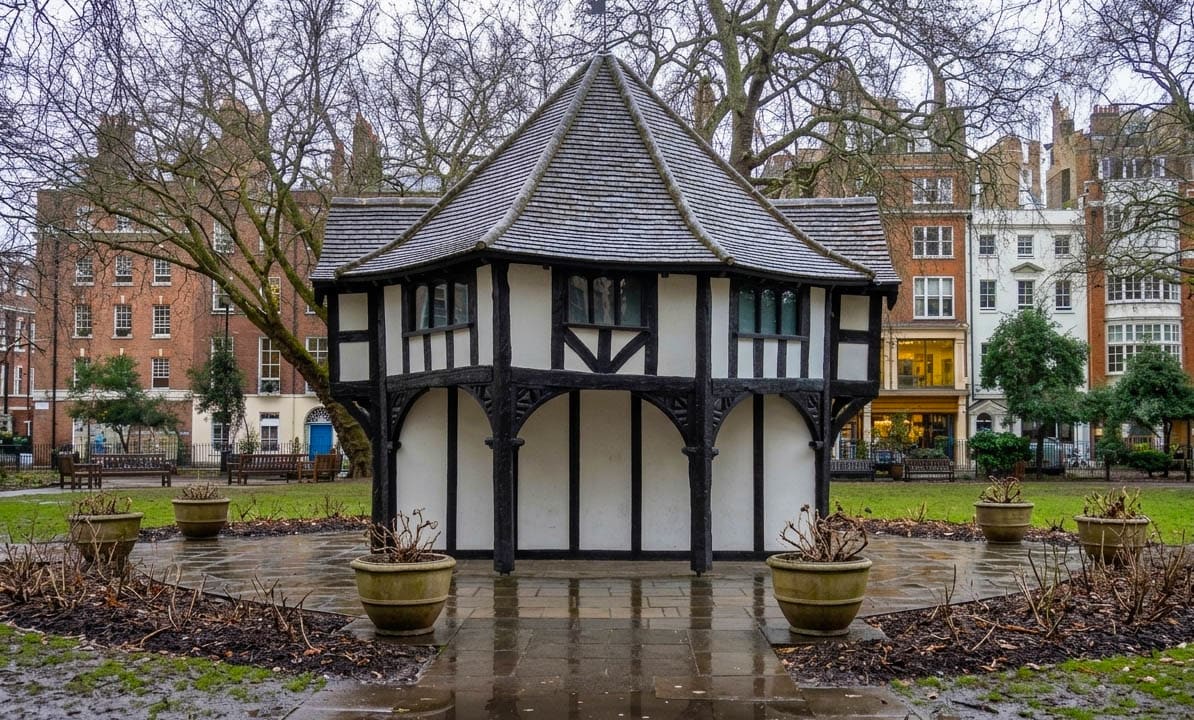
Soho Square is actually Soho gardens, and right in the middle of them is a little mock Tudor cottage, slightly lopsided and very dolls house like in appearance. The cottage has been there, in one form or another, since the 1870s, although the current version was built in 1925 by the Charing Cross Electricity Company, to disguise the entrance to an underground substation. During the Blitz the substation served as a bomb shelter. Now it stores spades, wheelbarrows and garden tools. The cottage is Grade II listed, which tells you something about England – we will heritage-protect a garden shed if it has a good enough story to go with it.
Luckily I was almost upon the cottage as the heavens opened. The cottage’s upper floor overhangs the lower part of the building, and it is an ideal spot for sheltering under during a downpour, so I ducked under the overhang. After fifteen minutes of staring to get cold and bored, and with no sign of the rain stopping, I tried one of the building’s two doors, just out of curiosity, as I had always wanted to see inside, and surprisingly, it opened, and even though I shouldn’t have – I went in.
The inside was just as I thought it would be, a garden shed with a very low ceiling. Against one wall there was a collection of garden tools – spades, rakes, a leaf blower and a hedge trimmer. There was also a large sit-on lawnmower that smelt of petrol and grass clippings. I could also smell seeds and that curious tang-warmth, of compost. On the far side of the room, there was a large, heavy-looking steel trap door, firmly bolted and padlocked shut. On it were a couple of bright neon signs – Danger of Electrocution and Authorised Persons Only – the shaft down to the old substation, presumably.
Meanwhile, the rain continued to hammer onto the roof just above my head, loud and close, the way rain sounds when you’re in a space too small for it. The room was wonderfully snug, and had that particular cosiness of being a dry space whilst the weather outside does its worst, which is one of the better feelings a wet November afternoon has to offer.
There were also stairs. Steep, narrow wooden steps grey with dust – the kind of dust that hasn’t been disturbed in years. I could see from outside that the cottage had low windows on the upper floor. I couldn’t resist it. I just had to go up and have a look.
As I reached the top of the stairs, the rain stopped. Not easing and then softening to a patter. Stopped, as though someone had turned it off. The silence after heavy rain is a very specific thing – it has a ringing quality, that is almost a sound in itself.
The stairs had emerged into a high-ceilinged room, the beams following the shape of the roof, with windows on all sides – the same windows I had seen from the outside. However, there was something very, very wrong with the room. The room was far too big to be inside a mock-Tudor cottage that was little more than a garden shed. I shouldn’t have been able to stand up, and the windows were in the wrong place as well. They should have been at my knees, but they weren’t. How on earth could this room be bigger on the inside than the outside? I crossed over to one of the windows to look out.
Soho Square was not there.
The trees were not there.
The grass was not there!
The benches, the railings, the office buildings with their lit windows – none of it. The London of 2025 had gone. What I was looking at, through rippled and filthy glass so old it had turned yellow, was a street. Narrow, cobbled, and very dark, despite it being the middle of the afternoon. The buildings opposite, leaned towards each other across the gap, timber-framed and jettied, their upper storeys so close that a tall man could have reached across from one window to the other. Everything was black and slimy-looking, darkened by centuries of smoke and weather, until it had turned to the colour of wet charcoal.
The street itself was busy and full of people of all ages. A few filthy looking children artfully dodged between the larger adults, who would occasionally give them a swipe which never connected – the children were far too quick.
Most people moved quickly, collars turned up, heads down, and none of them were dressed for the London I had just left. Robes, mostly – heavy and long, and in colours that might once have been bright but were now darker, most of them a variation of black, or black – with dirt. And hats of every kind. Tall, pointed witches hats, bonnets, top hats, derbies, flat caps. Most of them pulled low over the brow the way a man pulls a cap down when he doesn’t want to be recognised. One old lady was wearing a hat with a brim so wide it looked like an umbrella, but it also looked terribly cumbled, as though it had been sat on it. Everyone’s clothes were threadbare and dirty.
Below me, a woman crossed from one doorway to another without looking up, her heavy cloak held closed at the throat as though whatever she carried beneath must not be seen. Her face, in the few moments I saw it, had eyes that moved nervously from side to side. She had the complexion of someone who had not been outside in daylight for a very long time – a sickly yellow, indoor pallor, like old candle wax.
Passing her, without acknowledgement, was a big, sour-faced, man with a dangerous look as filthy as his overcoat. On his head, he wore an extremely battered top hat that was as grimy as he was. He was pushing a barrow, his hands thick and scarred, and he was missing a finger. On his barrow was a load wrapped in dirty sacking, shifting and settling as the wheels hit the cobbles. For a moment the cloth glowed a faint, sullen red. It then went dark again.
Further along, two figures stood at the entrance of a dark side alley, heads together, hands moving over something held between them that pulsed with an unhealthy yellow-green light. One of them had a long, raw looking scratch running from his temple to his jaw. The other kept glancing up the street and then back to the object, the quick automatic scan of a man who has been caught before and does not intend to be caught again. His robes were patched at the elbows and the hem was stiff with mud.
I stepped back from the window, half tempted to go back downstairs. This was all too peculiar, and I had the overwhelming feeling I was somewhere I had no business to be. The sensible thing would have been to retrace my steps, find my way back down to the lawnmower and the bags of compost, and back out into the reassuring London rain of 2025, but I didn’t. I never do the sensible thing. On the far side of the room, half in shadow, I saw what looked to be a large cupboard. On its door I could see a battered wooden sign, so I crossed over to look. The painted lettering was faded, but still legible. It said.
Knock, and then turn – to the right or to the left. You decide.
I knocked and the door swung inwards. Inside there was a small landing. Stairs led down to both the left and the right. From the left, came the smell of wet grass and rain, and the sound of distant London traffic splashing through the puddles. From the right, came the rotten smell of decaying river mud and the distant trot of horses’ hooves.
Right and Knockturn Alley, of course!!
A lovely opening. It starts with rain, compost and a lawnmower, which is already suspiciously good, and then quietly opens a door into something much darker.
I particularly liked the way the ordinary details make the impossible feel almost administratively plausible.