

Charlotte Mason's England – 'I Am Half-Sick of Shadows.'

I have a confession to make.
I have been having a love affair with another woman, and it has been going on since I was seventeen years old. I first met her on a trip to London from art college in the early nineteen eighties, and I have guiltily snuck back to see her more times than I can remember.
Yet my love has never said a word to me.
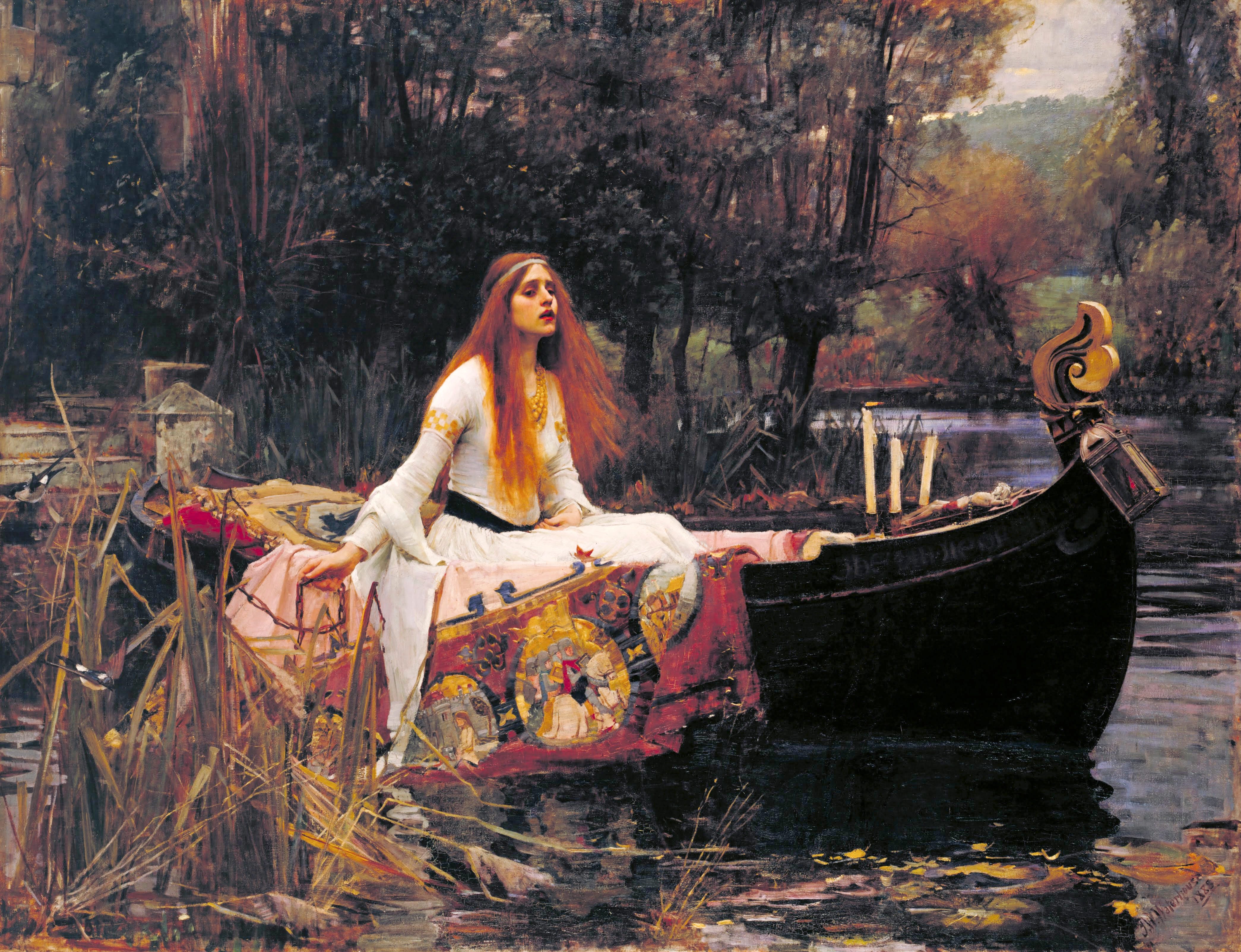
Always, she looks past me, her gaze fixed on something far off, her mind elsewhere. She is committed to a journey that she knows will be her last. Yet still I pine for her and the age in which she lived. I do not know her real name, only that she is the Lady of Shalott, and the Lady lives in a painting that has dwelt in the Tate Britain gallery in London for the last one hundred and thirty years.
A little history.
The artist John William Waterhouse painted The Lady of Shalott in 1888. It is a magnificent piece of work. The lady sits in a wooden boat draped with tapestry, one hand still resting on a chain, three candles guttering at the prow – two already spent, the third about to die. Her mouth is slightly open, as though she has just stopped singing. Her red hair falls loose around a face that questions, and asks ‘What have I done?’ The lady is floating downriver to Camelot, and she is dying, and for me on seeing her for the very first time, it was love at first sight.
The Lady of Shalott is probably one of the most recognised paintings in the world. It adorns a thousand posters, prints, greetings cards, jigsaws, bookmarks, and mouse mats. It is so familiar that most people have stopped seeing it at all, and I nearly made the same mistake myself.
In those teenage years, I loved that painting the way one loves a face across a room – intensely, but without understanding. I knew nothing about the lady in the boat, nothing about where she was going or why, and nothing about the poem that put her there. The painting was enough – or at least I thought it was.
Due to this one painting, Waterhouse is often associated with the Pre-Raphaelites – Rossetti, Millais, Holman Hunt, Burne-Jones – and it is easy to see why. The painting, with its medieval subject, its dream-like atmosphere, its richness of colour and feeling, sits comfortably in that company. But Waterhouse was not a Pre-Raphaelite, he was a classicist, closer in training and temperament to Lawrence Alma-Tadema and Lord Frederic Leighton, painters of marble and antiquity, sun-warmed stone and draped linen. The fact that this one painting has relocated him in the public imagination so completely, tells you something about its power. It is so thoroughly romantic, so completely saturated with the Pre-Raphaelite spirit, that it has in many ways, rewritten its artist’s biography.
And then, years later, something happened that changed the way I saw my Lady.
I was in my twenties and visiting the Watts Gallery in Compton, Surrey, for the first time. (you can read about that here) If you have not been, it is a remarkable place – the home and studio of the Victorian painter and sculptor George Frederic Watts, tucked into a Surrey hillside, just to the south of Guildford. It’s a beautiful gallery, quiet and unhurried and full of enormous canvases in half-light.
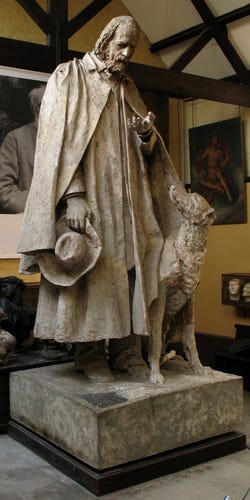
In the gallery, there is a sculpture of Lord Tennyson, modelled in gesso grosso – a rough, chalky, deeply textured medium that seems to hold the very act of making visible in its surface. It is a memorial statue and was created by Tennyson’s close friend, artist GF Watts. Watts sculpted it after Tennyson’s death in 1892, and the finished bronze stands in the grounds of Lincoln Cathedral. The statue is monumental in scale, yet there is something quite delicate about it. Watts wanted to demonstrate his friend’s love of nature and drew inspiration from Tennyson’s poem ‘Flower in the crannied wall’. The figure ponders the flower in his hand, while his dog Karenina peers up at him.
Like Tennyson’s poetry, the sculpture says much about the man – the bowed head, the weight of thought in the shoulders, the sense of a man carrying an entire mythology inside him – that made me want to know more about the man it depicted.
I had heard of Tennyson, of course. Everyone has. But until seeing that sculpture, I had never read any of his work. The Poet Laureate was a name on a school syllabus I had cheerfully ignored, as school boy, poetry left me cold.
But standing in front of that sculpture, in the gallery of a man who had known Tennyson personally, who had studied his face and worked it into clay with his own hands, I felt a pull. Not to the biography, not to the era, but to the words. What had this man actually written?
The first Tennyson poem I read was The Lady of Shalott.
And I realised, with a kind of slow, delighted shock, that I had been in love with a painting inspired by that poem for years without ever knowing that the poem underneath it was the real thing. The painting was the mirror. The poem was the world.
I suspect that most people who love Waterhouse’s painting have never read the poem it illustrates.
This is worth pausing over, because the irony is almost too perfect. A painting of a woman who has spent her life seeing the world only through a reflection has itself become a reflection – an image so widely reproduced, so thoroughly familiar, that the original work of art that inspired it has become almost invisible. The painting consumed the poem. The mirror replaced the real thing. And most of us never noticed, because the reflection, the painting is so very beautiful.
I have written before about what I call the chocolate-box problem – the way familiarity erases the thing it celebrates. Cicely Mary Barker’s Flower Fairies were reproduced on so many biscuit tins and jigsaw puzzles that the woman behind the images became invisible. Helen Allingham’s cottage watercolours were so thoroughly domesticated that a serious artist with a serious career disappeared behind her own prettiness. The same thing has happened to The Lady of Shalott, and the loss is greater, because the poem Tennyson wrote in 1832 is not merely good. It is one of the most extraordinary pieces of writing in the English language.
The poem has its roots in Arthurian legend, and Tennyson drew loosely on a thirteenth-century Italian novella, the Donna di Scalotta, which tells the brief tale of a young woman who dies of unrequited love for Lancelot and is carried by boat to Camelot. But the Italian story contains almost nothing of what makes Tennyson’s poem extraordinary – no mirror, no curse, no weaving, no tower, no song. Tennyson took a skeleton and gave it a soul. The Lady’s isolation, her craft, her fatal choice – these are entirely his.
He wrote the poem first in 1832 and revised it substantially a decade later, publishing the version we know today in 1842. The name Shalott itself is his transformation of Astolat – the castle of Elaine in Malory’s Le Morte d’Arthur – softened through the French, made musical and made his own.
Let me take you through it. If you wish, you can listen to the full poem below and read by me.
The Lady lives alone on an island in the middle of a river that flows down to Camelot. She has a loom, a mirror, and a curse.
The curse forbids her from looking directly at the world outside. She may only see it through the mirror that hangs before her, and she weaves what the mirror shows her into a tapestry – a web of colours, endlessly growing, endlessly reflecting a world she cannot touch.
There she weaves by night and day
A magic web with colours gay.
She has heard a whisper say,
A curse is on her if she stay
To look down to Camelot.
The lady does not know who placed the curse upon her, and she does not know what will happen if she breaks it. She onl knows that she must not look, and so she weaves.
And through her mirror she sees everything.
And moving thro’ a mirror clear
That hangs before her all the year,
Shadows of the world appear.
Shadows. Not the world itself, shadows of it.
She sees the road winding down to Camelot. She sees the river eddying. She sees market girls, the red cloaks of riders, a page in crimson clad, a funeral procession winding its slow way toward the towers. She sees young lovers walking in the starlight, newly wed. She sees all of life pass before her, and none of it belongs to her.
The lady is watching the world the way a child watches a screen – perfectly, vividly, and at an absolute remove. Every detail is clear, but nothing is real. The mirror shows her everything and gives her nothing.
And then Tennyson writes one of the most quietly devastating lines in English poetry.
‘I am half-sick of shadows,’ said
The Lady of Shalott.
Half-sick. Not furious, not despairing, not raging against her imprisonment. Half-sick. It is the weariness of someone who has lived at one remove for so long that she can barely remember what direct experience feels like. She is not in agony. She is in a fog. The shadow-life has not destroyed her – it has slowly drained her, and she names it with a tiredness that is more heartbreaking than any scream.
Tennyson wrote that line in 1832. He had never seen a screen, never imagined a world in which a people might spend hours watching their life pass slowly by in a glowing rectangle held inches from their face. But the human truth he identified – that a life lived through reflections is a life half-lived – has not aged by a single day.
And then Lancelot comes.
Tennyson gives him the most extraordinary entrance in English verse. Every other figure the Lady has seen through her mirror has been a shadow – riders, lovers, funerals, all of them passing and distant. Lancelot arrives like a fire.
All in the blue unclouded weather
Thick-jewell’d shone the saddle-leather,
The helmet and the helmet-feather
Burn’d like one burning flame together.
Everything about him blazes. The sun on his shield, the gemstones on his bridle, the rings of his armour flashing in the light. He is not a shadow. He is the most intensely, overwhelmingly real thing the mirror has ever shown her. He rides past her tower singing, and his voice carries across the water, and Tennyson’s verse shifts – it quickens, it catches fire – and the Lady does the thing she has been forbidden to do.
She turns.
She left the web, she left the loom,
She made three paces thro’ the room,
She saw the water-lily bloom,
She saw the helmet and the plume.
She look’d down to Camelot.
Look at the precision of that. She sees the water-lily first. Not Lancelot, not the burning armour – a flower. The first thing the direct gaze falls on is something small and beautiful and ordinary, something the mirror could never quite give her. Then the helmet. Then the plume. Reality arriving in pieces, each one sharper than the last.
And then the consequence.
Out flew the web and floated wide;
The mirror crack’d from side to side;
‘The curse is come upon me,’ cried
The Lady of Shalott.
The tapestry she has been weaving – her life’s work, the beautiful, careful, painstaking craft made from shadows – flies apart. The mirror shatters. Everything she built from the reflected life is destroyed in the moment she chooses the real one. The cost is absolute.
She knows it, she says so yet leaves anyway.
The lady then finds a boat beneath a willow, writes her name upon the prow,
lies down in her white robe, and lets the current carry her toward Camelot,
singing as the river takes her. The landscape darkens around her, the leaves fall and the evening deepens.
Singing in her song she died,
The Lady of Shalott.
She dies before Camelot can see her. She arrives as a body in a boat, and the knights and ladies come down to the water and read the name on the prow, and are afraid. Only Lancelot – the man whose blazing reality drew her from her tower – pauses and speaks.
He said, ‘She has a lovely face;
God in his mercy lend her grace,
The Lady of Shalott.’
Lancelot never knew her. He never knew she existed. He rode past her tower singing, and his passing destroyed her, and all he can offer at the end is a stranger’s courtesy and a prayer. It is unbearably tender, and Tennyson does not explain it, moralise, or tell you what to feel – he trusts the reader
I have a second confession.
The Lady of Shalott led me to Tennyson’s Idylls of the King – his twelve-poem Arthurian epic that he worked on for twenty-five years and that Charlotte Mason placed, unabridged, on her reading lists for children. I have read passages, fragments, famous lines, but the complete work has eluded me, and I suspect it has eluded most people, because the Idylls asks for a commitment of months, and modern life has a way of stealing months before you notice they are gone, so I have never got around to reading it in its entirety.
But this is the thing I have come to understand, standing in front of Waterhouse’s painting all those years ago and then finally reading the poem beneath it.
You do not need the full Idylls to fall in love with Tennyson’s poetry.
In my view, you need ten minutes and this single poem.
For those of you who are new to my writing – and to the woman who has quietly been shaping a great deal of it – Charlotte Mason was a Victorian educator, born in 1842, who spent her life fighting for the idea that children are born persons. Not blank pages to be written on. Not vessels to be filled. Whole human beings who deserve the same honesty, beauty, and seriousness that adults expect for themselves.
She died in 1923, and her philosophy lives on most vigorously among the American homeschooling families who have adopted her methods and her conviction that children deserve the best – the very best – in everything they read, see, and encounter. I have written about her extensively, and if she is new to you, you will find the full story here.
Mason put Tennyson on her reading lists. Not simplified Tennyson, not Tennyson retold for children, not selected stanzas with a glossary – Tennyson. She trusted that a child could hold the language, feel the weight of the ideas, and draw their own conclusions without being told what to think.
I have spent my last two essays examining what Charlotte meant by a living book – a book written by a single mind with genuine passion, offering real ideas in real language, with an absolute refusal to condescend. And I have been testing books against the four questions that define a living text.
Does it have real ideas? Does it have real language? Is there a living mind behind it? Does it trust the reader?
The Lady of Shalott poem passes every test.
Real ideas – the cost of choosing reality over comfort; the difference between living and observing; the courage to turn from the mirror even when turning destroys you. These are not children’s ideas or adult ideas. They are human ideas, and Tennyson trusts every reader – regardless of age – to feel their weight.
Real language – this is Tennyson at the height of his musical power. The rhyme scheme alone is extraordinary, building and building and resolving each stanza on the tolling repetition of her name. The vocabulary is rich and demanding. A child who reads this poem is being stretched, and Mason believed that stretching was the entire point. A child grows into language. A child does not need to be protected from it.
A living mind – one poet, returning to this poem across a decade, revising and deepening it from the first version of 1832 to the version of 1842 that we know today. Not a committee or corporate focus group, just one man who saw something true and spent years learning how to say it.
And trust, above everything, trust – in the reader. Tennyson never explains the curse. He never tells you what the mirror represents. He never stops the poem to say that choosing reality over comfort is brave, or foolish, or tragic. He shows you a woman who turns from the shadow to the real thing, and he lets you decide what it means.
That is what Charlotte Mason demanded of every book she placed in front of a child. Not instruction. Not moral commentary – trust.
I have been visiting the Lady of Shalott for over forty years. I have stood in front of Waterhouse’s painting so many times that I know every brushstroke – the chain slipping from her fingers, the crucifix at the prow, the darkening trees, the three candles and their trailing smoke. I thought I knew her.
I did not know her at all until I read the Tennyson’s wonderful poem.
The painting is magnificent, but the poem is greater still. Tennyson’s words are the world outside the tower, and when I finally turned to look at them directly, I understood – with the same slow, delighted shock I felt at the Watts Gallery all those years ago – that the real thing had been there all along, waiting patiently for me to stop looking at the reflection and turn around.
Tennyson wrote the final version of The Lady of Shalott in 1842. The poem was there my entire life — through art college, through the Watts Gallery, through every visit to the Tate — and it waited. That is what real beauty does. It does not chase you. It does not shout. It does not compete for your attention with noise and colour and movement. It sits quietly, and it trusts that one day you will find it.
Charlotte Mason knew this. She called it spreading the feast. The feast does not demand that the child eat. It should simply be there – beautiful, nourishing, real – and the child comes to it when they are ready.
If you have never read The Lady of Shalott, then I urge you to do so. It will take you ten minutes. Better still, read it aloud if you can, because Tennyson wrote for the ear as much as the eye, as all poetry is, and the music of the verse – the tolling repetition of her name at the close of every stanza, the quickening rhythm when Lancelot rides past, the slowing, fading cadence of her last journey downriver – transforms the poem in a way that silent reading cannot.
And if you have children, read it to them. Do not explain it. Do not tell them what it means. Trust them. Tennyson did. Charlotte Mason did.
The Lady chose reality over the mirror, even though it cost her everything. Her craft was destroyed. Her song ended. She never reached Camelot alive.
Was she right to turn?
Tennyson does not say, the poem does not answer the question. It simply shows you a woman who could no longer bear the life of shadows, and it trusts you – as Mason trusted the child – to sit with the weight of it and decide for yourself.
That is what a living poem does. It does not resolve. It holds the question open and lets you bring yourself to it. And every time you return – as I have returned, again and again, for over forty years – you are rewarded with a little more.
I still do not know whether the lady was right to turn, but I know that I love her, and that I will return and keep returning to her until my eyes close for the very last time.
"The feast does not demand that the child eat. It should simply be there – beautiful, nourishing, real – and the child comes to it when they are ready." This is a perfect encapsulation of a Mason principle, Vincent. Thank you for articulating it so well! --Dawn
Another wonderful article, Vincent! Everything you write blesses my heart.